
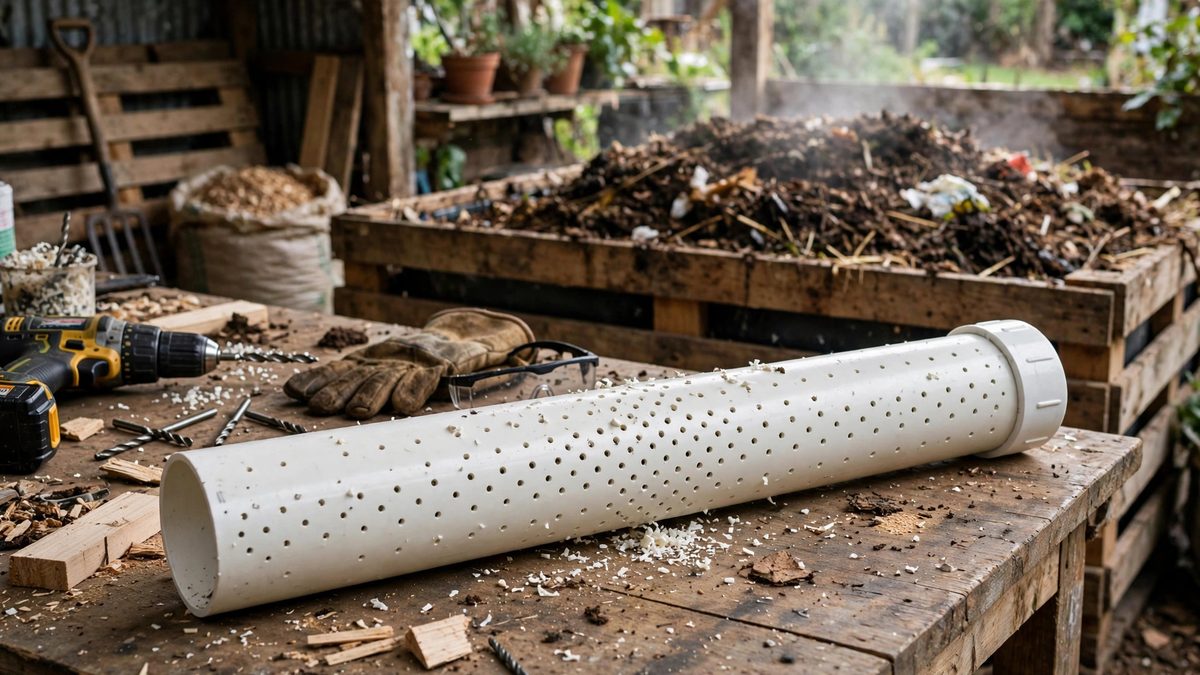
A hot compost bin lives or dies on oxygen. The thermophilic bacteria that drive temperatures into the active range need a steady air supply, and in a dense, wet pile, passive diffusion cannot deliver it to the core. An aeration plenum, a perforated pipe manifold under or through the pile that distributes air evenly, solves this mechanically. But a perforated pipe only distributes air evenly if its perforations are sized and spaced correctly; otherwise all the air exits the first few holes and the far end of the pile suffocates. Getting the perforation ratio right is the difference between a plenum and a pipe with holes.
Why hot compost needs forced air
Active composting bacteria consume oxygen voraciously, and a cubic yard of dense, moist compost seals itself against airflow surprisingly well. Without aeration, the core goes anaerobic: temperatures stall or the pile heats unevenly, anaerobic microbes take over, and the result is the familiar sour, slimy, foul-smelling mess instead of sweet, crumbly compost. Turning the pile reintroduces oxygen, but turning is labor and it disrupts the temperature profile each time. A perforated aeration pipe fed by natural convection (a chimney effect from the pile's own heat) or a small blower delivers air continuously to the core without turning. The thermophilic range, roughly 130 to 160 degrees Fahrenheit, is where decomposition runs fastest and pathogens and weed seeds are destroyed; holding that range requires both the right carbon-to-nitrogen balance and the oxygen to burn it.
The perforation ratio principle
Air, like water, takes the easiest path. In a perforated pipe, the holes near the inlet see higher pressure than the holes at the far end, so without design discipline, the near holes hog the airflow. The controlling relationship is between the total area of all the perforations and the cross-sectional area of the pipe. As a rough working rule, the combined area of the holes should be approximately equal to the pipe's cross-sectional area, never much larger. If total hole area greatly exceeds pipe area, pressure drops along the pipe and the far holes starve. If it is much smaller, the pipe chokes and overall airflow suffers. Within that budget, distribute holes evenly along the pipe's length, and consider making holes slightly smaller near the inlet and slightly larger toward the far end to compensate for the pressure gradient. Drill holes on the sides or upper quadrants of the pipe rather than the bottom, so leachate and fines do not plug them.
Sizing holes and spacing them
Hole diameter is a compromise between airflow and clogging. Holes around a quarter to three-eighths of an inch resist plugging by compost particles while passing useful air; much smaller holes clog, much larger ones weaken the pipe and pass coarse material. Space holes evenly, a few inches apart along the pipe, in staggered rows so the air jets cover the surrounding pile uniformly. For a typical backyard hot bin, a manifold of two or three parallel perforated pipes under the pile, fed from a common header, covers the footprint better than a single central pipe. Keep the pipe runs reasonably short; very long runs amplify the pressure-drop problem no perforation ratio can fully fix. Cap the far ends so air must exit through the perforations rather than blowing straight through.
Passive versus active air supply
A plenum can breathe passively or actively. Passive systems rely on the chimney effect: hot air rises out of the pile, drawing fresh air in through the pipes. This works when the pile is hot and the pipe inlets sit in cool outside air, but it fades as the pile cools, exactly when finishing compost still wants some air. Active systems use a small blower on a timer, cycling a few minutes several times a day, which gives positive control regardless of pile temperature. If you go active, size the blower modestly: compost wants gentle, continuous-ish aeration, not a blast furnace. Excessive airflow strips heat and moisture from the pile, cooling the very thermophilic activity you are trying to feed. A timer that runs the blower in short, frequent cycles beats continuous operation for both temperature and moisture retention.
Keeping the plenum working
Perforations clog over time as fines settle and microbial growth narrows the holes. Design for maintenance: make pipes removable or install cleanout caps so you can flush or rod them between batches. A layer of coarse wood chips or gravel around the pipes keeps fine compost from packing directly against the holes. Monitor pile temperature with a long probe thermometer; a pile that will not hold heat despite correct moisture and carbon-nitrogen balance is often an aeration failure, and the plenum is the first suspect. When the batch finishes, pull the pipes, clean them, and inspect for damage before the next load. A plenum is infrastructure, and infrastructure earns its keep through maintenance.
Even perforations, a sensible hole-to-pipe area ratio, and air delivered where the pile actually needs it: that is the whole art. Build the plenum right and the bin holds its heat, finishes faster, and smells like forest floor instead of a swamp.
Related Guides
- Static Aeration Tube Spacing for Winter Compost Bins: Winter composting stalls for one reason: the pile goes anaerobic. Cold slows microbial activity, wet material mats down, and without oxygen the pile
- Perforated Aeration Tube Spacing for Static Bin Piles: Static compost bins fail for one reason: the middle of the pile goes anaerobic, and an anaerobic middle smells, stalls, and composts at a crawl
- Carbon-to-Nitrogen Balancing for Continuous Tumblers: A continuous compost tumbler, the kind you add to daily and harvest from periodically, lives or dies by its carbon-to-nitrogen ratio. Batch piles can
- Passive Induction Vent Sizing for Static Compost Piles: A static compost pile, one that is built and left to cook without turning, lives or dies on airflow. The microbes doing the composting need oxygen