
A static compost pile, one that is built and left to cook without turning, lives or dies on airflow. The microbes doing the composting need oxygen, and without turning, that oxygen must arrive passively through vents. Sizing those vents correctly is the difference between a pile that heats and humus and one that goes anaerobic and stinks.
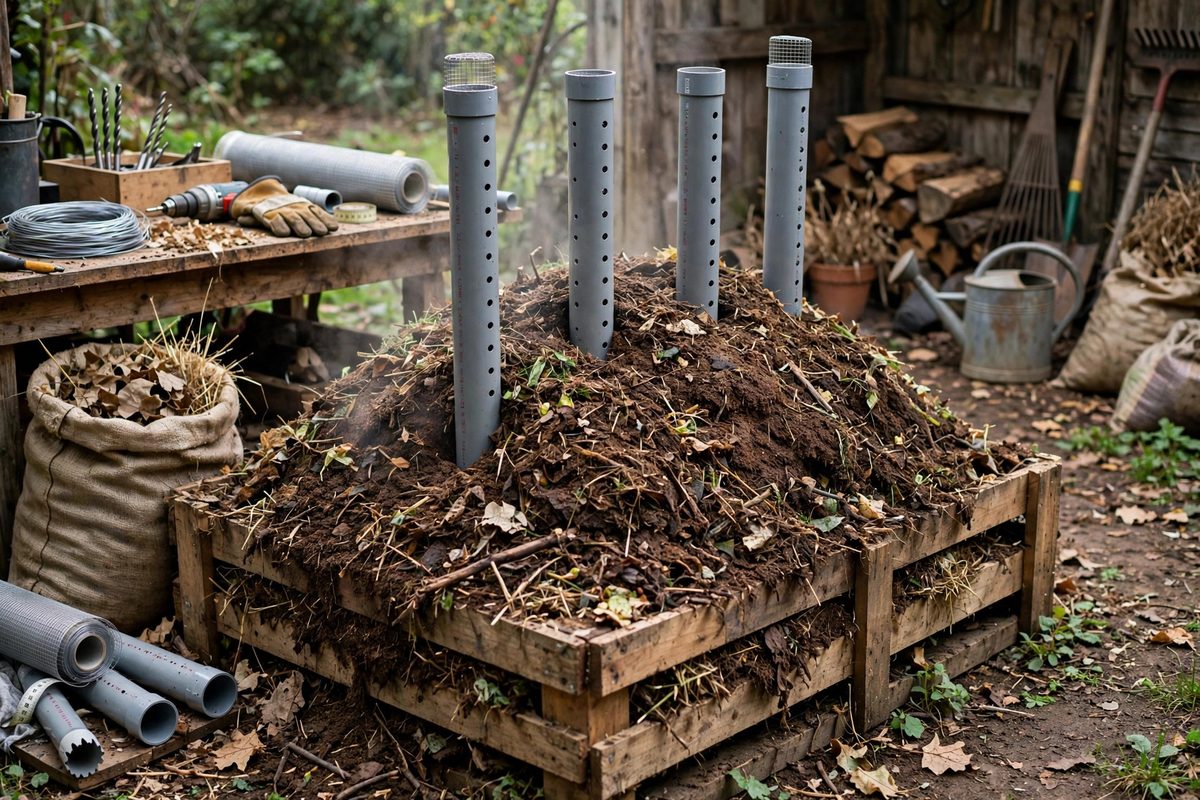
How passive induction works
Passive aeration uses the chimney effect: warm air rises through the pile, drawing fresh air in through low vents. The pile's own heat drives the circulation, which means the system is self-regulating to a degree: a hotter pile draws more air. But the vents must be sized to allow that flow; too small and the pile suffocates no matter how hot it gets, too large and the pile loses heat and moisture through excessive airflow. The vent sizing balances oxygen supply against heat and moisture retention.
Sizing the vent area
The vent area should be proportional to the pile's volume: a bigger pile needs more air. As a working approach, provide vent openings totaling a few percent of the pile's base area, distributed around the perimeter at the base where cool air enters. Perforated pipes run through the pile's base serve the same function and distribute air more evenly than perimeter vents alone. The exact sizing is forgiving within a range; the critical failure is far too little venting, not slightly too much. When in doubt, err toward more air.
Vent placement and distribution
Place the intake vents low, at or below the pile's base, so incoming air travels up through the full depth of material. Distribute them evenly around the pile; vents clustered on one side aerate one side. If using perforated pipes, run them across the base in parallel, with the perforations facing down or sideways to avoid clogging with material. The exhaust happens naturally through the pile's top surface; do not cap the pile tightly, or the chimney has no outlet. The air path is in low, up through, out top; every part of that path must be open.
The pile's structure matters
Vents cannot fix a pile with no internal porosity. The compost mix needs enough coarse, bulky material, wood chips, straw, corn stalks, to maintain air spaces between the particles. A pile of pure grass clippings or food scraps mats into an airless mass that no vent can aerate. Build the pile with structure first, then vent it; the vents supply the air, but the pile's porosity distributes it. This is the most common failure in static piles: perfect vents on a suffocated mix.
Moisture and airflow interaction
Airflow dries the pile, and composting microbes need moisture. In dry climates or windy sites, generous venting can desiccate the pile faster than it composts; in wet climates, the same venting keeps it from waterlogging. Adjust the effective vent area seasonally: partially cover vents in dry spells, open them fully in wet ones. Monitor the pile's moisture by squeezing a handful; it should feel like a wrung-out sponge. The vents are adjustable, and adjusting them is part of managing the pile.
Monitoring pile performance
A well-vented pile heats up within days, holds temperature for weeks, and smells earthy, never foul. Stick a compost thermometer into the pile's center regularly; sustained heat means the aerobic microbes are working. If the pile never heats, suspect insufficient nitrogen, poor moisture, or inadequate air, in that order of likelihood. If it smells like rot, it has gone anaerobic, and the vents, the structure, or both need attention. The pile tells you what it needs; the thermometer and your nose are the instruments.
Size the vents to the pile, place them low and distributed, build the pile with porosity, and manage moisture against the airflow. The static pile will compost itself with nothing but time and air, which is the elegant promise of the method.
Related Guides
- Perforated Aeration Tube Spacing for Static Bin Piles: Static compost bins fail for one reason: the middle of the pile goes anaerobic, and an anaerobic middle smells, stalls, and composts at a crawl
- Static Aeration Tube Spacing for Winter Compost Bins: Winter composting stalls for one reason: the pile goes anaerobic. Cold slows microbial activity, wet material mats down, and without oxygen the pile
- Aeration Plenum Pipe Perforation Ratios for Hot Bins: A hot compost bin lives or dies on oxygen. The thermophilic bacteria that drive temperatures into the active range need a steady air supply, and in a
- Carbon-to-Nitrogen Balancing for Continuous Tumblers: A continuous compost tumbler, the kind you add to daily and harvest from periodically, lives or dies by its carbon-to-nitrogen ratio. Batch piles can