
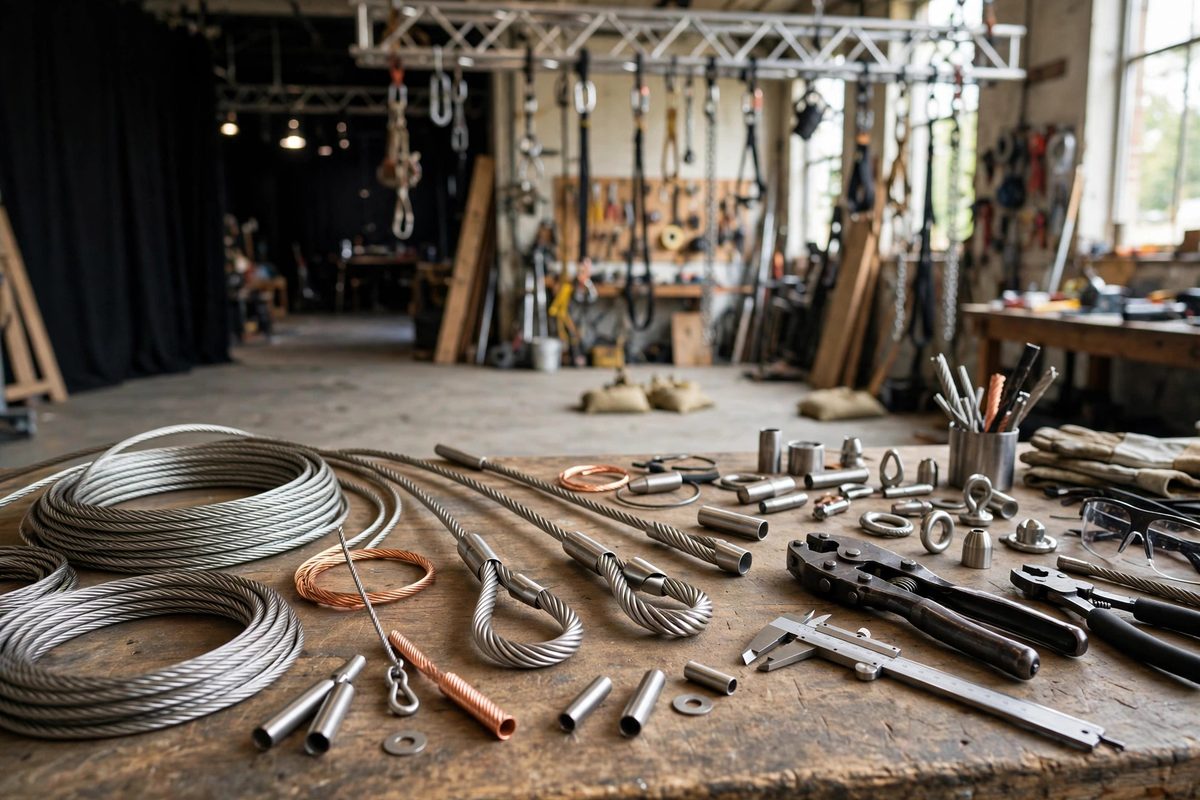
Stage rigging holds scenery, lights, and sometimes people above other people's heads, which makes it the highest-consequence craft in theatre production. Aircraft cable, wire rope, with swaged sleeve terminations is the standard for many rigging tasks because it is strong, compact, and inspectable. Swaging, compressing an aluminum or copper sleeve onto the cable with a dedicated tool, creates a termination that approaches the cable's full strength. But the specs matter enormously: the wrong sleeve, the wrong die, or an incomplete swage produces a termination that looks right and fails under load. This is a domain where specifications are safety equipment.
Why swaged terminations
A wire rope is only as strong as its termination. Knots in wire rope cut its strength roughly in half and damage the rope; wire rope clips (the U-bolt clamps) work but are bulky, require precise installation and retightening, and are easy to install wrong. A properly swaged sleeve, by contrast, develops nearly the full breaking strength of the cable in a compact, permanent termination. The swaging process cold-works the sleeve onto the rope, and the sleeve's grip comes from both compression and the slight extrusion of sleeve material into the rope's valleys. Because the termination is permanent and its quality is verifiable with a gauge, swaging is the preferred method wherever terminations must be trusted without ongoing adjustment. The trade-off is that swaging requires the right tooling and cannot be redone; a bad swage means cutting off the sleeve and starting over with fresh cable length.
Sleeve, cable, and die matching
The cardinal rule of swaging is that the sleeve, the cable diameter, and the swage die must all match. Sleeves are sized to specific cable diameters: a sleeve for 1/8 inch cable used on 3/32 inch cable will not compress enough to grip, and a sleeve for 3/32 used on 1/8 will not fit over the rope at all. Use sleeves from reputable rigging suppliers, not hardware-store mystery stock, and match the sleeve material to the application: aluminum sleeves for most general rigging, copper for applications needing maximum holding or where aluminum is incompatible. The swaging tool's dies must match the sleeve size; most swagers have multiple die cavities, and using the wrong cavity produces a visibly wrong swage. After swaging, verify with a go/no-go gauge: the swaged sleeve must fit the "go" dimension and not the "no-go." This check takes seconds and is the difference between a verified termination and a hope.
Swaging technique
Prepare the cable end cleanly: cut wire rope with proper cutters, not a hacksaw that frays it, and seize or tape the end to prevent unraveling while you work. Thread the cable through the sleeve, form the eye around a thimble, and bring the dead end back through the sleeve, leaving the correct amount of tail protruding. The thimble is not optional for any termination that will see load around a pin or hook; it protects the cable from the sharp bend that would otherwise fatigue it. Position the sleeve in the correct die cavity and compress fully, making the number of presses the sleeve manufacturer specifies, usually two or three compressions along the sleeve's length, rotating or repositioning between presses per the tool's instructions. Inspect the finished swage: it should be uniformly compressed with no cracks in the sleeve, no cable visible except the intended tail, and the gauge check should pass.
Safety factors and working loads
Rigging math uses safety factors that would seem extravagant in other fields because the consequences are absolute. A common standard for overhead rigging is a 5:1 safety factor: the rigging must be rated for five times the maximum load it will ever see. Some applications and jurisdictions demand more. This means selecting cable whose breaking strength, after accounting for termination efficiency, exceeds five times the working load, and it means every component in the system, shackles, turnbuckles, attachment points, meets the same standard. The chain is only as strong as its weakest link, and in rigging, people do the arithmetic on every link. Keep records: what cable, what terminations, what loads, what dates. Inspect rigging before every use, looking for broken wires, corrosion, kinked sections, and suspect terminations, and retire anything questionable immediately. Wire rope with broken wires or a damaged swage does not get a second chance.
Knowing when to call a professional
Stated plainly: rigging that suspends loads over people, and especially rigging involving performer flying, belongs to qualified riggers, not to enthusiastic volunteers with a new swaging tool. The techniques in this article suit scenery and equipment rigging within a maker's competence, built with proper specs and safety factors. Anything overhead in a public venue should be reviewed by someone qualified, and many venues and jurisdictions require it. There is no shame in this boundary; it is the mark of a professional to know where it lies. Swage your cables to spec, gauge every termination, respect the safety factors, and get expert review for anything that flies above an audience.
Match the sleeve to the cable to the die, compress fully, gauge every swage, and rig to a proper safety factor. In stage rigging, the specs are not bureaucracy; they are what stands between the show and the accident.
Related Guides
- Wire Rope Thimble Pinch Radii for Stage Drop Rigging: Stage drops, the big painted cloths that fly in and out, hang from wire rope, and the eye at the end of each rope is formed around a thimble. The
- Shackle Pin Mousing Techniques for Flying Loads: When scenery flies, when a batten, a drop, or a scenic piece hangs from rigging overhead, every connection in the load path must be secure against
- Drop Forged Shackle Pin Mouse Wiring for Flying Bars: A flying bar, a pipe batten or truss flown overhead carrying scenery or lights, hangs from rigging where every connection is life-safety critical
- Forged Steel Shackle Pin Mousing for Flying Trusses: Flying trusses (aluminum truss sections hung from motors or chain hoists, carrying lights and scenery above the stage) are held together and hung by