
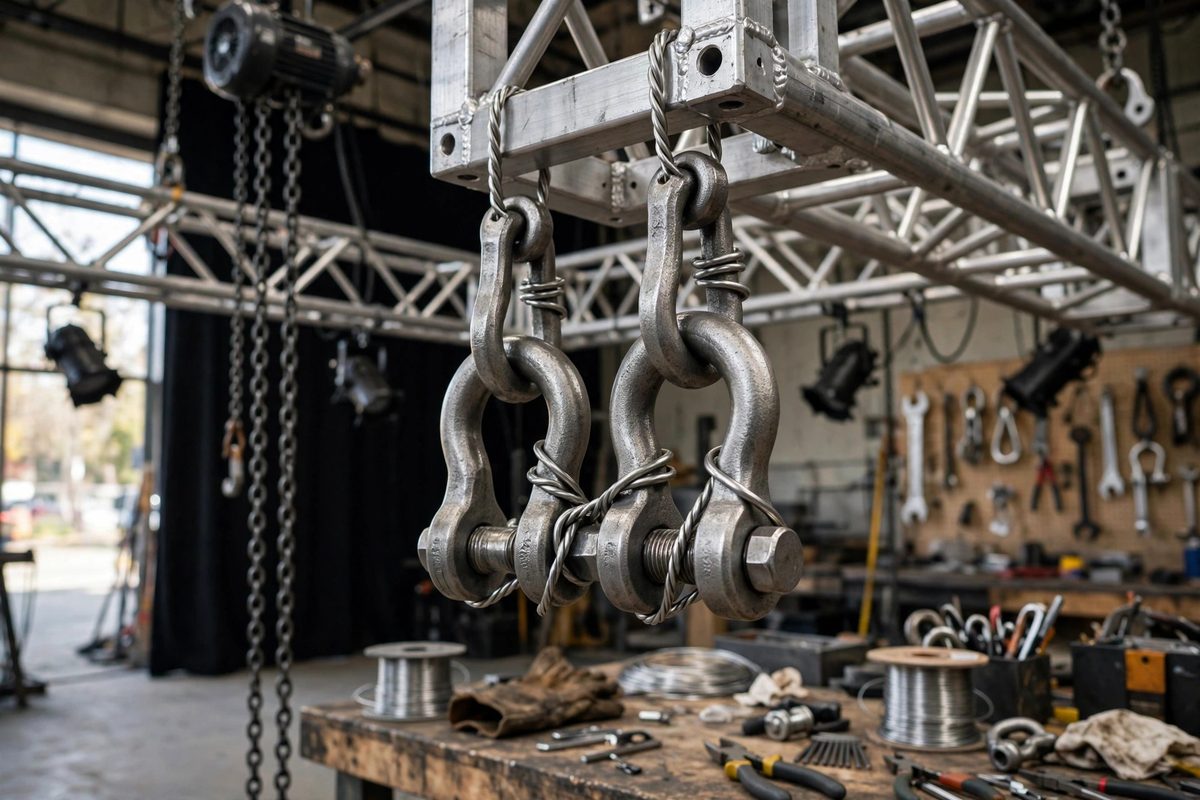
Flying trusses (aluminum truss sections hung from motors or chain hoists, carrying lights and scenery above the stage) are held together and hung by shackles, and every shackle has a pin that must not back out. Mousing is the practice of securing that pin with wire so it cannot rotate loose under vibration and load cycling. It is a small, fiddly job, and it is one of the non-negotiable safety practices in entertainment rigging.
Why Pins Back Out
A shackle pin is a threaded bolt that screws into one leg of the shackle. Under the constant small movements of a flown truss (sway from HVAC, vibration from bass, the bounce of a motor start), the pin can slowly rotate in its threads. It does not need to come all the way out to become dangerous; a pin backed out even a few threads has lost a large fraction of its engagement and can bend or pull under shock load. Mousing ties the pin to the shackle body so rotation is mechanically impossible, not just unlikely.
Forged Shackles and Proper Pins
Use only forged steel shackles rated for overhead lifting, with the working load limit marked on the body; cast or unrated shackles have no place in flying rigging. The pin must be the correct pin for that shackle (same manufacturer and size family), fully threaded home with the shoulder seated. Screw-pin shackles are common in entertainment rigging for their speed, but they are exactly the type that benefits most from mousing, since nothing but thread friction holds the pin. Bolt-type shackles with a nut and cotter pin are inherently more secure but still get moused in critical applications.
The Mousing Technique
Mouse with soft annealed steel wire or stainless seizing wire, roughly 1/16 inch diameter. Pass the wire through the pin's eye (or around the pin's head if it has no eye) and around the shackle's bow or leg, then twist the wire ends together tightly with pliers, trimming the twist short and folding it flat so it cannot snag. The wire should be taut enough that the pin cannot rotate even a fraction of a turn, but not so tight that it deforms the pin's eye. Two or three wraps before twisting gives redundancy; a single thin wrap can fatigue and break unnoticed.
Inspection Discipline
Mousing wire is sacrificial and must be inspected. Before every hang, check that each mouse is intact, taut, and correctly routed; after every show in a vibrating environment, glance at them again. Replace any mouse that is loose, corroded, or broken, which takes two minutes and costs pennies. Log shackle inspections on the same schedule as the rest of the rigging hardware: pins checked for thread damage and straightness, bodies checked for cracks, deformation, and wear at the bearing points. A shackle that has been overloaded (bent pin, spread legs) is retired, not repaired.
What Mousing Does Not Fix
Mousing secures the pin; it does not make an undersized shackle adequate, a damaged shackle safe, or a bad rigging plan acceptable. Every shackle in the system must be rated for its actual load with the appropriate safety factor (entertainment rigging typically designs to 5:1 or better on the working load limit for overhead suspension). Side-loading a shackle (pulling across the pin instead of along the shackle's axis) drastically reduces its strength; rig the geometry so every shackle loads in line. And never substitute the mousing wire for a missing cotter pin or a damaged thread; the mouse is a backup to a proper pin, not a replacement for one.
Training and Responsibility
Overhead rigging is one of the few areas of stagecraft where a mistake can kill someone, and it should be performed or directly supervised by qualified riggers. Mousing is simple enough to teach in minutes, but knowing which shackles to use, how to rate the system, and when to call in a professional takes training. If you are building or maintaining flying truss systems, get proper rigging training and work under qualified supervision until you are competent; no article substitutes for it.
Mousing a shackle pin is two minutes of wire and pliers that eliminates an entire failure mode from a flown truss. Use forged, rated shackles, seat the pins fully, mouse them tight, inspect them always, and respect the limits of what the practice covers; the audience under that truss is trusting you with their lives, and the wire is part of how you earn it.
Related Guides
- Shackle Pin Mousing Techniques for Flying Loads: When scenery flies, when a batten, a drop, or a scenic piece hangs from rigging overhead, every connection in the load path must be secure against
- Drop Forged Shackle Pin Mouse Wiring for Flying Bars: A flying bar, a pipe batten or truss flown overhead carrying scenery or lights, hangs from rigging where every connection is life-safety critical
- Aircraft Cable Swaging Specs for Stage Rigging: Stage rigging holds scenery, lights, and sometimes people above other people's heads, which makes it the highest-consequence craft in theatre
- Wire Rope Thimble Pinch Radii for Stage Drop Rigging: Stage drops, the big painted cloths that fly in and out, hang from wire rope, and the eye at the end of each rope is formed around a thimble. The