
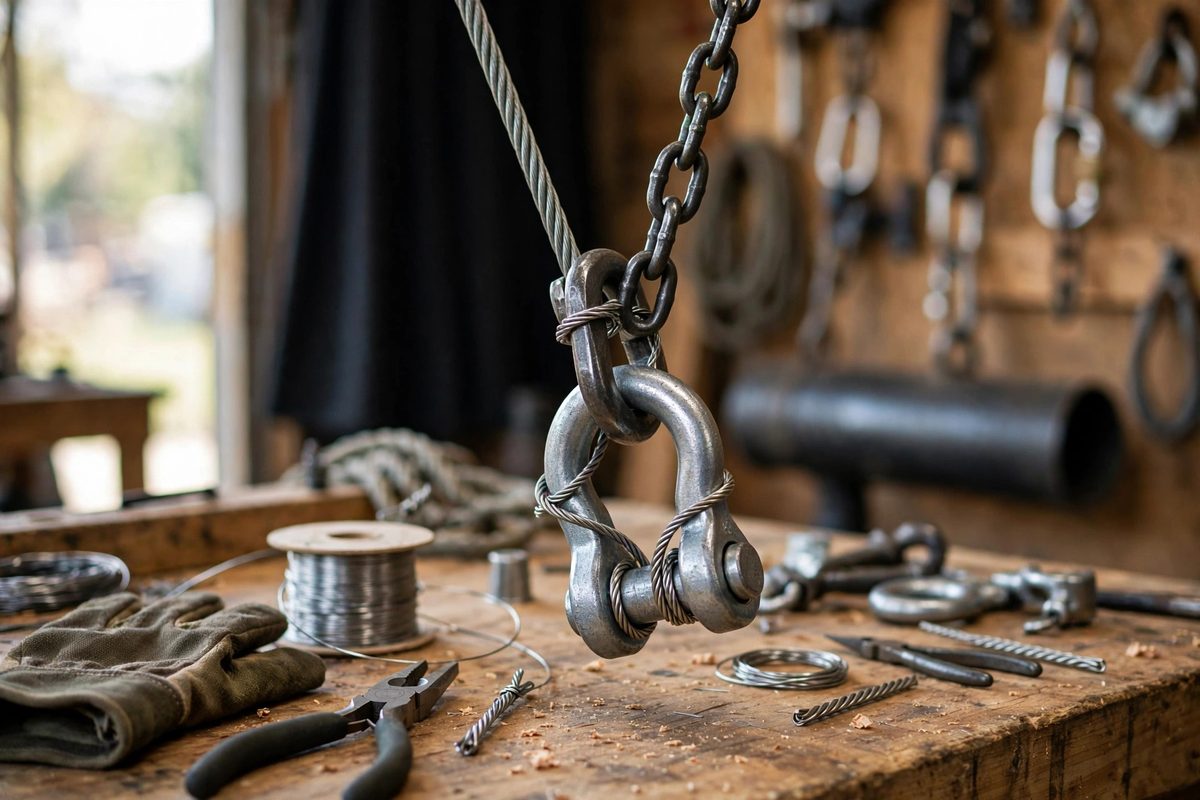
When scenery flies, when a batten, a drop, or a scenic piece hangs from rigging overhead, every connection in the load path must be secure against working loose. A shackle's pin can back out under the vibration and cyclic loading of a moving system, and a backed-out pin drops the load. Mousing, seizing the pin to the shackle body with wire or cord so it cannot rotate out, is the standard safeguard. It is simple, fast, and non-negotiable for overhead loads.
Why pins back out
Screw-pin shackles are convenient, but vibration loosens threaded connections; that is physics, not a defect. A flown piece moves, stops, and sways, cycling the load on the shackle with every cue. Over a run of performances, those cycles can walk a pin out far enough to unseat it. Bolt-type shackles with a nut and cotter pin resist this better, but even they benefit from mousing in critical applications. The rule in rigging is redundancy: the pin's threads are the primary retention, and the mousing is the backup that must hold if the primary fails.
The mousing technique
Mousing wire, typically soft annealed steel or stainless seizing wire, is wrapped through the shackle's eye (or around the pin's head) and around the shackle body in a figure-eight or several tight turns, then twisted off securely. The wraps must prevent the pin from rotating: for a screw pin, the wire connects the pin to the body so the pin cannot turn; for a bolt-type shackle, the wire secures the cotter pin and the nut. Pull each wrap tight before twisting; loose mousing is theater, not safety. Trim the twisted end and tuck it so it cannot snag or cut hands. Cord or zip ties are not substitutes for wire in overhead rigging; they degrade, stretch, and cut.
Shackle selection for flying
Use shackles rated for overhead lifting, with a legible working load limit (WLL) marking; unmarked shackles have no place in rigging. Size the shackle so the pin fits the connection without side-loading: shackles are rated for in-line loads, and side-loading dramatically reduces their capacity. For flown scenery that moves during the show, bolt-type shackles are preferred over screw-pin types because the nut and cotter provide positive retention even before mousing. Inspect every shackle before each use: look for stretched or deformed bodies, worn pin threads, and cracks, especially around the eyes.
Inspection and replacement
Mousing wire itself needs inspection: it work-hardens and fatigues, so re-mouse periodically rather than trusting old wire indefinitely. Any shackle that has been shock-loaded, dropped from height onto a hard surface, or shows any deformation gets retired immediately; rigging hardware does not get second chances. Keep a log of rigging hardware inspections for flown pieces; the log is both a safety practice and, in many venues, a requirement. When in doubt, replace: shackles are cheap, and the load above people's heads is not.
Know the limits of DIY rigging
This article covers a single technique, not rigging qualification. Overhead rigging over performers and audiences is regulated in most jurisdictions and venues, and it demands trained, often certified, personnel. If you are flying anything heavier than a lightweight drop, or flying over people, bring in a qualified rigger. Mousing your shackles correctly is necessary but not sufficient; the whole system, structure, motors, cables, and hardware, must be designed and inspected by someone who knows the loads. Respect the height.
Wire every pin, inspect every shackle, and know when the job needs a professional. Gravity does not negotiate.
Related Guides
- Forged Steel Shackle Pin Mousing for Flying Trusses: Flying trusses (aluminum truss sections hung from motors or chain hoists, carrying lights and scenery above the stage) are held together and hung by
- Drop Forged Shackle Pin Mouse Wiring for Flying Bars: A flying bar, a pipe batten or truss flown overhead carrying scenery or lights, hangs from rigging where every connection is life-safety critical
- Aircraft Cable Swaging Specs for Stage Rigging: Stage rigging holds scenery, lights, and sometimes people above other people's heads, which makes it the highest-consequence craft in theatre
- Wire Rope Thimble Pinch Radii for Stage Drop Rigging: Stage drops, the big painted cloths that fly in and out, hang from wire rope, and the eye at the end of each rope is formed around a thimble. The