
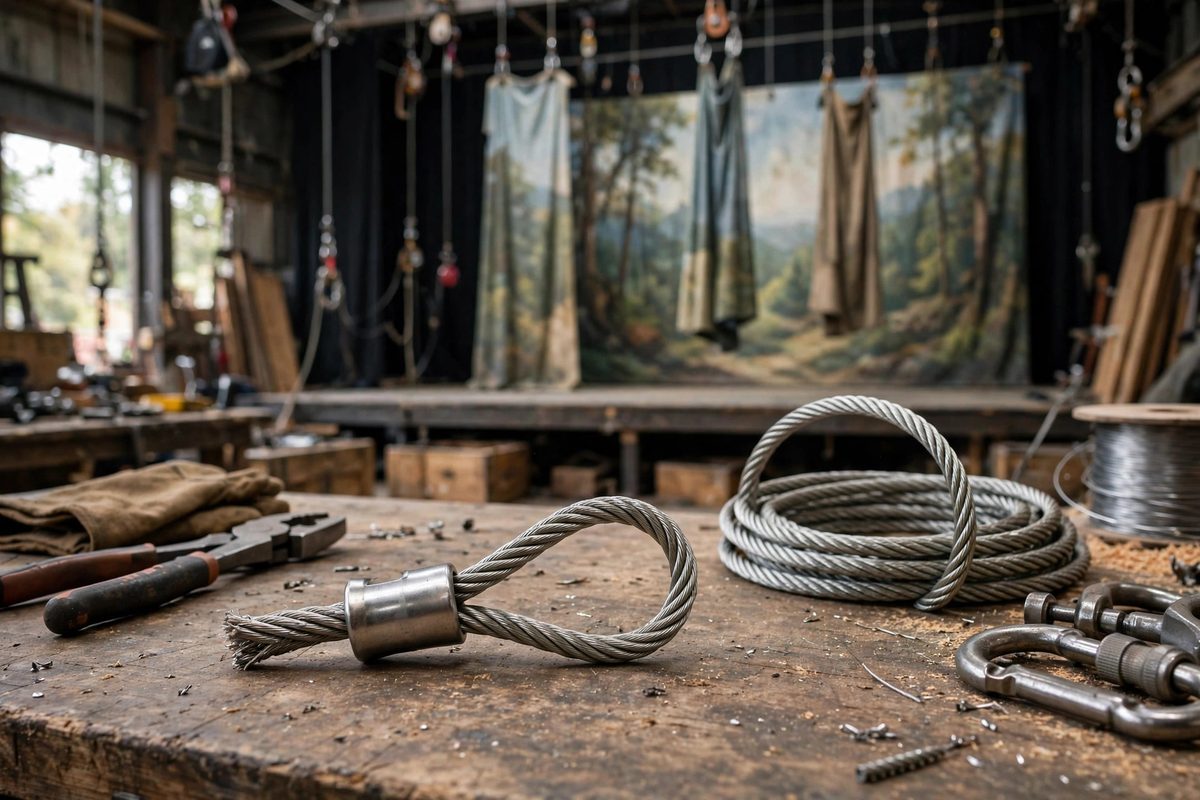
Stage drops, the big painted cloths that fly in and out, hang from wire rope, and the eye at the end of each rope is formed around a thimble. The thimble's job is to protect the rope from being pinched into too tight a bend. Get the thimble size wrong and the rope's strength drops at exactly the point where it carries the whole load. This is one of those details where a small part has an outsized effect on safety.
Why Bend Radius Controls Rope Strength
Wire rope is strong in straight tension and much weaker around a sharp bend. When rope bends tightly, the outer strands carry far more load than the inner strands, and the inner strands can kink or crush. The standard guidance is that the bend radius should be generous relative to the rope diameter; a widely used rule keeps the sheave or thimble radius at a multiple of the rope diameter that preserves most of the rope's rated strength. A thimble that is too small forces the rope around a tight radius, which can cut the effective strength of the termination dramatically. Since the eye termination is already the weakest point of the assembly, usually rated well below the rope's straight-pull strength, any additional loss from a tight bend eats directly into the safety margin.
Matching the Thimble to the Rope
Thimbles are sized to the rope diameter: a thimble made for half-inch rope has a groove that cradles half-inch rope and a bend radius suited to it. Using an oversized thimble lets the rope flatten and shift in the groove, which creates uneven loading and can let the rope slip under the clips. Using an undersized thimble pinches the rope and forces the tight bend described above. The fit check is simple: the rope should sit fully in the thimble groove with the thimble's ears closing around it without forcing. When in doubt, buy the thimble and the rope as a matched set from a rigging supplier rather than mixing hardware store parts, because rigging suppliers size their thimbles to recognized standards.
Clips, Swages, and Termination Practice
Most stage shops terminate rope eyes with wire rope clips (Crosby-style) or with swaged sleeves. With clips, the live end of the rope goes against the saddle and the dead end against the U-bolt, the arrangement summarized as "never saddle a dead horse." Space the clips a few rope diameters apart and use the recommended number for the rope size; too few clips slip, and over-tightening crushes the rope. Torque the clip nuts, then re-torque after the first loading, because the rope beds in and the nuts loosen. Swaged sleeves give a cleaner and generally stronger termination but require the correct press and dies; a poorly swaged sleeve is worse than good clips. Whichever method you use, the thimble stays in the eye during forming so the bend radius is set by the thimble, not by how tightly someone pulls the rope.
Inspection of Drops and Hardware
Rigging that flies over people gets inspected on a schedule, not when something looks wrong. Check each thimble eye for broken wires, especially at the point where the rope leaves the thimble, because that is where fatigue concentrates. Look for a thimble that has deformed, spread open, or shows the rope cutting into the groove. Check clips for loosened nuts and for rope slippage, which shows as the dead end creeping or as bright polished spots on the rope. Retire any rope with visible kinks, bird-caging, or a cluster of broken wires near a termination; rope is cheap compared to what it holds up. Keep a log of inspection dates and findings for every drop, since memory is not a maintenance program.
Respecting the Safety Margin
Stage rigging works with generous safety factors because the loads are dynamic: a drop that weighs a few hundred pounds can shock-load its rigging if it is flown too fast or snags. The rated strength of the rope, reduced by the termination efficiency and further reduced by any tight bend, must still exceed the working load by a wide margin. This is why every detail matters: the thimble radius, the clip count, the inspection log. None of these is dramatic on its own, but together they are the margin between a routine show and an accident. If any part of the system is questionable, ground the drop until it is fixed. No show cue is worth flying questionable rigging.
Size the thimble to the rope, form the eye around it, terminate with proper clips or swages, and inspect on a schedule. The pinch radius at the thimble is a small detail that protects the entire strength of the drop's rigging.
Related Guides
- Aircraft Cable Swaging Specs for Stage Rigging: Stage rigging holds scenery, lights, and sometimes people above other people's heads, which makes it the highest-consequence craft in theatre
- Drop Forged Shackle Pin Mouse Wiring for Flying Bars: A flying bar, a pipe batten or truss flown overhead carrying scenery or lights, hangs from rigging where every connection is life-safety critical
- Shackle Pin Mousing Techniques for Flying Loads: When scenery flies, when a batten, a drop, or a scenic piece hangs from rigging overhead, every connection in the load path must be secure against
- Forged Steel Shackle Pin Mousing for Flying Trusses: Flying trusses (aluminum truss sections hung from motors or chain hoists, carrying lights and scenery above the stage) are held together and hung by