
A marionette's control bar, the wooden handle the puppeteer holds, is the instrument through which every movement passes. Its geometry, the length of the bar, the position of the strings, the placement of the detachable leg bar, determines what the puppet can express. The traditional airplane-style control, with its crossbar layout, is a refined mechanism developed over centuries. Understanding its geometry lets you build or adapt controls that actually serve the performance.
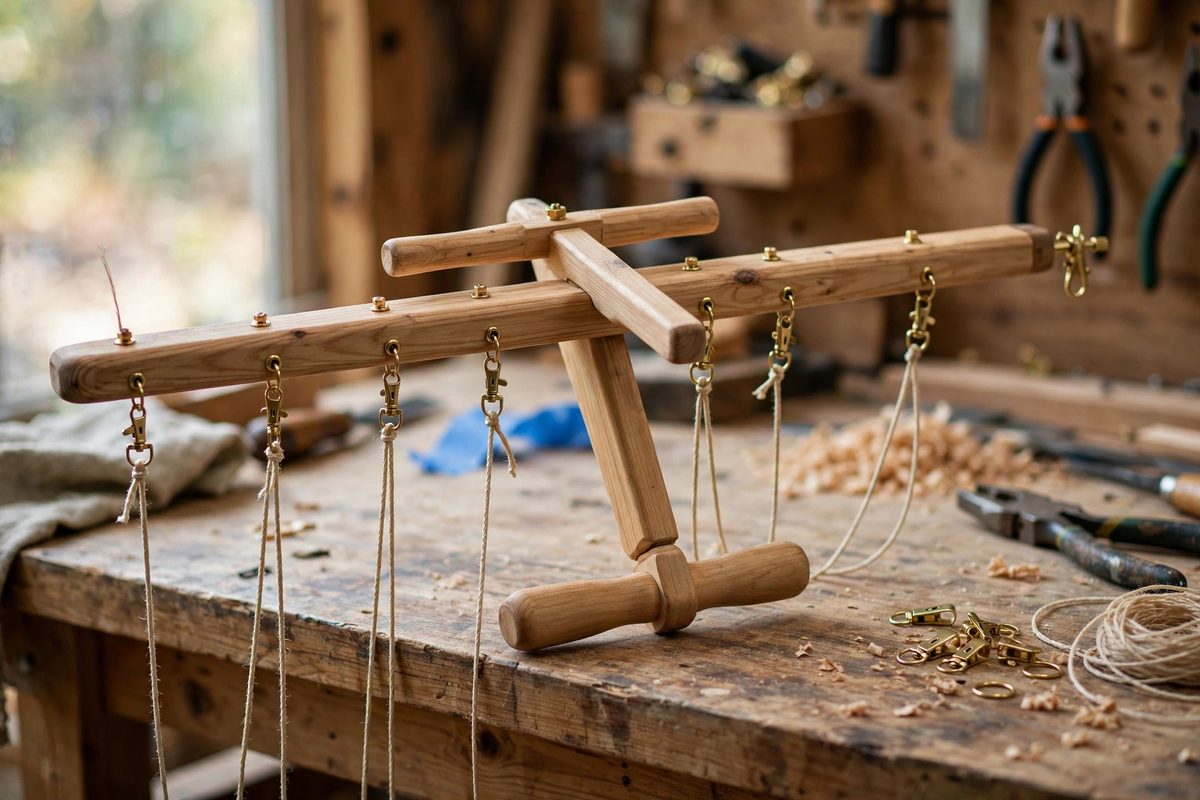
Anatomy of the airplane control
The classic control has a main bar roughly 12 to 18 inches long, held horizontally, with strings running from its ends and middle down to the puppet's head, shoulders, back, and hands. A second, shorter bar, the leg bar, detachably hooks to the main bar's center or hangs below it, carrying the knee and foot strings. The "airplane" name comes from the shape: the main bar is the fuselage, the leg bar the wing. Each string's attachment point on the bar maps to a body part, and the bar's movements, tilting, rotating, lifting, combine into the puppet's motion.
String placement and leverage
Strings attached near the bar's ends get large motion from small tilts: a slight roll of the wrist swings the hand strings widely. Strings near the center move less, giving fine control over the head and torso. This is deliberate leverage design: the expressive extremities (hands) get the long lever arms, while the stable core (head, back) gets the short ones. When laying out a control, place the strings for the finest movements nearest the center and the broadest gestures at the ends. The leg bar hangs below on its own pivot so leg movements stay independent of the torso's motion.
Bar length and puppet scale
Scale the control to the puppet: a good starting point is a main bar roughly as long as the puppet is tall, though personal preference varies widely. Longer bars give finer control through greater leverage but demand larger hand movements and more space; shorter bars are nimble but twitchy. The string lengths matter equally: strings from bar to puppet should let the puppet hang with its feet just above the stage when the bar is held at comfortable height, with enough slack for the puppet to sit, bow, and gesture without the bar hitting the stage.
The detachable leg bar
The leg bar's detachability is a performance feature: with it attached, the puppeteer controls the full body; detached and set aside, the legs hang naturally for scenes where the puppet sits or the legs should be still. The attachment should be quick and secure, a hook and eye or a slot that cannot accidentally release mid-performance but comes free with a deliberate motion. Some puppeteers use the detached leg bar as a second control in the other hand for complex leg choreography. Design the attachment for your performance style, not for tradition alone.
Building and balancing the control
Build the bars from straight, light hardwood; a warped control telegraphs its warp into every movement. Drill string holes cleanly and smooth their edges so strings run free; a catching string ruins a gesture. Balance the control with the puppet attached: it should hang neutrally, not tipping toward one end, which means the string tensions must be roughly symmetric. An unbalanced control fights the puppeteer constantly. Finish the wood smooth; the control lives in the hands for the whole show, and comfort is not optional.
Long levers for expression, short ones for stability, scaled to the puppet, balanced in the hand. The control bar is the puppet's voice; build it to speak clearly.
Related Guides
- Cross Bar Rocker String Ratios for Marionette Knees: A marionette that walks convincingly does it with its knees, and the knees work because of string geometry at the control. The cross bar rocker, the
- Cross-Bar Tilting Rocker Rigging for Twelve Cords: A marionette control bar (the cross-shaped handle the puppeteer holds) is the puppet's entire nervous system: every cord runs from a body part up to
- Nine Hole Control Perch String Balancing for Puppets: The airplane control, a flat bar with nine holes held above the marionette, is the puppeteer's cockpit: every string runs from the puppet up through
- Tilting Head Rocker Rigging for Twelve-String Puppets: A marionette's head needs to nod, tilt, and turn convincingly, and the rocker mechanism inside the head is what makes that possible. A tilting head