
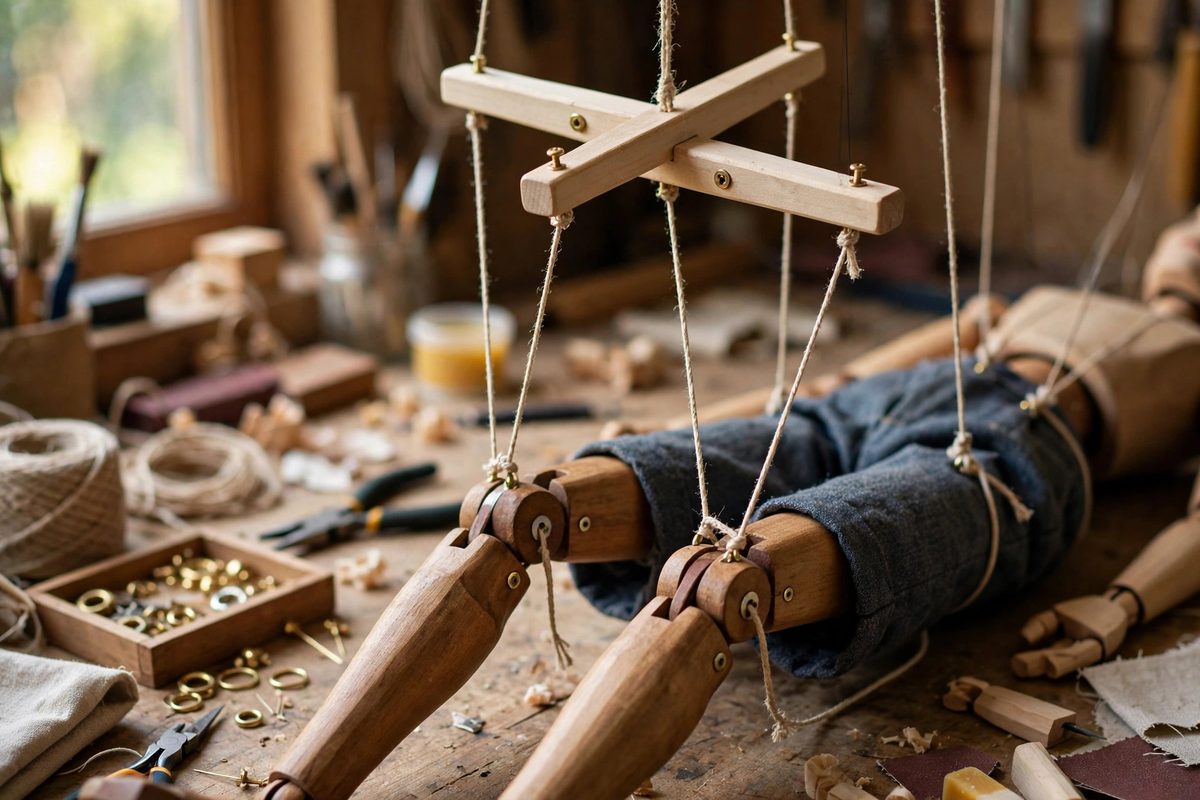
A marionette that walks convincingly does it with its knees, and the knees work because of string geometry at the control. The cross bar rocker, the tilting bar the leg strings attach to, translates the puppeteer's hand motion into leg motion, and the ratio between string attachment points decides whether the knee bends naturally or jerks like a broken hinge.
How the Rocker Drives the Leg
The leg strings typically run from the control to the knee and the foot. Tilting the rocker raises one string while lowering the other, which bends the knee and lifts the foot in coordination. The ratio that matters is the distance from the rocker's pivot to each string's attachment point: a longer lever arm moves its string further for the same tilt. If the knee string and the foot string have the wrong ratio, the foot lifts before the knee bends, or the knee collapses without the foot clearing the ground, and the walk looks wrong in a way the audience feels before they can name.
Finding the Natural Ratio
Watch a human leg walk. The knee bends first, lifting the lower leg, and the foot follows, clearing the ground with the toe trailing. To reproduce this, the knee string needs to take up slack slightly before the foot string, which means the knee attachment sits slightly further from the rocker pivot than the foot attachment, giving it more travel per degree of tilt. A practical starting ratio puts the knee string about one and a quarter to one and a half times as far from the pivot as the foot string. Tune from there by watching the puppet walk and adjusting the attachment points in small steps; marionette tuning is empirical, and the eye is the instrument.
Building an Adjustable Rocker
Do not fix the string attachment points permanently on the first build. Drill a row of holes along each rocker arm so the strings can be moved in and out to change the ratio, and use the puppet's own walking as the test. Some builders use sliding clips or knotted loops that can be repositioned without re-drilling. The ability to adjust in the rehearsal room is worth more than getting the ratio right on paper, because every puppet's weight distribution and joint friction is different and the paper ratio is only a starting point.
String Length and Knee Behavior
The ratio at the rocker interacts with the total string length. Long strings amplify small rocker movements and add lag, which can make the knees feel floaty; short strings respond crisply but demand more precise hand control. Keep the leg strings as short as the performance space allows while still giving the puppet room to move. Equally important, the knee joint itself must move freely; a stiff knee joint fights the string ratio and no amount of rocker tuning fixes a joint that binds. Wax or graphite on the joint, and a knee that swings freely by gravity alone, are prerequisites.
Coordinating Both Legs
Walking needs the legs to alternate, which means the rocker work for the two legs must be mirrored and timed. Many controls use a single rocker per leg or a split rocker, letting each hand drive one leg independently. Practice the alternating tilt until it becomes rhythm rather than thought; the ratio work is wasted if the timing is off. Film the puppet walking and watch the footage, because the camera catches knee timing errors the live eye forgives in the moment.
Convincing marionette knees come from the rocker ratio: knee string slightly favored over foot string, attachment points adjustable, joints free, and timing practiced. Tune it by watching the walk, and the puppet will start covering ground like it means it.
Related Guides
- Cross-Bar Tilting Rocker Rigging for Twelve Cords: A marionette control bar (the cross-shaped handle the puppeteer holds) is the puppet's entire nervous system: every cord runs from a body part up to
- Tilting Head Rocker Rigging for Twelve-String Puppets: A marionette's head needs to nod, tilt, and turn convincingly, and the rocker mechanism inside the head is what makes that possible. A tilting head
- Nine Hole Control Perch String Balancing for Puppets: The airplane control, a flat bar with nine holes held above the marionette, is the puppeteer's cockpit: every string runs from the puppet up through
- Airplane Control Bar Geometry for Puppet Struts: A marionette's control bar, the wooden handle the puppeteer holds, is the instrument through which every movement passes. Its geometry, the length of