
A marionette's head needs to nod, tilt, and turn convincingly, and the rocker mechanism inside the head is what makes that possible. A tilting head rocker is a small pivoting cradle that lets the head move on multiple axes while the strings stay organized. Rigging it correctly for a twelve-string puppet means the head responds to the control with nuance instead of flopping or locking up.
What the Head Rocker Does
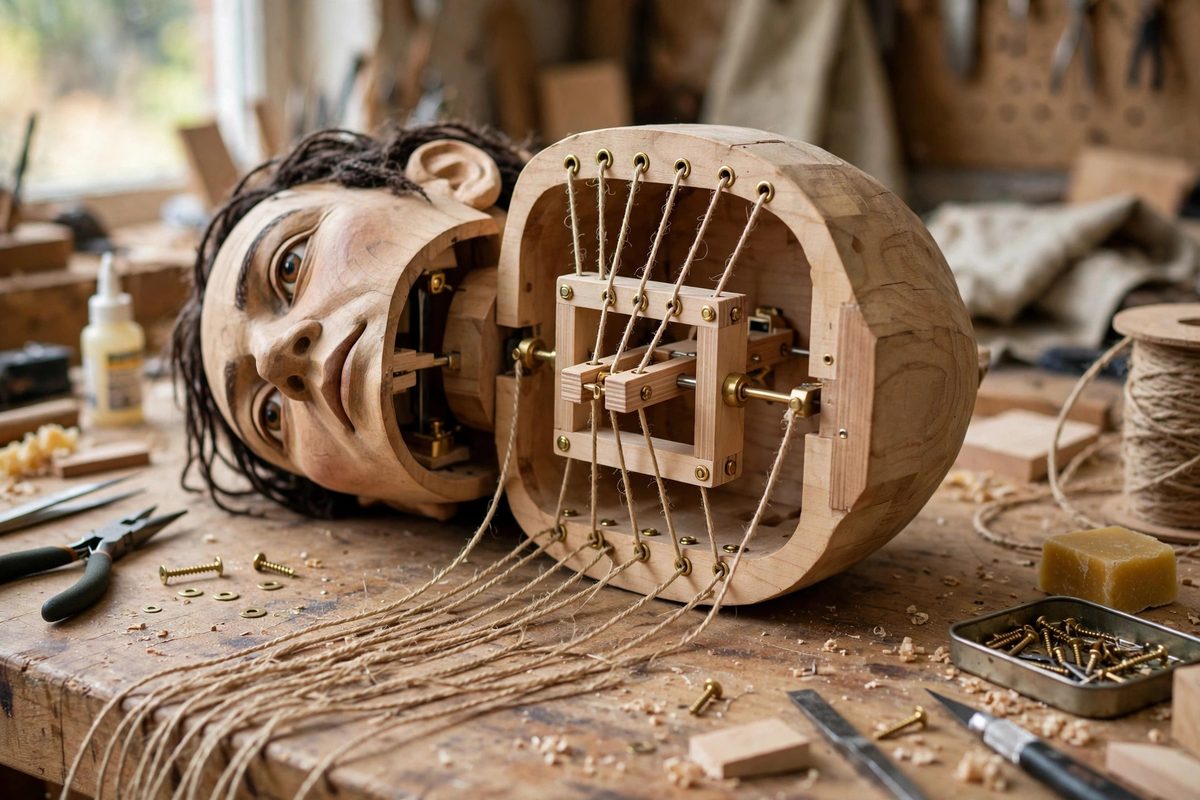
The rocker is a pivoting mount, often a small wooden or plastic yoke, fixed inside the head. The head strings attach to the rocker rather than directly to the head shell, and the rocker pivots on the neck post. When the puppeteer tilts the control, the strings pull the rocker, and the rocker translates those pulls into smooth head motion. The key advantage over direct stringing is leverage and range: the rocker gives the strings a longer moment arm, so small control movements produce natural head motion, and the pivot constrains the head so it cannot twist into unnatural positions. Without a rocker, head strings tend to fight each other, and the head either barely moves or jerks.
String Layout for Twelve-String Control
In a typical twelve-string layout, the head gets two or three strings: one to the top of the head for lift and nodding, and often one to each side of the head or jaw for tilt and turn. The top head string runs to the main control bar, while the side strings may run to the same bar or to a separate head control depending on the tradition you build in. Attach the head strings to the rocker at points spread around its perimeter, not clustered together; spread attachment gives the strings differential leverage, which is what produces tilt as opposed to pure lift. Keep the head strings slightly longer than the back and shoulder strings so the head hangs with a natural slight forward inclination rather than being yanked upright.
Balancing the Rocker
The rocker must be balanced so the head rests in a neutral position when the strings are slack. If the head is front-heavy, it nods forward constantly and the puppeteer fights it the whole show. Counterweight the back of the rocker or shift the pivot point until the head sits level with no string tension. Then set the string lengths so that a small pull produces a small motion; strings that are too tight make the head twitchy, and strings that are too loose make it lag. A good test is to tilt the control slowly and watch the head follow smoothly through its range with no dead spots and no sudden jumps. Dead spots mean a string is going slack mid-travel, usually because its attachment point on the rocker is too close to the pivot.
Preventing Tangles and String Interference
Twelve strings in a small space tangle if you let them. Run the head strings through guides or keep them separated from the shoulder and back strings by their attachment positions on the control. The head strings should leave the head at angles that keep them clear of the arms and the body as the puppet moves; a side head string that drapes across a shoulder string will catch every time the puppet turns. Wax the strings lightly to reduce friction where they pass through guides, and check that the rocker pivots freely without the strings sawing against the edge of the neck opening. A small piece of smooth tubing as a string guide at the neck prevents the most common wear point.
Tuning for Performance
Final tuning happens with the puppet hanging from the control, not on the bench. Walk through the head's vocabulary: nod yes, shake no, tilt quizzically, look up, look down. Each motion should be achievable with a distinct, comfortable control movement, and the head should return to neutral when released. If nod and tilt blur together, move the side string attachments further apart on the rocker to separate the axes. If the head cannot look up, the top string is too short or the rocker hits its travel limit against the neck. Adjust in small increments and retest, because marionette rigging is a system: changing one string length shifts the balance of the rest. Keep a record of the final string lengths for repairs; restringing a marionette from memory is a long afternoon.
A tilting head rocker turns three strings into a full vocabulary of head motion, but only if the rocker is balanced, the attachments are spread, and the strings are tuned as a system. Build it on the bench, tune it hanging, and the puppet will nod, shake, and tilt like it means it.
Related Guides
- Cross-Bar Tilting Rocker Rigging for Twelve Cords: A marionette control bar (the cross-shaped handle the puppeteer holds) is the puppet's entire nervous system: every cord runs from a body part up to
- Nine Hole Control Perch String Balancing for Puppets: The airplane control, a flat bar with nine holes held above the marionette, is the puppeteer's cockpit: every string runs from the puppet up through
- Cross Bar Rocker String Ratios for Marionette Knees: A marionette that walks convincingly does it with its knees, and the knees work because of string geometry at the control. The cross bar rocker, the
- Airplane Control Bar Geometry for Puppet Struts: A marionette's control bar, the wooden handle the puppeteer holds, is the instrument through which every movement passes. Its geometry, the length of