
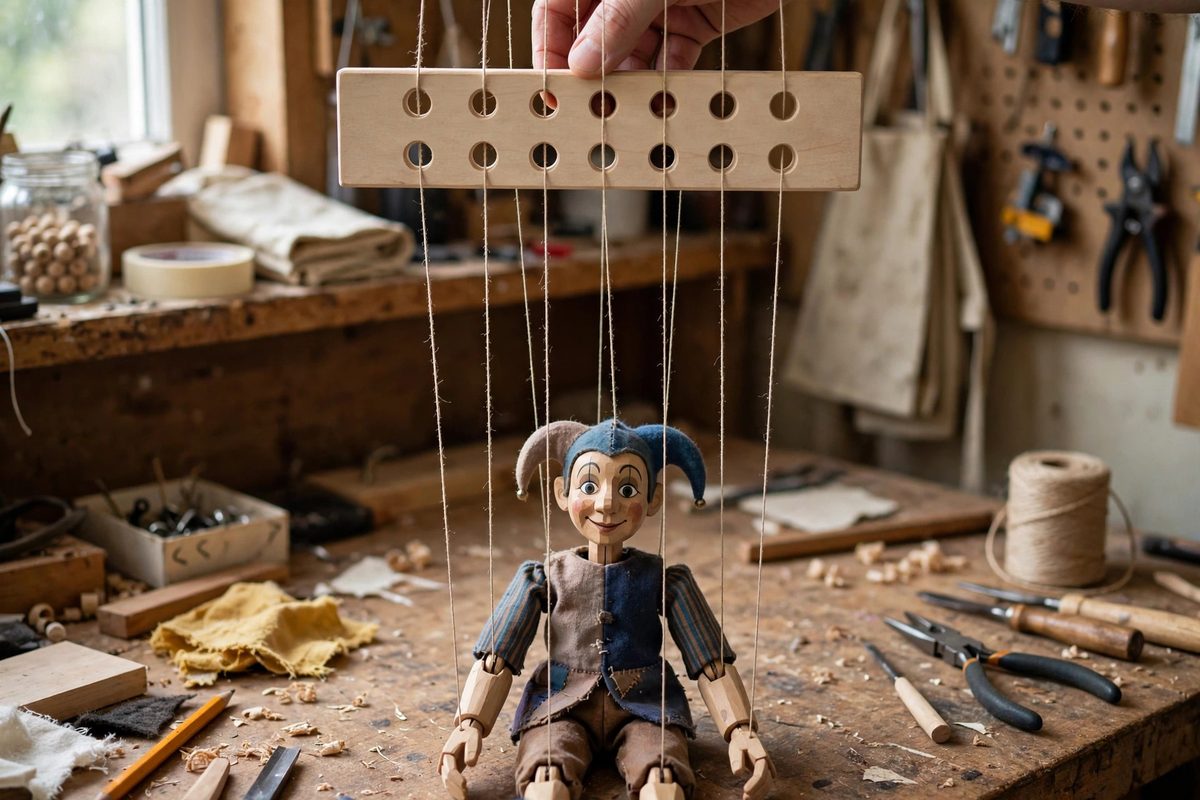
The airplane control, a flat bar with nine holes held above the marionette, is the puppeteer's cockpit: every string runs from the puppet up through a hole to the performer's hand, and the arrangement of those holes determines what the puppet can express. Nine holes is the traditional full layout, enough for head, shoulders, hands, knees, and back with room for extras. Stringing a control is easy; balancing it, so the puppet hangs neutrally and each string does exactly one job, is the craft. An unbalanced marionette fights the puppeteer on every movement.
What each hole controls
The standard nine-hole layout assigns strings by function. The center holes typically carry the head and back strings, the puppet's vertical anchors. Holes toward the front and back of the bar handle the hands and shoulders, giving the arms their forward-backward and lifting range. The outer holes serve the knees and legs. The geometry matters because each hole's position on the bar sets the string's angle to the puppet: a hand string running through a hole directly above the hand lifts straight up, while one offset to the side pulls at an angle. The traditional layout evolved to give each control point the most useful angle, and deviating from it should be deliberate, not accidental. Before stringing, lay out the plan on paper: which hole serves which point, so the web of strings stays organized instead of becoming a tangle that fights itself.
Hanging neutral: the balance principle
A balanced marionette hangs with its weight distributed so that no single string carries a disproportionate load and the puppet rests in a natural standing posture with all strings just taut. Achieving this is iterative. Hang the puppet from the control with all strings attached, then observe: does it lean, does one leg dangle, does the head tip? Each symptom points to a string length problem. A puppet leaning left has a right-side string too long or a left-side string too short. Adjust string lengths in small increments, a quarter inch at a time, because tiny changes at the control translate into visible posture changes at the puppet. The back string deserves special attention: it carries much of the torso's weight and sets the puppet's overall verticality. When the balance is right, the puppet hangs still and straight with minimal hand effort, and the puppeteer's slightest input produces clean, isolated movement instead of a whole-body wobble.
String lengths and the movement envelope
Each string's length defines its control point's range of motion. Hand strings need enough length to let the hands reach down to the puppet's sides at rest and rise above the head at full lift; too short and the puppet is perpetually shrugging, too long and the hands drag with a permanent droop. Knee strings should let the legs hang straight at rest with enough slack for a natural walking lift. The head string controls nodding and turning: it must be short enough to support the head's weight but long enough to allow expressive tilts. Set the rest lengths first, with the puppet hanging neutral, then test the extremes of each movement. A string that goes slack at one extreme and bar-tight at the other is correctly ranged; a string that is tight at rest has no room left to perform.
The perch: holding and manipulating the control
The control itself is held and worked as an instrument. The traditional grip keeps the bar roughly horizontal, with the puppeteer's fingers working individual strings or small groups while the whole bar tilts for gross movements like walking or bowing. The bar's balance in the hand matters: it should feel like an extension of the arm, not a separate object being wrestled. Some puppeteers add a handle or shape the bar to their grip; the nine-hole pattern stays standard while the handling adapts to the performer. Practice the basic vocabulary, walking by rocking the bar, bowing by tipping it forward, gesturing by lifting individual hand strings, until the control disappears from your awareness and only the puppet's movement remains. That transparency is the goal of all the balancing work: a control so well set up that the audience never suspects the strings.
Maintenance and restringing
Strings stretch, fray, and tangle with use, and a working marionette needs regular attention. Check strings before every performance: frayed strings break at the worst moment, and stretched strings throw off the balance you worked to achieve. Keep spare string of the same type and weight; changing string types changes the balance because different strings stretch differently. When restringing, do one string at a time against the balanced reference of the others, rather than stripping the whole control and starting over. Store the puppet hanging from its control, not crumpled in a box, so the strings keep their set and the balance survives between shows. A marionette is a precision instrument wearing a costume; maintain it like one.
Plan the hole layout, hang the puppet neutral, range each string's motion, and learn the control until it vanishes. Nine holes, correctly balanced, give a puppeteer a full expressive vocabulary with nothing left to fight.
Related Guides
- Tilting Head Rocker Rigging for Twelve-String Puppets: A marionette's head needs to nod, tilt, and turn convincingly, and the rocker mechanism inside the head is what makes that possible. A tilting head
- Cross Bar Rocker String Ratios for Marionette Knees: A marionette that walks convincingly does it with its knees, and the knees work because of string geometry at the control. The cross bar rocker, the
- Airplane Control Bar Geometry for Puppet Struts: A marionette's control bar, the wooden handle the puppeteer holds, is the instrument through which every movement passes. Its geometry, the length of
- Cross-Bar Tilting Rocker Rigging for Twelve Cords: A marionette control bar (the cross-shaped handle the puppeteer holds) is the puppet's entire nervous system: every cord runs from a body part up to