
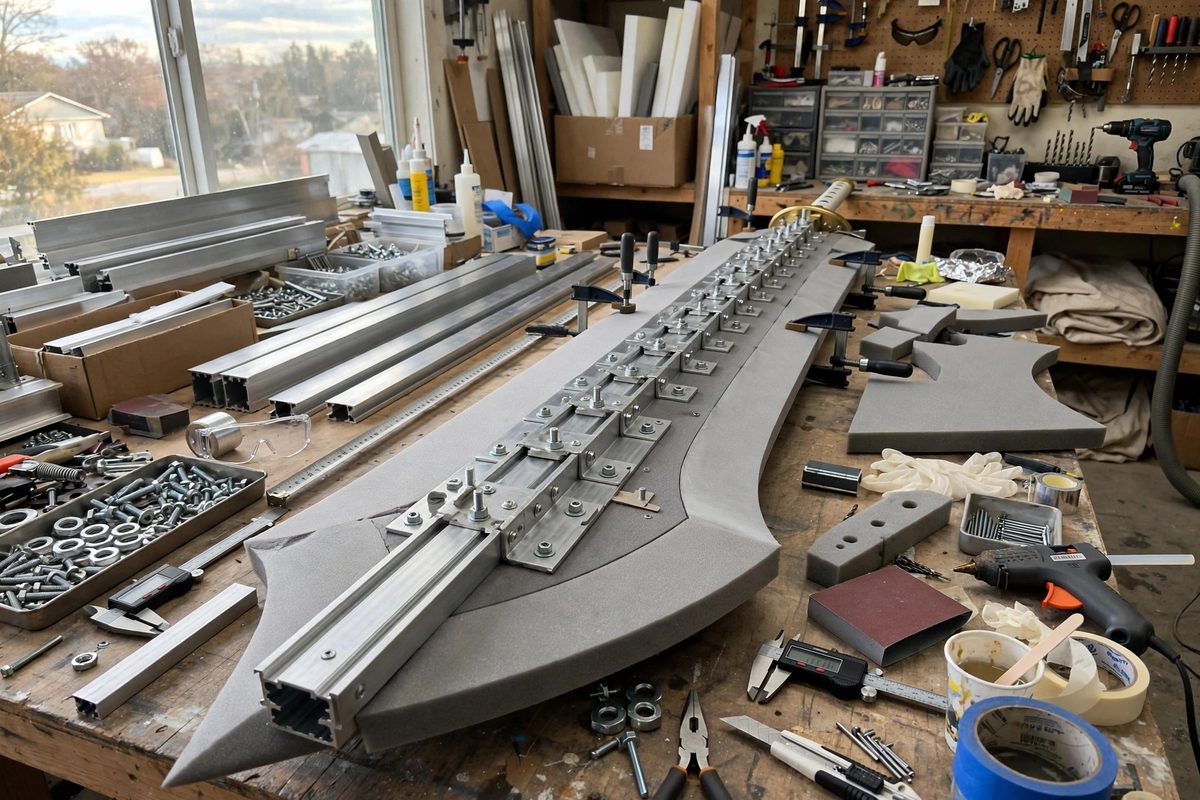
Anime swords are drawn without regard for physics: six feet long, a foot wide, wielded one-handed by characters who never visit the gym. Building one as a cosplay prop means reconciling the fantasy silhouette with the reality that a six-foot foam blade is a floppy sail. An aluminum spine running the length of the blade is the standard solution, giving the prop rigidity without the weight of a solid core, and the bracing details determine whether the sword survives a convention weekend.
Why the Blade Needs a Spine
A foam blade long enough to be impressive is long enough to flex, wobble, and eventually crease under its own weight, especially when carried blade-up through crowds or posed at angles. The aluminum spine acts as the blade's skeleton: it carries bending loads while the foam provides the shape and the safe, con-safe exterior. Without it, the blade droops within hours; with it, the sword holds its line all day. The spine also gives mounting points for the guard, handle, and pommel, turning a stack of foam into one connected assembly.
Sizing the Spine
Rectangular aluminum tube (roughly 1/2 by 1 inch, with 1/16-inch walls) is the sweet spot for most oversized blades: stiff in the bending plane, light enough to carry, and easy to source. For truly massive blades (over five feet), step up the section or use two parallel tubes joined at intervals, because stiffness scales with the fourth power of the section depth and a single small tube will still flex. The spine should run the full length of the blade and extend into the handle, where it anchors the grip; a spine that stops at the guard leaves the handle as a separate weak assembly.
Bonding Foam to Aluminum
Foam does not bond to smooth aluminum reliably, so prep the spine: scuff it with coarse sandpaper, wipe it clean, and consider wrapping it with a layer of tape or thin foam to give adhesives tooth. Use a flexible adhesive (contact cement or a flexible epoxy) rather than a rigid one, because the foam and aluminum expand differently with temperature and a rigid bond will shear. Laminate the blade foam in two halves around the spine so the metal is fully captured; a spine glued to one face of a foam slab will peel under bending loads.
Guard, Handle, and Pommel Integration
The guard should bolt or pin through the spine, not just glue to the foam, because the guard takes impacts (door frames, other props, enthusiastic posing) that would tear a foam-only joint. Drill through the spine and use bolts with large washers or a through-pin; the foam guard then slides over the hardware and hides it. Build the handle around the spine's extension with a solid core (wood or dense foam) so the grip feels substantial, and cap the pommel end with a retaining nut or pin so the whole assembly cannot slide apart lengthwise.
Weight Balance and Carry
A six-foot sword is unwieldy no matter what, but balance makes it manageable. Keep the heavy hardware (guard bolts, pommel cap) toward the handle end so the balance point sits within the grip or just ahead of the guard; a blade-heavy prop exhausts your wrist in an hour. If the blade still feels tip-heavy, a small counterweight in the pommel (a stack of washers on the spine end) shifts the balance back dramatically for almost no visible change. Test-carry the finished sword around the house for an hour before the convention; your shoulder will tell you what the workbench could not.
Convention Safety and Durability
Check the event's prop rules before building: many conventions require peace-bonding, limit prop length, or prohibit metal cores entirely, in which case the design must adapt (a wooden dowel spine is the usual compliant substitute). Round or pad any exposed metal at the tip and pommel, since even a blunt aluminum end is a hazard in a crowd. And build in repairability: a blade skinned in removable sections or with an access panel at the guard lets you re-glue a delaminated spine on the road instead of retiring the sword mid-weekend.
An aluminum spine turns an impossible anime silhouette into a prop you can actually carry, pose, and survive the weekend with. Size the tube to the blade, bond it flexibly, bolt the furniture through it, balance the assembly, and check the rules; the fantasy stays in the shape, and the engineering stays invisible.
Related Guides
- Internal Aluminum Spine Rigging for Giant Anime Props: A giant anime prop, a sword taller than its wielder, a scythe with a blade like a sail, looks like foam and paint on the outside. Inside, it needs a
- Balancing Counterweights in Large Foam Swords: A great foam sword feels alive in the hand: it swings fast, stops where you aim it, and does not tire your wrist during a long convention day. That
- Make a Safe EVA Foam Cosplay Sword: Craft Convention-Safe Props! EVA foam swords are the standard for cosplay and LARPing because they're lightweight, safe, durable, and look amazing
- Rigid Polyurethane Foam Core Carving for Cosplay: Some cosplay props are too large, too sculptural, or too organically shaped for EVA foam sheets: oversized weapons, creature heads, architectural set
- Fiberglass Core Tension in Oversized Fantasy Glaives: An oversized fantasy glaive, with a long haft and a broad blade head, puts serious leverage on its core. Fiberglass rods and tubes are the standard