
A great foam sword feels alive in the hand: it swings fast, stops where you aim it, and does not tire your wrist during a long convention day. That feel comes from balance, the relationship between the blade's weight and the counterweight in the pommel. Large foam swords, with their long blades, go wrong easily: all the weight ends up forward, and the sword handles like a club. Counterweighting the pommel fixes it, and the physics is simple.
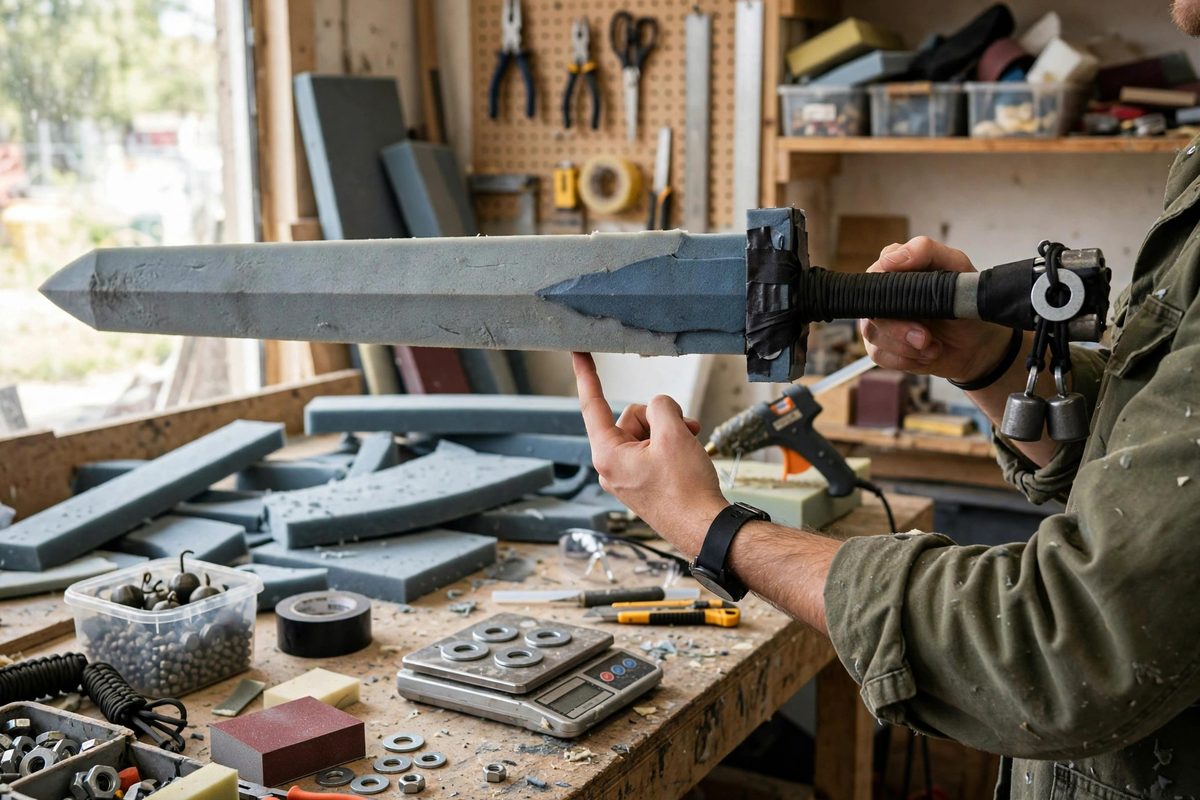
Where the balance point should be
A sword balances at the point where it neither tips toward the blade nor toward the pommel. For a wieldable prop, that point should sit just in front of the guard, roughly a hand's width up the blade from the handle. Balance farther up the blade and the sword feels blade-heavy and sluggish; balance behind the guard and it feels unnatural, like the blade is not there. The exact preference varies, but the just-ahead-of-the-guard target suits most large foam swords and most wielders. Test by balancing the finished sword across two fingers; the balance point is where it sits level.
Why foam blades need help
Foam is light, which sounds like an advantage until you add the core rod, the handle wrap, and the guard; the blade assembly of a large sword still outweighs the handle end significantly because of its length. A four-foot blade has enormous leverage: even a light blade creates substantial forward moment at the grip. Without counterweight, the wielder's wrist fights that moment on every swing and stop. Adding weight to the pommel, the farthest point from the blade, gives maximum counter-lever per ounce, which is why a small pommel weight corrects a large blade imbalance.
Choosing and installing counterweights
Dense, compact weights work best: lead-free options like steel washers, tungsten putty, or stacked coins embedded in the pommel. Start with an estimated weight, roughly 10 to 20 percent of the blade assembly's weight for a large sword, installed so it can be adjusted; a pommel cap that unscrews or a pommel cavity packed with removable putty lets you tune. Add weight incrementally and re-check the balance point each time; overshooting makes the sword pommel-heavy, which is just as bad. Secure the final weight permanently so it cannot shift or rattle: a moving counterweight changes the balance mid-swing.
The core rod's role
The core rod, usually fiberglass or carbon fiber, runs the blade's length for stiffness, and its own weight distribution affects balance. A rod that extends into the handle shifts weight rearward, helping balance; a rod that stops at the guard does not. When planning counterweight, account for the rod: weigh the blade assembly complete with rod before calculating pommel weight. Never use a metal core rod in a sword meant for contact or combat-style play; the counterweight discussion assumes a display or costume prop, and safety rules for live-action use are a separate, stricter matter.
Handling test
The final test is not the finger balance but the swing: hold the sword as you would in costume and make slow practice swings, stops, and direction changes. It should feel responsive, not ponderous, and your wrist should not strain. Walk around with it for a few minutes; convention days are long, and a sword that feels fine for thirty seconds but tires you in ten minutes needs more counterweight or a lighter blade. Comfort is the spec.
Balance just ahead of the guard, weight the pommel incrementally, account for the core, and test by swinging. The sword will feel like it wants to move, which is exactly right.
Related Guides
- Aluminum Spine Bracing for Massive Anime Prop Swords: Anime swords are drawn without regard for physics: six feet long, a foot wide, wielded one-handed by characters who never visit the gym. Building one
- Make a Safe EVA Foam Cosplay Sword: Craft Convention-Safe Props! EVA foam swords are the standard for cosplay and LARPing because they're lightweight, safe, durable, and look amazing
- Rigid Polyurethane Foam Core Carving for Cosplay: Some cosplay props are too large, too sculptural, or too organically shaped for EVA foam sheets: oversized weapons, creature heads, architectural set
- Fiberglass Core Tension in Oversized Fantasy Glaives: An oversized fantasy glaive, with a long haft and a broad blade head, puts serious leverage on its core. Fiberglass rods and tubes are the standard
- Internal Aluminum Spine Rigging for Giant Anime Props: A giant anime prop, a sword taller than its wielder, a scythe with a blade like a sail, looks like foam and paint on the outside. Inside, it needs a