
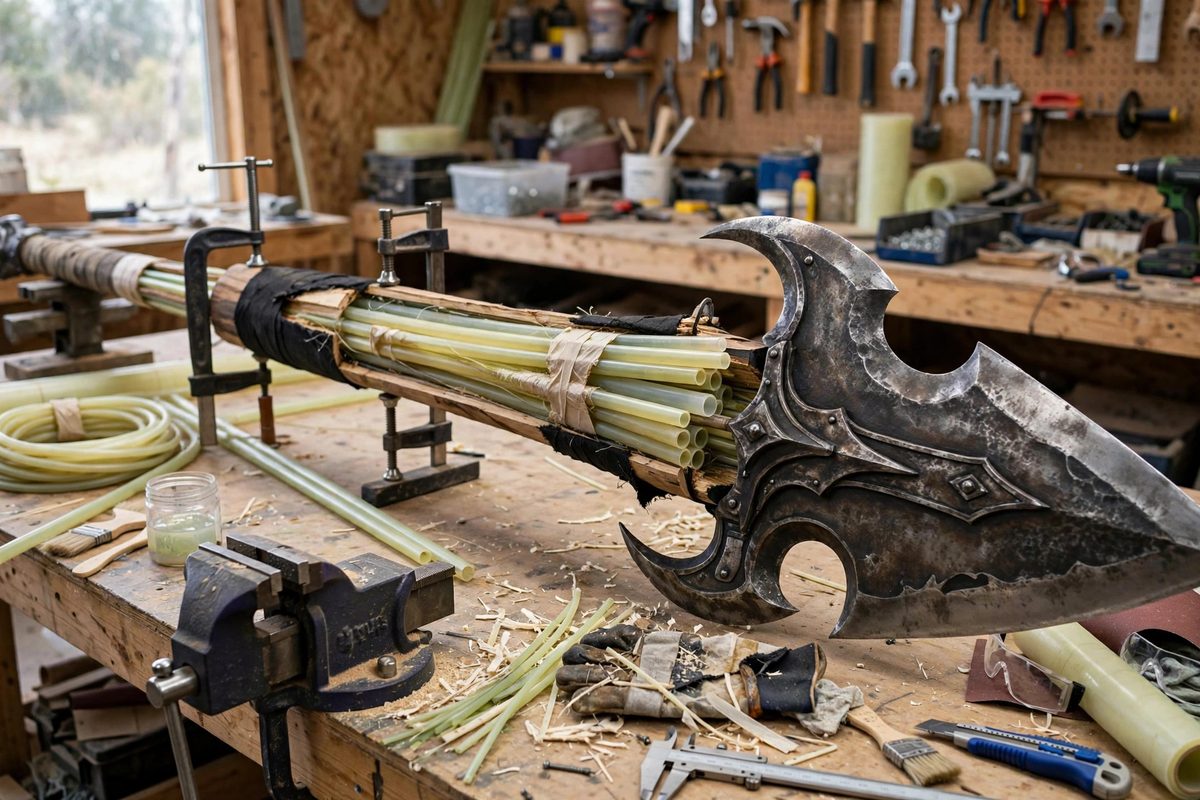
An oversized fantasy glaive, with a long haft and a broad blade head, puts serious leverage on its core. Fiberglass rods and tubes are the standard core material because they combine stiffness with light weight, but a core that is too thin will whip and snap under its own blade, while a core that is too stiff transmits every knock straight into the joint between core and foam. Getting the tension and stiffness right is a structural problem first and a cosmetic problem second.
Why Fiberglass Suits Long Props
Fiberglass bends and returns instead of taking a permanent kink the way aluminum can, and it is far lighter than steel rod at the same stiffness. For a glaive that may run six to eight feet long, weight is the dominant design constraint: every extra ounce in the haft multiplies the effort of carrying and posing the prop all day. Fiberglass gives you a core that flexes slightly under load and springs back, which also helps the prop survive the inevitable bumps of a convention hall. The trade-off is that fiberglass fails suddenly rather than bending as a warning, so the core must be sized with real margin and the stress concentrations at joints and socket fittings must be managed.
Sizing the Core for the Length
Stiffness drops fast as length grows. Doubling the length of a rod makes it roughly eight times more flexible under the same load, so a core diameter that works for a four-foot staff will be far too whippy for a seven-foot glaive. As a shop rule of thumb, step up the core diameter as the prop gets longer and heavier: solid rods in the three-quarter inch range suit very long props, while half-inch rods handle moderate lengths. Hollow pultruded tube can give similar stiffness with less weight if the wall is thick enough. The blade head is the real load: a wide, heavy foam blade acts like a sail and a hammer at the end of a lever, so test the assembled core by holding it at the grip and giving the blade a firm shake. If the tip oscillation takes more than a couple of seconds to settle, or the core feels like it is bowing under its own blade, it is undersized.
Managing Tension at Joints and Sockets
Most glaives are built in sections for transport, which means the core has joints, and joints are where props break. A slip-fit socket where one tube slides over another concentrates all the bending stress at the rim of the socket. Wrap the socket area with several layers of fiberglass cloth and epoxy, or with tightly wound strapping tape over a glued joint, to spread the load over a longer section. The bond between core and foam deserves the same thinking: the foam blade should be anchored to the core along its full length, not just at the tip and base, so bending loads transfer gradually instead of peeling the foam off at one point. Contact adhesive plus a mechanical wrap at the blade root gives a joint that survives drops that would shear a glue-only joint.
Controlling Whip Without Deadening the Prop
Some flex is good; uncontrolled whip is not. A glaive that oscillates wildly looks flimsy and will eventually fatigue the core at the grip. You can tune the response by adding a second, shorter core segment inside or alongside the main core through the highest-stress zone, typically the grip and the first foot of blade. This is the same principle as a tapered fishing rod: more material where the bending moment is highest, less where it is not. Do not overdo it, though. A core so stiff it cannot flex at all passes every shock directly into the blade foam, cracking the coating at the root. The target is a prop that feels lively but settles quickly, with no visible permanent bow after you lean on it.
Foam, Coating, and Core Protection
The foam skin and its coating do real structural work: they keep the fiberglass core from taking abrasion and UV damage, and they add a little damping. Seal cut foam ends so moisture cannot wick along the core, and round over any sharp fiberglass edges before wrapping them in foam, because a sharp rod end will saw through foam from the inside under flex. Wear a respirator and gloves when cutting or sanding fiberglass; the dust is an irritant and does not belong in lungs. After final assembly, flex the whole glaive through its travel a dozen times and inspect every joint for cracking sounds or visible separation. A joint that creaks is a joint that is about to fail, and it is far easier to reinforce it now than to rebuild the blade after it snaps mid-event.
Size the core for the length and the blade mass, reinforce every joint over a long overlap, and tune for a quick-settling flex rather than a whip or a dead stick. The foam and paint get the compliments, but the fiberglass core is what lets the glaive survive the weekend.
Related Guides
- Rigid Polyurethane Foam Core Carving for Cosplay: Some cosplay props are too large, too sculptural, or too organically shaped for EVA foam sheets: oversized weapons, creature heads, architectural set
- Make a Safe EVA Foam Cosplay Sword: Craft Convention-Safe Props! EVA foam swords are the standard for cosplay and LARPing because they're lightweight, safe, durable, and look amazing
- Balancing Counterweights in Large Foam Swords: A great foam sword feels alive in the hand: it swings fast, stops where you aim it, and does not tire your wrist during a long convention day. That
- Internal Aluminum Spine Rigging for Giant Anime Props: A giant anime prop, a sword taller than its wielder, a scythe with a blade like a sail, looks like foam and paint on the outside. Inside, it needs a
- Aluminum Spine Bracing for Massive Anime Prop Swords: Anime swords are drawn without regard for physics: six feet long, a foot wide, wielded one-handed by characters who never visit the gym. Building one