
A longarm quilting machine at speed is a marvel: thousands of stitches a minute, flowing curves, consistent length. It is also a system operating near its limits, where the upper thread path, every guide, disc, and eye the thread passes through, determines whether the stitching is beautiful or a bird's nest. Balancing that path is the core maintenance skill of high-speed quilting.
What the thread path does
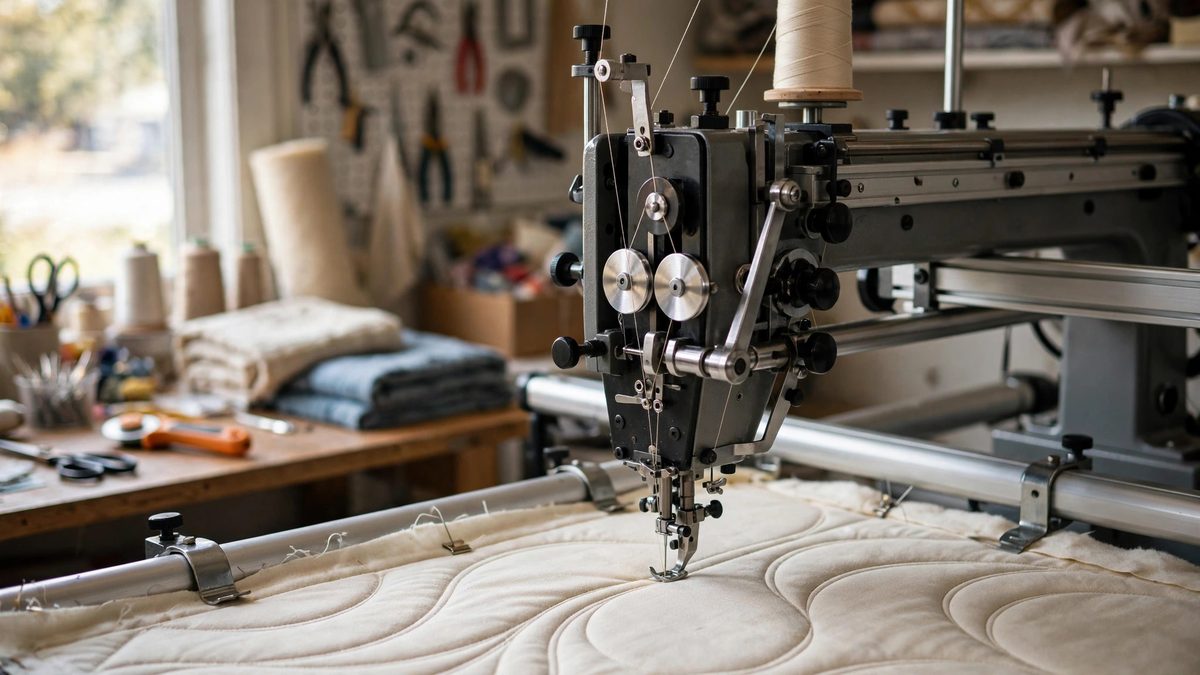
The upper thread travels from the cone through a series of guides and tension discs to the needle, and each contact point adds or regulates tension. At high speed, the thread is yanked through this path thousands of times per minute, and any inconsistency, a rough guide, a misadjusted disc, a thread cone feeding poorly, shows up in the stitch. The path must deliver thread to the needle at consistent tension, neither starving the stitch nor flooding it. Balance means every element doing its share, none dominating.
Tension discs and their setting
The tension discs are the heart of the path. They should grip the thread firmly enough to regulate it but not so tightly the thread stretches or breaks. The classic test: with the presser foot down, the thread should pull through the discs with noticeable, even resistance; with the foot up, it should pull freely. Adjust in small increments, testing on a practice sandwich, not on the quilt. Keep the discs clean; lint packed between them changes the tension silently, and a soft brush or a folded piece of fabric run between the discs clears it.
Guides, eyes, and wear points
Every guide the thread touches is a wear point. Inspect them regularly for grooves, burrs, or rough spots, running a fingertip or a bit of thread through each to feel for catches. A grooved guide shreds thread at speed; a burr breaks it outright. Replace worn guides promptly; they are cheap parts that protect expensive quilting time. Check the thread path diagram for your machine and verify the thread is actually routed through every guide; a skipped guide is a common cause of mysterious tension problems.
Thread cone feeding
At high speed, how the thread leaves the cone matters. The cone should feed smoothly without hopping, tipping, or snagging on its own tail. Use a thread stand or guide that lets the thread pull straight up off the cone, and keep the cone from rotating or bouncing. Some quilters use thread nets on slippery threads to control the feed. If the thread breaks at speed and everything else checks out, watch the cone during a run; the problem is often visible there.
Needle and thread matching
The needle's eye must suit the thread: too small and the thread abrades with every stitch, too large and the stitch formation suffers. Change needles on a schedule, not when they break; a dull or burred needle damages thread and fabric long before it snaps. Match the needle size and type to the thread weight and the quilt's fabrics. The thread path ends at the needle, and a wrong or worn needle undoes everything upstream.
Testing at speed
Balance the path at the speed you will quilt, not at a crawl. Tension behaves differently at speed, and a path that looks perfect slowly can misbehave at full pace. Keep a practice sandwich loaded for testing: run a minute of the actual quilting motifs at speed, inspect both sides of the stitching, and adjust. The back of the quilt tells the truth about tension balance; the top can look fine while the back shows loops or tight pulls.
Clean the discs, inspect every guide, feed the cone smoothly, match the needle, and test at speed. The thread path disappears as a concern, and the quilting gets all the attention, which is how it should be.
Related Guides
- Hopping Foot Height Calibration on Longarm Quilters: The hopping foot on a longarm quilting machine does a job that looks simple and is actually precise: it hops up and down with the needle, pressing
- Hopping Foot Height Tuning for High Loft Battings: The hopping foot, the little foot that bounces up and down with the needle on a longarm quilting machine, is the quilter's window onto the quilt
- Longarm Bobbin Tension Calibration With Towa Gauges: Bobbin tension is the quiet half of every longarm stitch, and it is the half most quilters set by feel and hope. A Towa gauge takes the guessing out
- Setting Needle Bar Rise Speeds for Longarm Top Threads: On a longarm quilting machine, stitch quality lives in the timing between the needle bar and the hook: the needle must rise just enough, at just the