
On a longarm quilting machine, stitch quality lives in the timing between the needle bar and the hook: the needle must rise just enough, at just the right moment, for the hook to catch the thread loop. When top thread shreds, skips, or breaks, especially with specialty threads, the needle bar rise timing is a prime suspect. Understanding what rise speed means and how to set it gives you control over the most common longarm frustration.
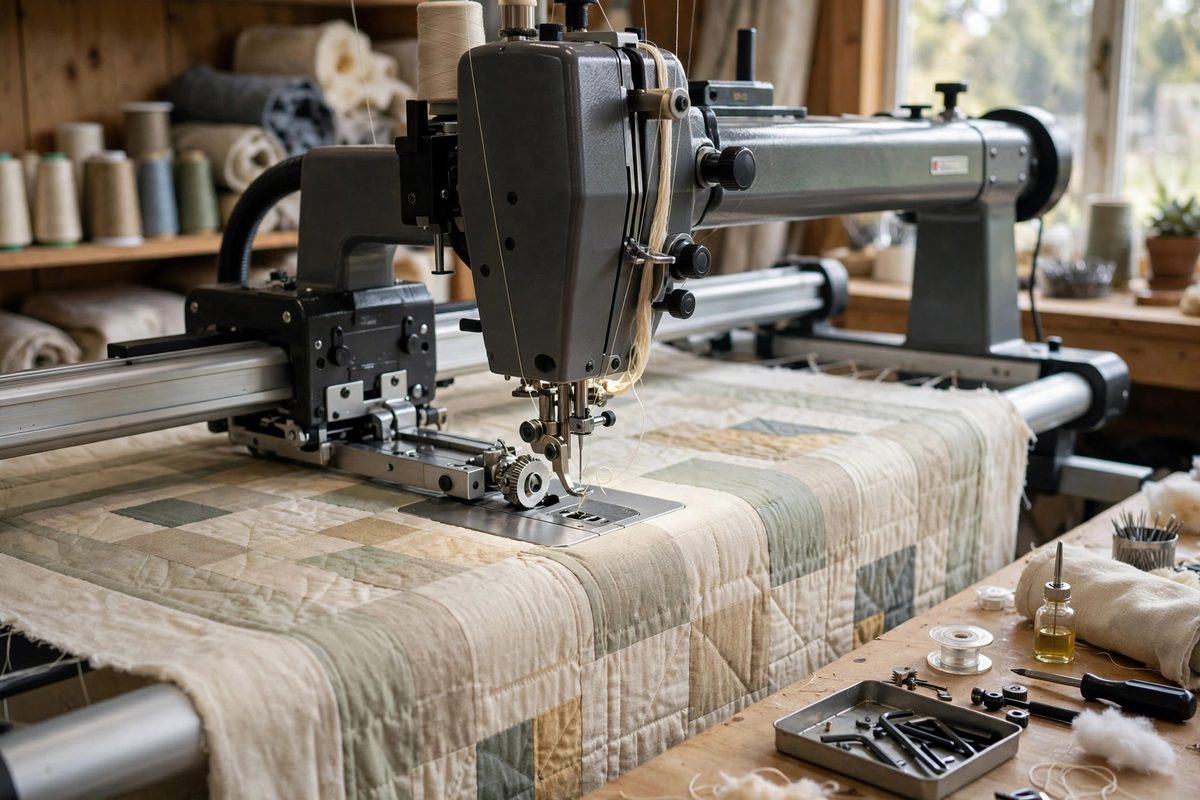
What needle bar rise actually is
As the needle reaches the bottom of its stroke and starts back up, the thread forms a small loop on the scarf side of the needle. The hook's point must pass through that loop to form the stitch. The needle bar rise is how far the needle has risen from bottom dead center when the hook point arrives. Too little rise and the loop has not formed yet; the hook misses and you get skipped stitches. Too much rise and the loop has started to collapse; the hook catches poorly, shredding thread or breaking it. The correct rise is a narrow window, and different threads need slightly different positions within it.
Why thread type changes the requirement
Standard quilting cotton thread is forgiving: it forms a clean loop across a fairly wide timing window. Specialty top threads are not. Metallics are stiff and springy, forming small, reluctant loops that need the timing near the early edge of the window. Fine silk and monofilament form loops readily but are fragile, punishing any timing that drags them. Heavy decorative threads need a larger needle and form bigger loops, shifting the ideal rise point. When you change thread families, assume the timing needs checking; the machine does not know you switched from cotton to metallic.
Checking and setting the timing
Timing is set mechanically, and the procedure varies by machine, so your manual is the authority on which screws and gauges to use. The general principle is universal: with the needle at its lowest point, rotate the handwheel to raise the needle bar by the specified amount (commonly around two millimeters, but verify for your machine), and check that the hook point sits just above the needle eye, centered on the scarf. Make this check with the actual needle and thread you plan to quilt with, since needle size changes the geometry. If your machine offers electronic timing fine-tune, use it for thread-family adjustments and reserve the mechanical setting for the baseline.
Speed, tension, and the whole system
Rise timing does not act alone. Running the machine faster effectively narrows the timing window, because everything happens with less margin; when troubleshooting thread breakage, slow down before you reach for the timing tools. Top tension that is too tight pulls the loop small and early, mimicking a timing problem, so verify tension is in a sane range first. And a burred or grooved needle eye shreds thread regardless of timing; change the needle as part of any thread-breakage diagnosis. Work through the cheap fixes, needle, tension, speed, before the mechanical ones.
When to call for service
If the timing will not hold, if you set it correctly and it drifts within a quilting session, something mechanical is worn: hook shaft bearings, needle bar bushings, or drive components. Continued quilting on a machine that will not hold timing chews hooks and needles and produces unreliable stitch quality. A service visit is cheaper than a damaged hook assembly. Keep a log of when timing was set and with what thread; patterns in the log tell a technician exactly where to look.
Needle bar rise is invisible when it is right and maddening when it is wrong. Learn your machine's window, check it when you change thread families, and the top thread will behave.
Related Guides
- Longarm Bobbin Tension Calibration With Towa Gauges: Bobbin tension is the quiet half of every longarm stitch, and it is the half most quilters set by feel and hope. A Towa gauge takes the guessing out
- Hopping Foot Height Calibration on Longarm Quilters: The hopping foot on a longarm quilting machine does a job that looks simple and is actually precise: it hops up and down with the needle, pressing
- Balancing Upper Thread Paths for High-Speed Quilters: A longarm quilting machine at speed is a marvel: thousands of stitches a minute, flowing curves, consistent length. It is also a system operating
- Hopping Foot Height Tuning for High Loft Battings: The hopping foot, the little foot that bounces up and down with the needle on a longarm quilting machine, is the quilter's window onto the quilt