
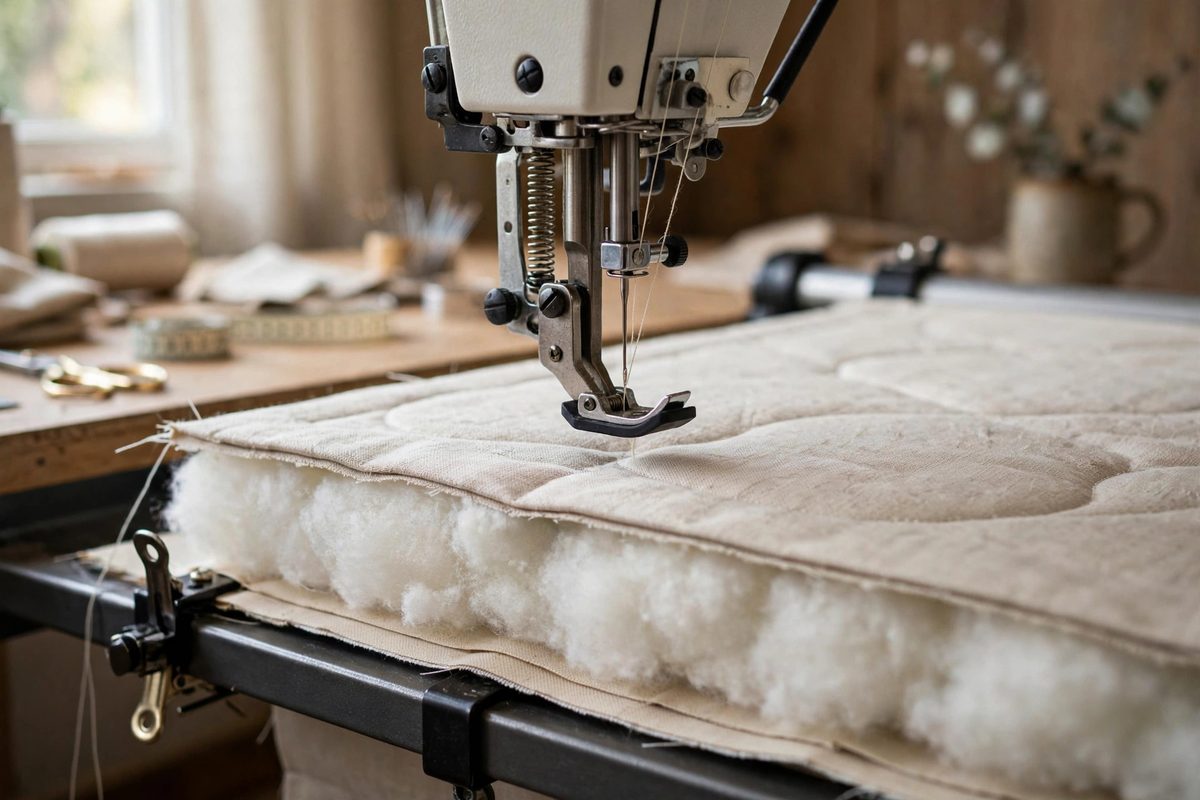
The hopping foot, the little foot that bounces up and down with the needle on a longarm quilting machine, is the quilter's window onto the quilt sandwich. Its height determines how the machine sees the quilt: too low and it drags, compresses the batting, and fights the quilter's movements; too high and the needle flexes, stitches skip, and control suffers. With high-loft battings, which are thicker and springier than standard, the hopping foot height needs deliberate tuning: the default setting is almost never right.
What the Hopping Foot Does
On a longarm, there is no feed dog moving the fabric: the quilter moves the machine (or the quilt) by hand, and the hopping foot's job is to press the quilt sandwich down around the needle just long enough for the stitch to form, then lift to let the sandwich move freely. The foot hops in sync with the needle, down as the needle descends, up as it rises. The clearance between the foot and the quilt at the top of the hop, and the pressure at the bottom, define how the machine handles the sandwich. Correct height gives smooth movement with positive stitch formation; incorrect height gives you a fight on every inch.
Why High-Loft Batting Changes the Equation
High-loft batting is thick and resilient: it springs back after compression, which is exactly what gives quilted pieces their puffy, dimensional look. But that springiness means the sandwich is taller and pushes back harder against the hopping foot. A foot height set for standard batting sits too low for high loft: the foot compresses the batting excessively on every hop, the quilter feels the machine dragging, and the batting's resistance can deflect the needle or cause skipped stitches. The foot needs to ride higher to accommodate the loft, clearing the uncompressed sandwich while still coming down far enough to stabilize the stitch formation.
Setting the Height: The Procedure
The standard method: with the needle at its lowest point, set the hopping foot so it just clears the quilt sandwich, typically about the thickness of a coin above the uncompressed top. Then check at the top of the needle stroke that the foot lifts clear enough for free movement. For high-loft batting, start from the standard setting and raise incrementally: the sandwich is thicker, so the foot must be higher, but raise it only until the dragging stops and the stitches form cleanly. Test on a practice sandwich made with the actual batting and fabrics: stitch curves and direction changes, the moves that reveal hopping foot problems, and inspect the stitches. Skipped stitches or looping mean the foot is too high to stabilize the sandwich; dragging and resistance mean it is too low. Adjust in small increments until both symptoms disappear.
Reading the Stitches for Diagnosis
The stitching tells you what the foot is doing. Consistently skipped stitches, especially on curves or when changing direction, point to excessive foot height: the sandwich is moving before the stitch completes because the foot is not holding it. Uneven stitch length with the machine set to regulated mode suggests the foot is interfering with the sandwich movement, either too low (dragging) or inconsistently contacting the springy batting. Thread breaks and needle deflection, particularly with the thicker needles high-loft work sometimes requires, can indicate the foot pressing the sandwich into the needle's path. Diagnose from the stitches, adjust the height, and re-test: the loop is quick once you know what to look for.
Needle and Thread Pairing
Hopping foot height does not exist in isolation: needle size and thread weight interact with it. High-loft batting often wants a slightly larger needle to penetrate the thick sandwich cleanly, and the larger needle needs the foot height set with that needle installed, since the geometry references the needle's lowest point. Heavier decorative threads need adequate clearance too: a foot set perfectly for fine thread may drag with a heavy thread that adds bulk at the stitch point. When you change any element of the combination, batting, needle, thread, recheck the foot height: it is a system setting, not a set-and-forget.
Maintenance and Consistency
Hopping foot height drifts: vibration loosens the adjustment, and switching between projects with different battings demands different settings. Check the height at the start of each quilting session, not just when problems appear. Keep the foot clean: lint and thread waste packed under the foot changes its effective height and causes the very dragging you tuned out. And record your settings: note the foot height that worked for each batting type, so returning to a familiar batting means dialing in a known value rather than re-discovering it.
The hopping foot is the interface between machine and quilt, and high-loft batting demands that the interface be set for its thickness and spring. Tune the height on a practice sandwich, read the stitches, pair the needle and thread thoughtfully, and check the setting routinely. Smooth quilting on lofty batting is not luck; it is geometry set correctly.
Related Guides
- Hopping Foot Height Calibration on Longarm Quilters: The hopping foot on a longarm quilting machine does a job that looks simple and is actually precise: it hops up and down with the needle, pressing
- Balancing Upper Thread Paths for High-Speed Quilters: A longarm quilting machine at speed is a marvel: thousands of stitches a minute, flowing curves, consistent length. It is also a system operating
- Longarm Bobbin Tension Calibration With Towa Gauges: Bobbin tension is the quiet half of every longarm stitch, and it is the half most quilters set by feel and hope. A Towa gauge takes the guessing out
- Setting Needle Bar Rise Speeds for Longarm Top Threads: On a longarm quilting machine, stitch quality lives in the timing between the needle bar and the hook: the needle must rise just enough, at just the