
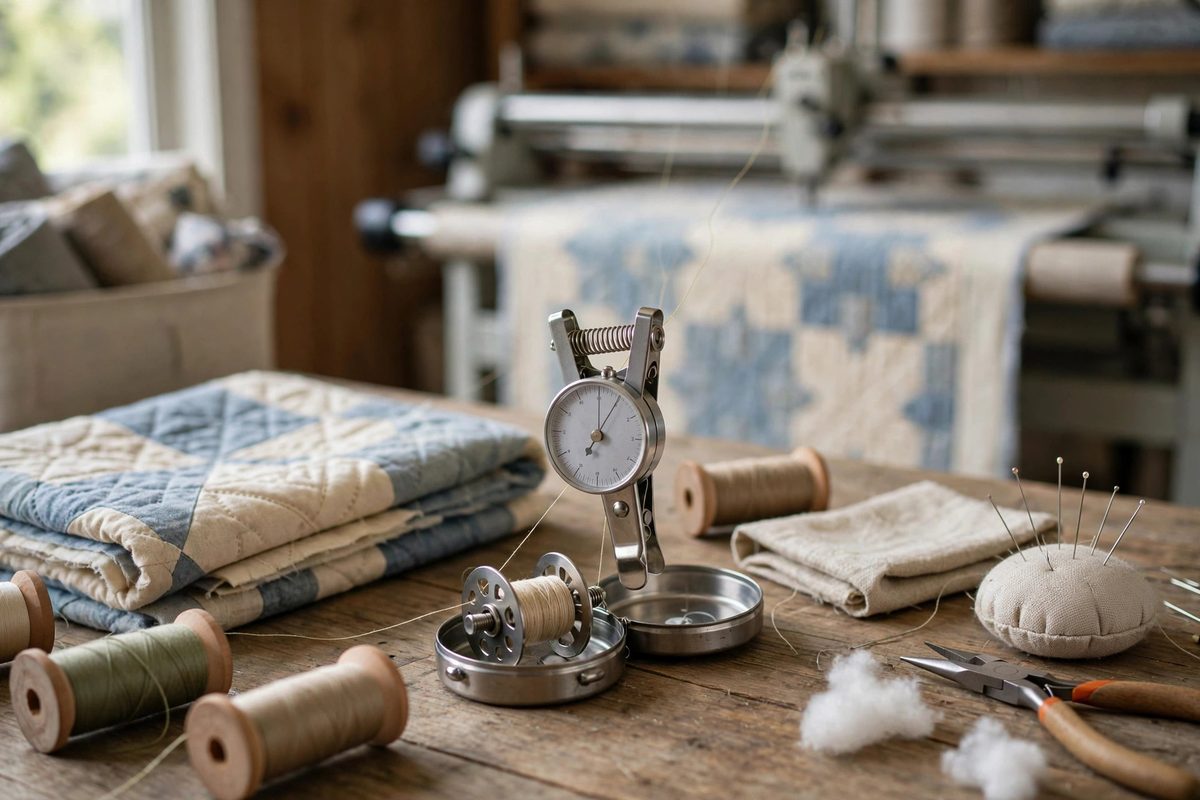
Bobbin tension is the quiet half of every longarm stitch, and it is the half most quilters set by feel and hope. A Towa gauge takes the guessing out of it. This small spring scale clips to the bobbin thread and reads the pull in grams, giving you a repeatable number you can return to whenever stitches misbehave or you switch thread. Calibrating with a gauge instead of the old drop test turns tension from a superstition into a setting.
Why grams beat the drop test
The classic drop test, where you dangle the bobbin case by the thread and watch how it falls, tells you something is in a broad range but never tells you the number. Two quilters can watch the same bobbin drop and reach different conclusions. A Towa gauge reads the actual resistance the thread feels as it leaves the case, usually expressed as a pull weight in grams. That number is comparable across sessions, across machines, and across conversations with a technician. Most longarm bobbin tensions land somewhere around 180 to 220 grams with common quilting threads, but the right number for your setup is whatever your machine likes once everything else is dialed in. The point of the gauge is not a universal magic number; it is a personal baseline you can reproduce. Write it down. Tape it inside the machine cabinet. When tension drifts six months from now, you will know exactly where you started instead of reconstructing a feeling.
Setting up the gauge correctly
Wind a full bobbin the way you normally would, because a nearly empty bobbin pulls differently than a full one and calibration should reflect real quilting conditions. Seat the bobbin in the case exactly as it sits in the machine, thread it through the tension spring and the pigtail or slot per your machine's threading path, and clip the gauge's hook to the thread tail. Hold the case still and pull the gauge straight away in a smooth, steady motion, watching the needle settle rather than the spike as you start pulling. Take three readings and average them. If the three numbers scatter widely, something mechanical is wrong: lint packed under the tension spring, a burr on the case, or thread catching on a rough spot. Clean first, then measure again. The gauge only reports honestly when the case is clean.
Adjusting the bobbin case screw
The tension screw on the side of the bobbin case is a small slotted screw that pinches the tension spring tighter or looser. Turn it in tiny increments, roughly an eighth of a turn at a time, because the difference between good and bad tension can be a quarter turn total. Clockwise (as you look at the screw head) tightens and raises the gram reading; counterclockwise loosens and lowers it. After each adjustment, re-seat the bobbin, re-thread, and take fresh readings. Patience here pays directly in stitch quality. While you adjust, notice whether the screw feels gritty or loose. A screw that turns too freely can walk during quilting, and a dab of thread-locking care or a replacement case is cheaper than the thread nest a walking screw creates mid-quilt.
Balancing bobbin tension against the top
Bobbin tension does not exist in isolation. The visible goal is a balanced stitch where the top and bobbin threads meet inside the quilt sandwich, so the bobbin gauge reading is the foundation and the top tension dial is the variable you tune against it. Once the bobbin reads your baseline, load your usual top thread, quilt a test sandwich of the same batting and fabrics you plan to use, and adjust the top tension until the knot hides in the batting and neither thread shows as dots on the opposite side. This is why calibrating the bobbin first matters: if the bobbin drifts, you end up chasing the top dial forever and never finding stability. Lock the bobbin to its number, then tune the top. When you change thread weight, recheck the bobbin, because a finer bobbin thread at the same spring setting reads lower and needs the screw snugged to return to your baseline.
When to recheck and what drift means
Tension drifts for mechanical reasons, not mystical ones. Lint compresses under the tension spring and effectively tightens the pull. Thread weight changes alter the reading. A dropped bobbin case can bend the spring. Temperature and humidity shifts move metal and thread slightly. Make the gauge part of a routine: check at the start of a big quilt, after any thread change, and whenever the stitch starts looking off. Keep a small log of date, thread, and grams. Over time the log reveals your machine's personality, like a case that always needs a touch more tension with a particular bobbin brand. If readings swing wildly day to day with the same thread and a clean case, the spring is fatigued or the screw threads are worn, and replacing the case is a small cost against the price of a ruined quilt top.
Calibrated bobbin tension will not make you a better quilter by itself, but it removes one of the biggest hidden variables in the machine. Get the number, write it down, and quilt with one less thing to worry about.
Related Guides
- Hopping Foot Height Calibration on Longarm Quilters: The hopping foot on a longarm quilting machine does a job that looks simple and is actually precise: it hops up and down with the needle, pressing
- Setting Needle Bar Rise Speeds for Longarm Top Threads: On a longarm quilting machine, stitch quality lives in the timing between the needle bar and the hook: the needle must rise just enough, at just the
- Balancing Upper Thread Paths for High-Speed Quilters: A longarm quilting machine at speed is a marvel: thousands of stitches a minute, flowing curves, consistent length. It is also a system operating
- Hopping Foot Height Tuning for High Loft Battings: The hopping foot, the little foot that bounces up and down with the needle on a longarm quilting machine, is the quilter's window onto the quilt