
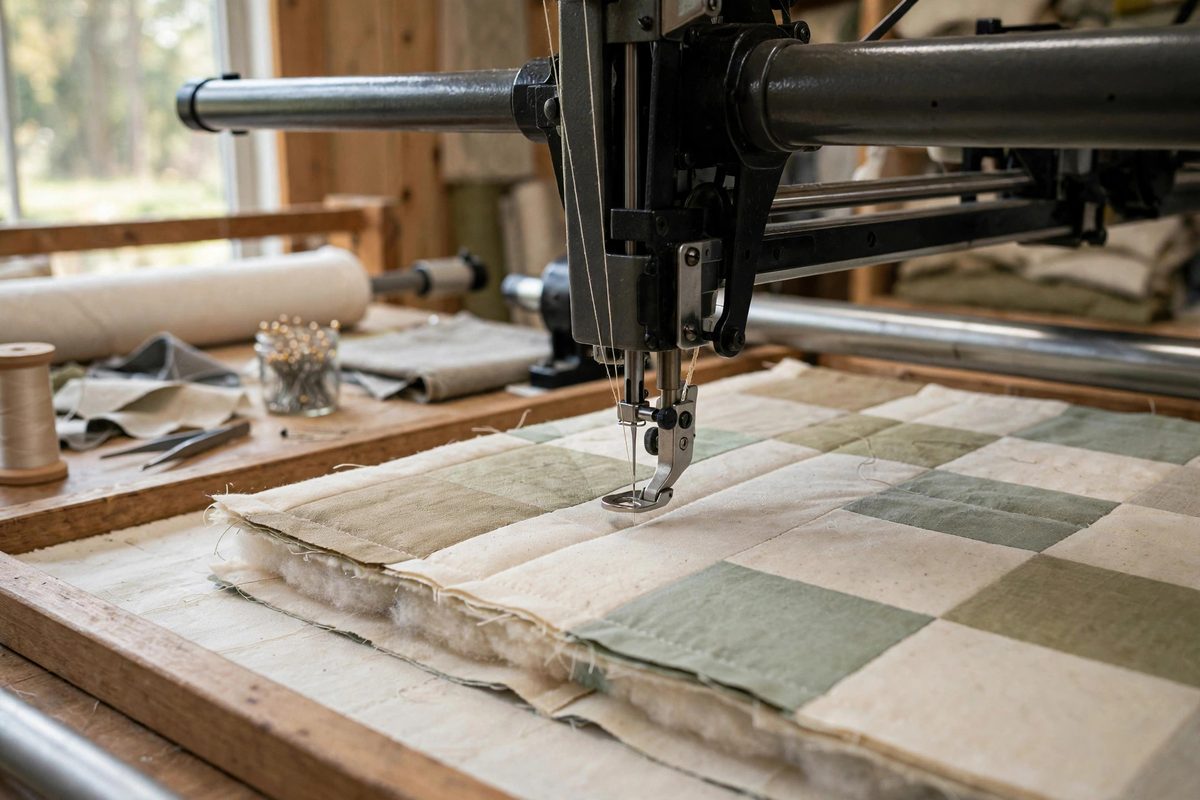
The hopping foot on a longarm quilting machine does a job that looks simple and is actually precise: it hops up and down with the needle, pressing the quilt sandwich flat at the moment of stitch formation and lifting to let the fabric move between stitches. The height of that hop, the clearance between the foot and the needle plate at the top of its travel, is a critical adjustment. Set it right and stitches form perfectly while the quilt glides freely. Set it wrong and you get skipped stitches, broken thread, or a foot that drags and distorts the quilt top. Calibrating the hopping foot height is a short procedure with an outsized effect on stitch quality.
What the hopping foot does
During each stitch cycle, the needle descends through the quilt layers, the hook forms the stitch, and the needle rises. The hopping foot, mechanically linked to the needle bar, descends as the needle descends, clamping the quilt sandwich against the needle plate so the layers cannot flag, bounce, with the needle; then it rises as the needle rises, releasing the quilt so it can be moved to the next stitch position. This clamping is what makes consistent stitch formation possible on a thick, compressible sandwich that would otherwise ride up and down with the needle. The foot's height determines both the clamping force at the bottom of the stroke and the clearance for fabric movement at the top. Both matter, and they trade against each other.
Finding the correct height
The correct hopping foot height is specified by the machine manufacturer as a clearance measurement, typically checked with the needle at its highest position and measured between the bottom of the foot and the needle plate. The standard method uses a gauge of the specified thickness, often around the thickness of a coin, slipped under the foot: the gauge should just pass with slight drag. Too much clearance and the foot never properly clamps the quilt, leading to flagging, skipped stitches, and poor tension; too little clearance and the foot drags on the quilt top between stitches, making the machine hard to move smoothly and distorting the fabric. Adjust via the foot's mounting screw in small increments, rechecking with the gauge after each change, since the adjustment is sensitive.
Adjusting for quilt thickness
The factory specification assumes a typical quilt sandwich, but real quilts vary from whisper-thin summer quilts to lofty batting behemoths. The hopping foot height should be verified against the actual quilt on the frame: with the quilt loaded, the foot should clear the quilt top comfortably at the top of its hop while still clamping effectively at the bottom. For very thick quilts, a slightly higher setting prevents dragging; for very thin ones, a slightly lower setting ensures the clamping. Some quilters keep notes of the ideal setting for their common batting types, returning to each as quilts change. The gauge measurement is the starting point; the quilt itself is the final judge. Always recheck the height when changing to a markedly different batting.
Symptoms of misadjustment
Learn to read the symptoms. Skipped stitches, especially in a regular pattern, often indicate the foot is too high to clamp the sandwich during stitch formation; the fabric flags and the hook misses the loop. Thread breakage and shredding can indicate the foot is too low, with the thread path pinched or the fabric dragging. A machine that suddenly becomes hard to move smoothly, with the quilt feeling glued to the needle plate area, is dragging its foot. Uneven stitch length in manual mode frequently traces to inconsistent fabric movement caused by foot drag. When these symptoms appear, check the hopping foot height before adjusting tension or timing; it is the simpler explanation and the easier fix, and chasing tension around a mechanical misadjustment wastes hours.
Maintenance of the foot mechanism
The hopping foot's linkage needs the same maintenance as the rest of the machine. Keep the foot and its shaft clean of lint and thread nests, which accumulate rapidly in quilting and change the foot's effective height and motion. Check that the foot is not bent; a bent foot contacts the quilt unevenly and no height adjustment compensates. Verify the hopping motion itself is smooth and correctly timed with the needle; a linkage that sticks or lags produces intermittent symptoms that mimic tension problems. Include the foot height check in the regular maintenance routine, alongside oiling and tension verification, because vibration gradually shifts adjustments and the drift is slow enough to be mistaken for declining skill.
Technique around the adjustment
Even a perfectly adjusted foot needs compatible technique. Move the machine at a speed matched to the stitch regulator or your manual rhythm; rushing the machine with a correctly set foot still produces long stitches and poor formation. Support the quilt's weight so it does not drag against the foot's motion; a heavy quilt hanging off the frame pulls the sandwich and fights the clamping. And remember that the hopping foot is one element of a system with needle size, thread weight, and tension; when changing any of the others significantly, reverify the foot height as part of the setup. The machine quilts best when all its adjustments agree.
Calibrate the hopping foot height to the manufacturer's gauge specification, verify it against the actual quilt thickness, learn its symptoms, and maintain the mechanism. The foot's little hop is the heartbeat of stitch formation; set its height right and the stitches take care of themselves.
Related Guides
- Hopping Foot Height Tuning for High Loft Battings: The hopping foot, the little foot that bounces up and down with the needle on a longarm quilting machine, is the quilter's window onto the quilt
- Longarm Bobbin Tension Calibration With Towa Gauges: Bobbin tension is the quiet half of every longarm stitch, and it is the half most quilters set by feel and hope. A Towa gauge takes the guessing out
- Balancing Upper Thread Paths for High-Speed Quilters: A longarm quilting machine at speed is a marvel: thousands of stitches a minute, flowing curves, consistent length. It is also a system operating
- Setting Needle Bar Rise Speeds for Longarm Top Threads: On a longarm quilting machine, stitch quality lives in the timing between the needle bar and the hook: the needle must rise just enough, at just the