
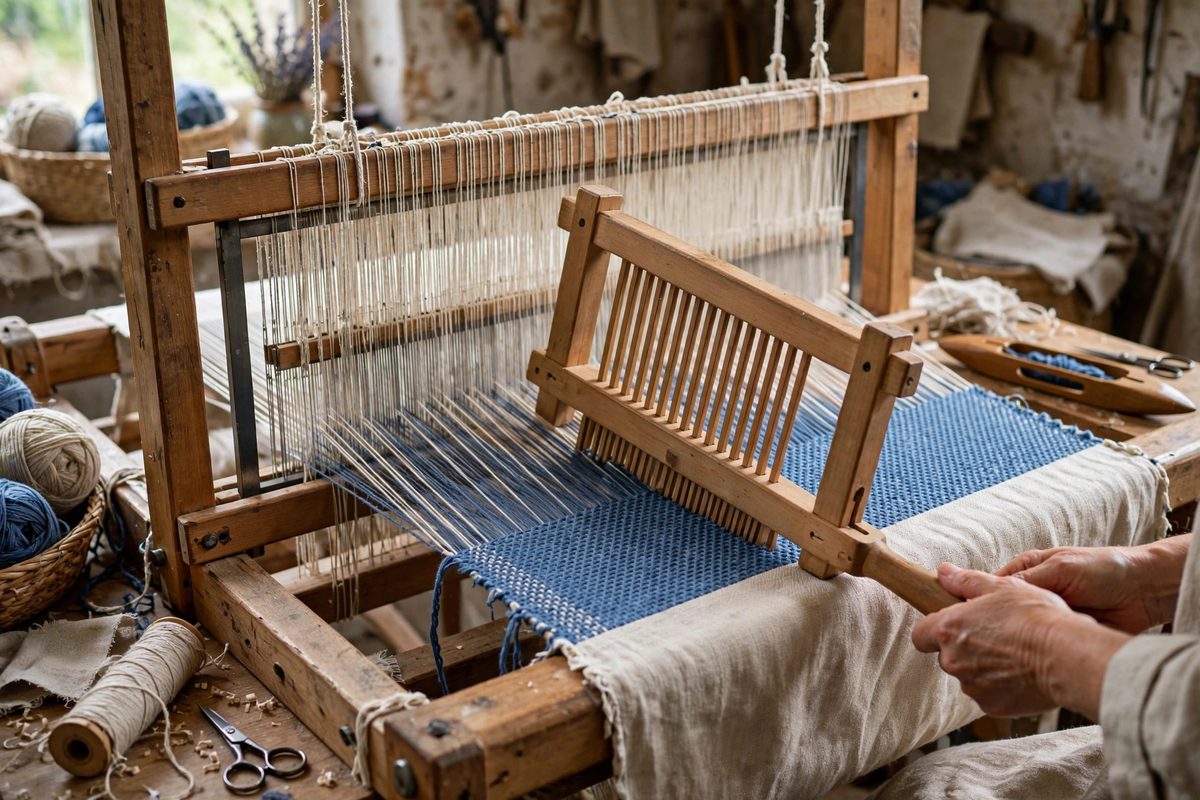
The weaver's batten, the swinging beater that packs each weft pick into place, is the metronome of the cloth: every tap sets the weft's spacing, and inconsistent taps weave inconsistent fabric. Uniform sett, the even spacing of weft threads that gives cloth its regular hand and appearance, comes from tap dynamics that are repeatable pick after pick: the same force, the same angle, the same rhythm. Understanding what the batten actually does to the weft, and what variations do to the cloth, turns beating from a habit into a controlled process.
What the tap does to the weft
When the batten swings in, the reed's teeth push the just-thrown weft pick against the fell, the leading edge of the woven cloth. The tap compresses the weft into its neighbors, and the friction between warp and weft then holds it in place. The force of the tap determines how tightly the pick packs: a firm tap drives the weft hard against the fell for a dense, firm cloth, while a light tap leaves the picks loosely spaced for an open, drapy fabric. The critical insight is that the cloth's sett is not set by the reed's denting alone but by the weaver's beating: the same warp and weft produce different fabrics under different taps. Consistency of the tap is therefore consistency of the cloth.
The dynamics of a good tap
A good tap is a single, decisive motion, not a series of hesitant pushes. The batten should swing in with enough momentum to seat the pick firmly in one contact; multiple small taps on the same pick pack unevenly, since each partial tap moves the weft a different amount. The batten must strike squarely, contacting the fell evenly across the full weaving width; a batten that hits harder on one side weaves a cloth that is denser on that side, a fault visible as diagonal distortion. The weaver's body mechanics matter: sit centered, pull or push the batten with a symmetric motion, and let the batten's weight do the work rather than muscling it. Rhythm helps enormously; many weavers develop a steady cadence, throw, tap, throw, tap, that keeps every pick's treatment identical.
Calibrating tap force to the cloth
Different cloths want different taps, and the weaver calibrates by sampling. Weave a sample with the intended sett, varying the tap force deliberately across sections, then examine and measure: picks per inch counted under magnification, cloth hand assessed by feel, drape observed. The sample reveals the tap that produces the target fabric, and the weaver's job is then to reproduce that tap for the project's duration. Mark the sample with notes on the tap used; memory of force is unreliable across days. For patterned weaves where the weft must pack to a specific ratio against the warp, the tap calibration is part of the pattern's execution, as critical as the treadling sequence. The sample is the contract between the weaver's intention and the batten's action.
Common tap faults
Several faults trace directly to tap dynamics. Uneven beat, varying force pick to pick, produces bands of denser and looser cloth, visible as horizontal striping; the cure is rhythm and attention, sometimes aided by counting or by weaving to music. Edge packing, where the weft packs tighter at the selvedges than in the middle, comes from the batten flexing or from the weaver pulling harder at the edges; check the batten's squareness and consciously even the stroke. Draw-in, the narrowing of the cloth at the fell, relates to weft tension interacting with the tap; the tap seats what the shuttle delivered, so weft tension and tap must be balanced together. A reed that is too coarse or too fine for the sett fights the tap: the weaver beats harder to compensate, introducing the very inconsistency the tap should prevent. Match the reed to the sett and let the tap be moderate.
The fell line as feedback
The fell, the cloth's leading edge, reports the tap's consistency continuously. A straight, even fell line across the width indicates uniform beating; a wavy or diagonal fell signals uneven taps, often before the cloth itself shows the fault clearly. Watch the fell as you weave, correcting the tap in real time rather than discovering the problem rows later. The fell also reveals the interaction with weft tension: if the fell advances unevenly despite even taps, the weft delivery is the culprit. Experienced weavers read the fell the way drivers read the road, a constant low-level monitoring that prevents most faults before they form. Teach beginners to watch it from the first project; the habit pays lifelong dividends.
Maintaining consistency over long warps
Long projects test tap consistency through fatigue and changing conditions. Take breaks before tiredness degrades the rhythm; the picks woven tired are the ones that show. Note that the tap feel changes as the warp advances and the cloth beam fills; the geometry shifts subtly, and the weaver must recalibrate the familiar motion to the new feel. Keep the sample and the notes accessible for reference when returning after interruptions. And accept that perfect uniformity across a very long warp is an aspiration; the goal is cloth whose variations are below the threshold of perception, achieved through disciplined, rhythmic, attentive beating.
Uniform weft sett comes from uniform taps: one decisive beat per pick, square across the width, calibrated to the cloth by sampling, monitored through the fell line, and maintained rhythmically over the project's length. The batten is the weaver's signature on the cloth; make it a steady one.
Related Guides
- Raddle Spacing Calculations for Even Beam Spooling: Winding the warp onto the loom's back beam is the foundation of every weaving project, and the raddle is what keeps the warp threads evenly spaced
- Warp Tension Parity on Rigid Heddle Loom Apron Bars: A rigid heddle loom is beautifully simple: warp threads run from the back apron bar, through the heddle, to the front apron bar, and the whole system
- Beater Bar Angle Consistency on Floor Looms: The beater bar, the swinging frame that carries the reed, is the weaver's metronome: every pick of weft gets pressed into place by its beat. But the
- Warp Beam Flange Friction on Large Four-Shaft Looms: On a large four-shaft loom, the warp beam holds hundreds or thousands of warp threads under tension, and the flanges, the discs at each end of the