
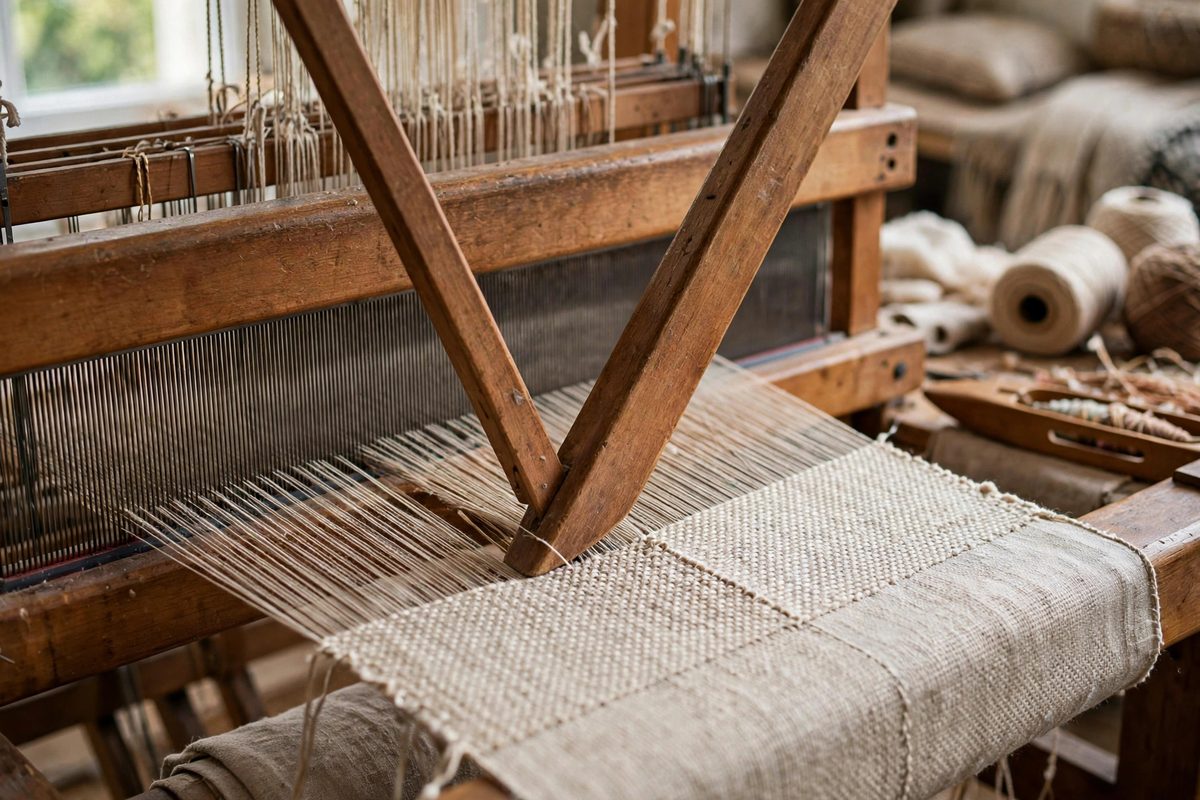
The beater bar, the swinging frame that carries the reed, is the weaver's metronome: every pick of weft gets pressed into place by its beat. But the angle at which the reed meets the fell, the edge of the woven cloth, changes the fabric more than most weavers realize. An inconsistent beat angle produces uneven picks, wavy selvedges, and cloth whose density drifts from one section to the next. Consistency in the beater's angle is a foundational skill.
What the beat angle does
When the reed is perfectly vertical at the moment of beating, it presses the weft straight back into the fell with even force across the warp's width. If the beater is still swinging forward or has started to fall back, the reed meets the fell at an angle, pressing harder at the top or bottom of the warp and packing the weft unevenly. Over a long warp, a weaver who beats with a changing angle produces cloth that is measurably denser in some sections than others. The fabric may look fine on the loom and only reveal its inconsistency after washing, when the uneven areas shrink differently.
Finding your consistent beat
Every loom has a natural beat point where the beater hangs at rest against the fell. Learn to bring the beater to that same point on every pick: pull it toward you with the same motion, let it contact the fell, and release without shoving. The beat should feel like a firm tap, not a slam; force compensates for nothing and only distorts the warp. Many weavers develop a rhythm, throw the shuttle, beat, change the shed, and the rhythm itself enforces consistency. If your picks per inch are drifting, the beat is the first variable to examine, before blaming the yarn or the tension.
Body mechanics and the loom setup
Consistency is physical. Sit at a height where your arms reach the beater comfortably without stretching or scrunching; fatigue changes your beat angle within an hour. The bench should let your feet work the treadles without shifting your torso, because torso movement changes the beater's arc. If the loom rocks or walks during beating, stabilize it; a moving loom makes a consistent beat impossible. Some weavers mark the beater's rest position with tape on the castle as a visual reference until the motion becomes automatic.
Beating different weaves
Not every weave wants the same beat pressure, but every weave wants a consistent angle. Plain weave generally needs a firm, even beat to pack the weft square. Twills can take a slightly lighter beat since the diagonal structure packs itself. Weft-faced weaves need a hard beat to bury the warp completely. Whatever the weave demands, deliver it at the same angle every pick; varying the pressure is a design choice, varying the angle is an error. When changing weaves on the same warp, recalibrate your beat deliberately for the first few inches.
Diagnosing beat problems in finished cloth
Unroll finished cloth and look at it in raking light: bands of slightly different density, picks that wave instead of running straight, and selvedges that draw in unevenly all point to beat inconsistency. Measure picks per inch in several places; variation of more than about ten percent across a piece signals a beat problem. The fix is always in the weaving, not the finishing: no amount of washing corrects cloth beaten at a wandering angle.
The beater is the weaver's signature on every inch of cloth. Make the motion the same every time, and the fabric will be too.
Related Guides
- Warp Beam Flange Friction on Large Four-Shaft Looms: On a large four-shaft loom, the warp beam holds hundreds or thousands of warp threads under tension, and the flanges, the discs at each end of the
- Warp Tension Parity on Rigid Heddle Loom Apron Bars: A rigid heddle loom is beautifully simple: warp threads run from the back apron bar, through the heddle, to the front apron bar, and the whole system
- Raddle Spacing Calculations for Even Beam Spooling: Winding the warp onto the loom's back beam is the foundation of every weaving project, and the raddle is what keeps the warp threads evenly spaced
- Batten Tap Dynamics for Uniform Weft Sett Spacing: The weaver's batten, the swinging beater that packs each weft pick into place, is the metronome of the cloth: every tap sets the weft's spacing, and