
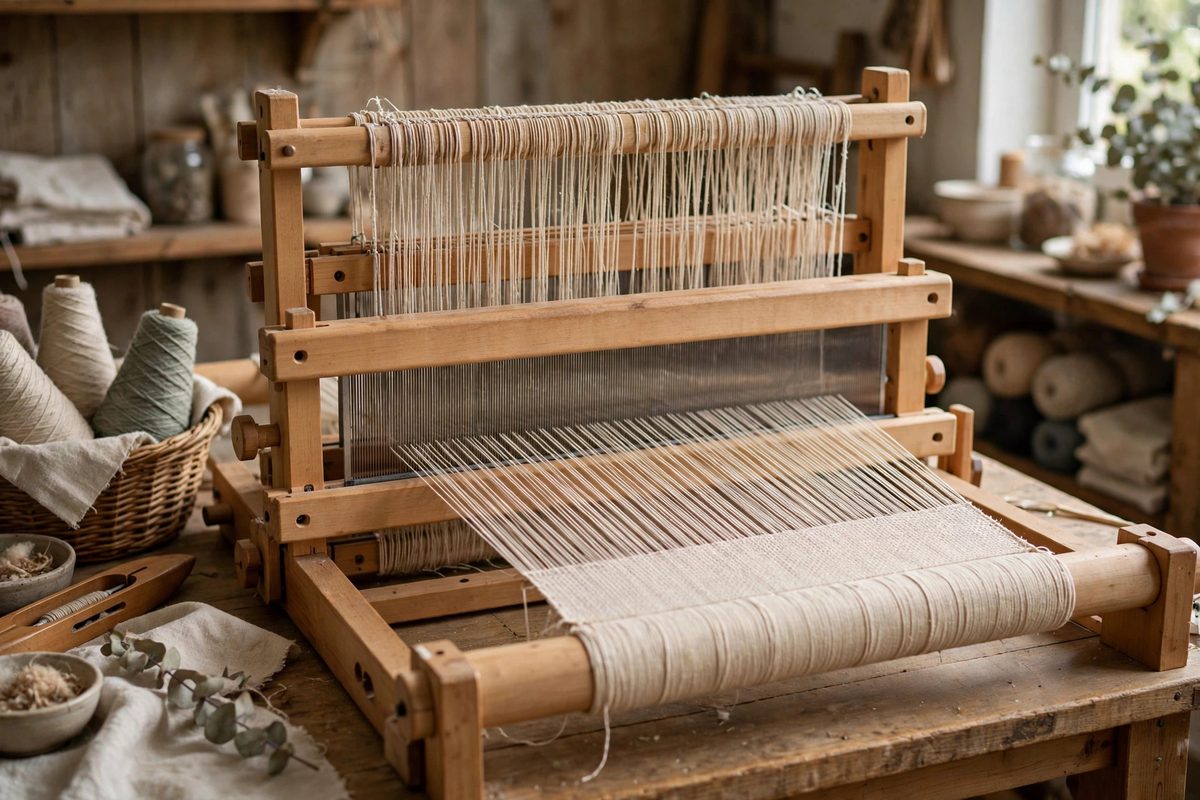
A rigid heddle loom is beautifully simple: warp threads run from the back apron bar, through the heddle, to the front apron bar, and the whole system lives or dies on even tension. When every warp thread carries the same load, the shed opens cleanly, the weft packs evenly, and the selvedges behave. When tension varies across the width, you get broken warp threads, scalloped edges, and a shed that fights you on every pick. Parity, meaning equal tension on every thread from edge to edge, is the foundation skill of warping a rigid heddle loom.
Why uneven tension causes the symptoms it does
Think of the warp as a set of parallel springs. In a clean shed, the heddle lifts half the threads and the other half stay down, and the weft slides through the gap. If some threads are tighter than their neighbors, the tight ones resist lifting and the loose ones sag, so the shed opens unevenly and the shuttle or stick catches. Tight threads also bear more than their share of the abrasion from the heddle and the beater, so they snap first, and each broken thread dumps its load onto its neighbors. At the selvedge, uneven tension shows as scalloping: the weft pulls the edge threads inward where they are loose and cannot where they are tight. Almost every mysterious rigid heddle problem that is not a threading error traces back to tension parity.
Winding with even tension from the start
Parity is created during warping, not fixed afterward. Whether you wind directly onto the back beam or use a warping board and then beam the warp, the cardinal rule is consistent, moderate tension on every thread as it goes on. When beaming, crank slowly and steadily, keeping a hand on the warp to feel for threads going slack. Wind a layer of paper, cardboard, or warp sticks between each revolution of warp on the beam: this separator keeps the threads from biting into the layer below and equalizes the winding diameter across the width, which is a major hidden source of uneven tension. Without separators, threads pack tighter in the middle or at the edges depending on your cranking, and no amount of later adjustment fully corrects it. Tie the warp to the apron bar with a lark's head or secure knot at even intervals so the attachment itself does not introduce slack spots.
Balancing front and back beams
Once the warp is threaded through the heddle and tied to the front apron bar, the front and back beams need to agree. Advance the warp until the tension feels firm and even, then check: press down gently on the warp at several points across the width. Every thread should deflect about the same amount. If the edges are tight and the middle sags, or vice versa, the warp was beamed unevenly or tied unevenly to an apron bar. Small imbalances can be coaxed out by adjusting individual tie-on knots at the front bar, lengthening tight sections or taking up slack ones. Larger imbalances mean re-beaming, and it is worth doing: an hour of re-warping beats a whole project of fighting the loom. Engage the ratchets or brakes on both beams firmly once tension is set, and check that neither beam creeps during weaving.
Maintaining parity while you weave
Tension changes as you weave. The warp stretches slightly, the take-up advances, and the fell of the cloth moves. Advance the warp regularly in small increments rather than weaving until the shed gets tight and then jumping forward; frequent small advances keep tension constant, while infrequent big ones create a cycle of too-tight and too-loose. If a single thread goes slack mid-project, it has usually slipped at a tie-on or stretched more than its neighbors. You can often fix it by weighting it: tie a small weight, even a film canister of coins, to the slack thread behind the heddle to restore its share of the load. If several threads slacken together in one area, check that section of the beam for uneven winding or a slipped separator.
Diagnosing tension by reading the cloth
The woven cloth is a tension diary. Consistent weft angle and straight selvedges mean parity is good. A weft that angles consistently to one side suggests one edge is tighter. Puckering in the middle of the width suggests the center threads are tighter than the edges. Threads that break repeatedly in the same area point to a local high-tension zone, often where the warp bit into the beam. Learn to read these signs and correct early, because tension problems compound: a broken thread changes the load on its neighbors, which changes the shed, which changes your beating, which changes the cloth. Parity is not a one-time setup; it is a condition you monitor for the life of the warp.
Warping feels slow until you have fought a badly tensioned warp, and then it feels like the most important hour of the project. Even tension across the apron bars is what makes a rigid heddle loom feel effortless instead of adversarial.
Related Guides
- Warp Beam Flange Friction on Large Four-Shaft Looms: On a large four-shaft loom, the warp beam holds hundreds or thousands of warp threads under tension, and the flanges, the discs at each end of the
- Beater Bar Angle Consistency on Floor Looms: The beater bar, the swinging frame that carries the reed, is the weaver's metronome: every pick of weft gets pressed into place by its beat. But the
- Raddle Spacing Calculations for Even Beam Spooling: Winding the warp onto the loom's back beam is the foundation of every weaving project, and the raddle is what keeps the warp threads evenly spaced
- Batten Tap Dynamics for Uniform Weft Sett Spacing: The weaver's batten, the swinging beater that packs each weft pick into place, is the metronome of the cloth: every tap sets the weft's spacing, and