
A bee smoker is a simple machine with one job: deliver a steady stream of cool smoke on demand. The bellows provides the air, the firebox provides the smoke, and between them sits a small, easily overlooked component that determines whether the smoker puffs obediently or wheezes: the leather flapper valve. This one-way valve controls airflow into the bellows, and its design directly sets the velocity of the air jet that drives the smoke out. Understanding it turns smoker building and repair from guesswork into engineering.
What the flapper valve does
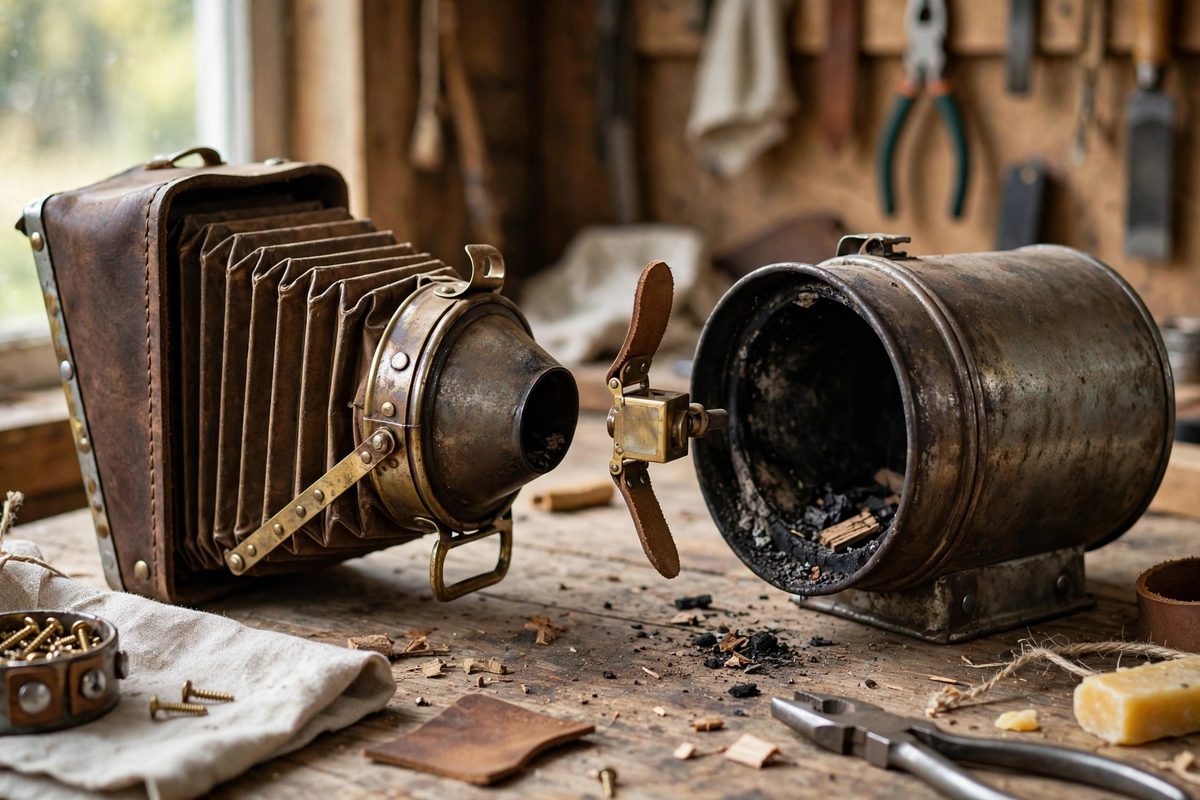
The bellows is a chamber with boards that open and close. When you open the bellows, air must enter the chamber; when you squeeze, that air must go into the firebox, not back out the way it came. The flapper valve, a piece of leather covering an intake hole on the bellows board, is the one-way gate. On the intake stroke, the slight vacuum inside the chamber lifts the leather and air flows in. On the squeeze stroke, pressure presses the leather flat against the hole, sealing it, so all the air is forced through the nozzle into the firebox. Without a working flapper, the bellows just shuttles air in and out of the same hole and the smoker barely puffs. A stiff, curled, or gapped flapper leaks on the squeeze stroke, and every bit of leaked air is air that never reaches the fire.
Airflow, nozzle, and jet velocity
The air jet's velocity at the nozzle follows a simple relationship: the volume the bellows displaces per squeeze, divided by the time of the squeeze, divided by the nozzle's cross-sectional area. A smaller nozzle makes a faster jet from the same bellows stroke; a larger nozzle makes a slower, fatter puff. Jet velocity matters because the air stream does two jobs in the firebox: it feeds oxygen to the smoldering fuel and it entrains smoke, carrying it out the spout. Too slow a jet and the smoke dribbles out weakly; too fast and the jet can blow the fuel into flame or scatter hot embers, which is the opposite of the cool, calm smoke you want. The traditional smoker nozzle size represents generations of practical optimization: a jet strong enough to push smoke several feet but gentle enough not to stoke the fire into flame. When building or modifying a smoker, keep the nozzle in the traditional proportions rather than improvising, and tune the puff by how you work the bellows instead.
Leather selection and valve geometry
The flapper needs to be flexible enough to lift easily on the intake stroke and flat enough to seal on the squeeze. A soft, pliable leather of moderate thickness, roughly the weight of a sturdy garment leather, works well; leather that is too thick or stiff resists lifting and starves the intake, while leather that is too thin or floppy may not seal crisply. Cut the flapper generously larger than the intake hole so it covers the opening with margin all around, and attach it along one edge only, with a tack or staple at the top edge, so it hinges freely. The intake hole itself should be sized to admit plenty of air without choking: a hole roughly an inch across is typical for standard bellows. Check the seal by holding the bellows up to your ear and squeezing slowly; you should hear air hissing from the nozzle, not whispering past the flapper.
Tuning for a sustained, cool puff
A well-tuned smoker delivers smoke in controllable puffs with a rhythm the beekeeper sets. If the smoker dies between puffs, the usual cause is fuel or airflow, not the valve: pack the fuel loosely enough for air to move through it, and give a few strong priming puffs to establish the smolder. If puffs feel weak despite good fuel, inspect the flapper for curling, hardening, or gaps, and check the bellows boards and seams for air leaks, which steal stroke volume just as surely as a bad valve. The leather benefits from occasional conditioning to stay supple; a dried-out flapper is a common cause of a smoker that slowly goes feeble over a season. Keep a spare flapper cut and ready, because it is a wear part.
Safety around the smoker
The smoker contains live fire, and the air jet that makes it work can also make it dangerous. Never leave a lit smoker unattended, never set it down in dry grass, and carry it with the spout pointed away from yourself and others. A too-vigorous pumping can blow sparks and hot embers out of the spout, so work the bellows with steady, moderate strokes. Let the smoker cool completely before storing it, and store fuel separately. The flapper valve and jet velocity are about control; the safety practices are about respecting what is being controlled.
A smoker is only as good as its air system, and the air system is only as good as a small piece of leather over a hole. Get the flapper right, respect the nozzle proportions, and the smoker becomes an extension of your hand: smoke when you want it, as much as you want, no drama.
Related Guides
- Combustion Can Ventilation Spacing in Bee Smokers: A bee smoker is a controlled smolder: fuel burns slowly in the combustion can, the bellows puffs air through it, and cool smoke comes out the spout
- Perforated Inner Shield Gaps for Heavy-Draft Smokers: A bee smoker is a simple machine: a firebox, a bellows, and a spout. But a smoker that burns too hot, produces harsh smoke, or dies mid-inspection is
- Direct Draft Grate Hole Patterns for Stainless Smokers: A bee smoker is a small furnace, and like any furnace it lives or dies on air management. The grate at the bottom of the fire chamber decides how
- Direct Draft Grate Hole Patterns for Bee Smokers: A bee smoker lives or dies on its draft: the bellows must push air through the fuel chamber in a way that keeps the fuel smoldering evenly, without