
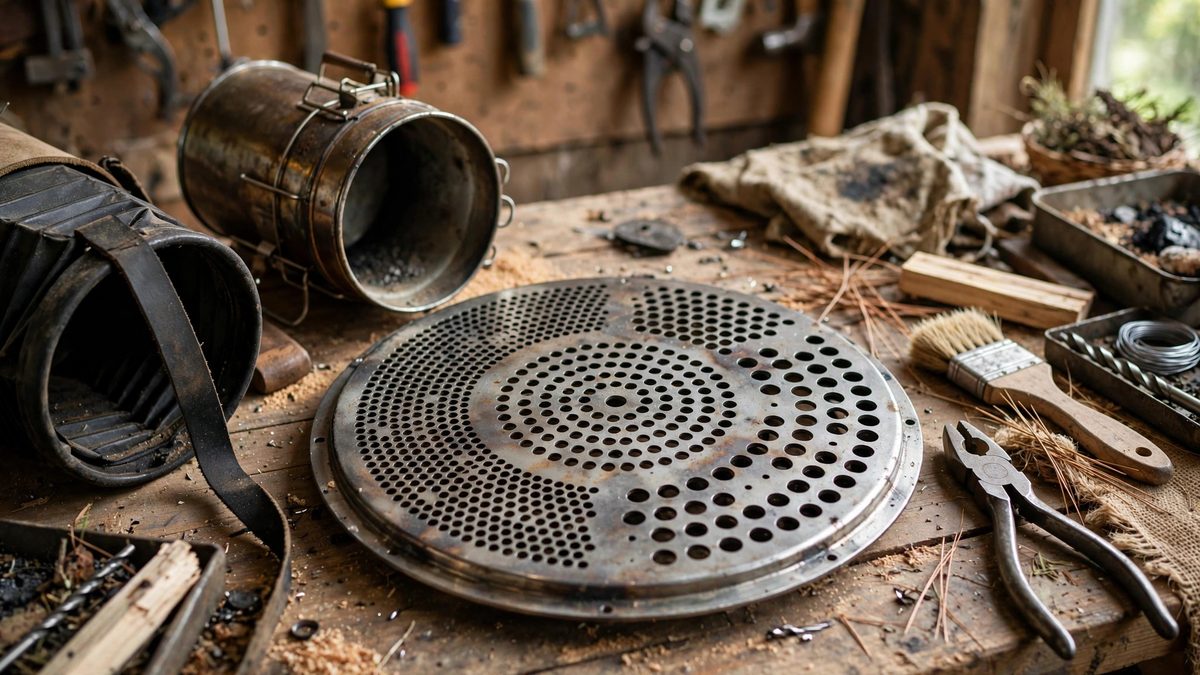
A bee smoker lives or dies on its draft: the bellows must push air through the fuel chamber in a way that keeps the fuel smoldering evenly, without blowing flames out the spout or starving the fire of oxygen. The grate at the bottom of the fuel chamber is where that draft gets shaped. Hole size, hole count, and hole pattern determine whether your smoker puffs cool, steady smoke for an hour or sputters out every ten minutes.
What the Grate Actually Does
The grate holds the burning fuel above the air inlet while letting bellows air pass through the fuel bed. Air entering from below percolates up through the fuel, feeding combustion evenly, and the smoke exits through the spout. Without a grate, fuel packs against the inlet and smothers the draft; with a badly designed grate, air channels through a few large holes and leaves the rest of the fuel cold. The goal is even distribution: many small passages spread across the full diameter of the chamber.
Hole Size and Count
Holes around 3/16 to 1/4 inch strike the working balance. Smaller holes clog with ash and creosote faster; larger holes let embers and fuel chunks fall through into the bellows airway. Aim for an open area of roughly 30 to 40 percent of the grate disc: enough passage for strong bellows strokes, enough metal left to support the fuel and survive the heat. Space the holes in a staggered triangular pattern rather than a square grid, because the staggered layout leaves no large unperforated zones where air cannot reach the fuel above.
Grate Material and Thickness
Smoker grates live in a hot, corrosive environment of wood smoke, ash, and creosote. Stainless steel plate around 1/16 inch thick is the durable choice; plain steel works but rusts through within a season or two of heavy use. Galvanized metal is a poor choice because the zinc coating gives off fumes when heated, and a smoker is already enough of a fire risk without adding toxic smoke. Cut the grate as a disc that fits the chamber snugly, and drill the holes before any forming so the layout stays even.
Supporting the Grate
The grate needs to sit a half inch or so above the chamber floor, creating a plenum where bellows air spreads before passing through the holes. Support it on three or four small standoffs riveted or welded to the chamber wall, or rest it on an internal lip rolled into the chamber. The plenum must be sealed from the fuel above except through the grate holes; if air can leak around the grate edge, it bypasses the fuel bed and the draft weakens. A snug disc fit plus the standoff height is usually enough, since ash quickly seals minor gaps anyway.
Tuning Draft With a Variable Restrictor
Some builders add a rotating damper plate under the grate with matching holes, letting the beekeeper throttle the draft. This is genuinely useful: wide open for lighting and reviving a dying fire, partially closed for a long, cool, lazy smoke during a calm inspection. If you build one, make the damper operable from outside the chamber with a simple lever, and design it so fully closed still leaves some minimum airflow; a fully sealed smoker goes out, and relighting a packed smoker mid-inspection is nobody's idea of fun.
Cleaning and Longevity
Creosote and ash will eventually narrow the holes, so design the grate to be removable for cleaning. A disc that lifts out with a hooked tool, or a chamber with a hinged bottom, makes maintenance a two-minute job instead of a teardown. Scrape the holes clear with a wire, check for thin spots or burn-through in the metal, and replace the grate when it starts to sag; a sagging grate lets fuel settle into the plenum and chokes the whole system. Empty the ash after every use, because wet ash is corrosive and cold ash is the seed of the next clog.
A well-built smoker grate is invisible in use: you pump, smoke comes out, the fire stays alive, and you never think about it. That invisibility comes from many small holes in a staggered pattern, stainless steel, a real air plenum below, and a grate you can pull out and clean. Build it that way once and the smoker just works.
Related Guides
- Direct Draft Grate Hole Patterns for Stainless Smokers: A bee smoker is a small furnace, and like any furnace it lives or dies on air management. The grate at the bottom of the fire chamber decides how
- Combustion Can Ventilation Spacing in Bee Smokers: A bee smoker is a controlled smolder: fuel burns slowly in the combustion can, the bellows puffs air through it, and cool smoke comes out the spout
- Perforated Inner Shield Gaps for Heavy-Draft Smokers: A bee smoker is a simple machine: a firebox, a bellows, and a spout. But a smoker that burns too hot, produces harsh smoke, or dies mid-inspection is
- Bellows Leather Flapper Valve Airflow Jet Velocity: A bee smoker is a simple machine with one job: deliver a steady stream of cool smoke on demand. The bellows provides the air, the firebox provides