
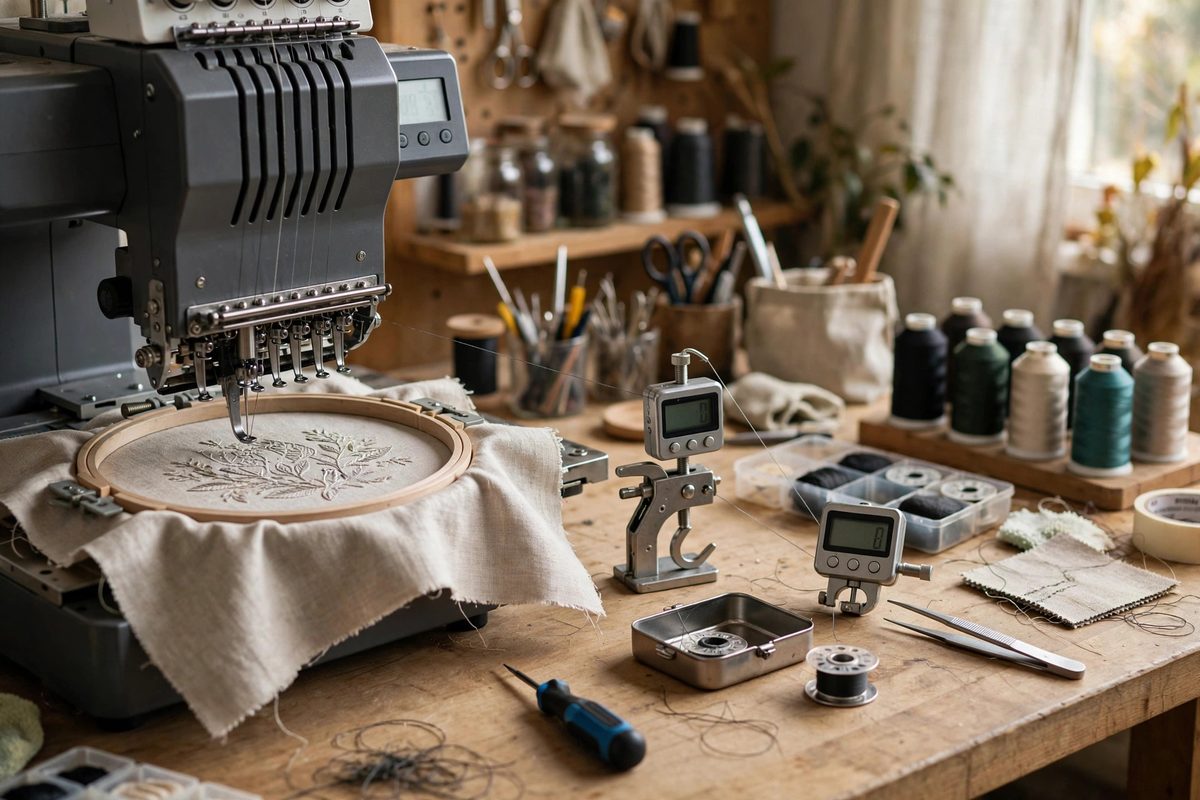
Machine embroidery quality lives or dies on thread tension balance, and the bobbin side is the foundation everything else references. If bobbin tension is wrong, no amount of top-tension adjusting produces a clean stitch; the operator chases the problem in circles, tightening the top to compensate for a loose bobbin until both are wrong. A tension gauge meter, a small device that measures the actual pull force of the bobbin thread, replaces guesswork with a number. Calibrating bobbin tension to a measured value, then balancing the top tension against it, is the systematic path to the perfect stitch: top thread pulled just to the underside, bobbin thread hidden, no loops, no puckering.
Why bobbin tension is the reference
The stitch forms by the top thread and bobbin thread interlocking in the middle of the fabric layers. The top tension is easily adjustable on the machine; the bobbin tension is set by a small screw on the bobbin case and changes only when deliberately adjusted or when lint and wear shift it. This asymmetry makes the bobbin the natural reference: set it to a known, stable value, and adjust the variable top tension to match. The alternative, adjusting both by feel, has two moving targets and no fixed point, which is why operators get lost. Establish the bobbin baseline first, verify it periodically, and let the top tension do the adapting. Every tension troubleshooting session should begin by confirming the bobbin baseline before touching anything else.
Using the gauge meter
A bobbin tension gauge measures the force required to pull thread from the bobbin case, typically read in grams. To measure, thread the bobbin case normally, attach the gauge to the thread tail, and pull steadily in the direction the thread feeds during sewing; the gauge reads the resistance. Take several readings and average them, since the pull speed and angle introduce variation. The target value depends on the machine and the thread: manufacturers and experienced operators publish typical ranges for common setups, and the right approach is to find the value that produces balanced stitches on your machine and then record it as your personal baseline. The absolute number matters less than its repeatability; the gauge's job is to return you to the same tension every time.
Setting and adjusting the bobbin case
Adjust bobbin tension with the small screw on the bobbin case, turning in tiny increments; a fraction of a turn makes a measurable difference, which is why the gauge is essential. Righty-tighty increases tension, but verify on your specific case since some are reversed. After each adjustment, re-seat the bobbin, re-thread the tail through the tension spring properly, and re-measure; the thread must sit correctly under the tension spring or the reading is meaningless. Clean the bobbin case and the area under the tension spring before calibrating, because a wad of lint under the spring is the most common cause of mysterious tension drift, and calibrating around lint just institutionalizes the error. Keep a dedicated, clean bobbin case for the calibrated baseline if the machine allows it.
Balancing the top tension against the baseline
With the bobbin calibrated, sew a test: a straight stitch on scrap of the actual project fabric with stabilizer, using the actual threads. Examine the underside: in a balanced stitch, the top thread is just visible as tiny dots along the bobbin thread's path, meaning the interlock sits at the fabric's underside. If loops of top thread show underneath, the top tension is too loose; if the bobbin thread pulls up to the top surface, the top is too tight. Adjust only the top tension dial to correct, in small steps, re-testing after each change. Resist the urge to touch the bobbin screw during this process; the whole point of the baseline is that it does not move. When the test stitch is balanced, record the top dial setting alongside the bobbin gauge reading for that thread and fabric combination.
When to recalibrate
Bobbin tension drifts. Lint accumulates under the tension spring, the spring itself fatigues over time, and different thread weights need different baselines. Recalibrate whenever stitch quality degrades without another explanation, when changing to a significantly different bobbin thread weight, after cleaning the bobbin area, and on a preventive schedule for machines in heavy use. Keep a log: date, gauge reading, thread type, and any adjustments made. The log turns tension from a mystery into a maintenance item, and it reveals patterns, such as a particular thread that always needs a different baseline, that save troubleshooting time. Operators who log tension spend their time embroidering; operators who do not spend it fiddling.
Troubleshooting with the baseline known
A known bobbin baseline transforms troubleshooting. Birdnesting under the fabric with a correct bobbin reading points at top threading, not tension: rethread the top path completely, checking that the thread seats in the tension discs and the take-up lever. Intermittent tension problems that come and go often trace to the top thread catching somewhere or to a damaged needle, not to the bobbin at all. Consistent imbalance in one direction, correctable only by extreme top dial settings, suggests the bobbin baseline itself needs rechecking; verify with the gauge rather than assuming. The discipline is always the same: confirm the knowns before chasing the unknowns, and the bobbin gauge makes the bobbin a known.
Calibrate bobbin tension with a gauge meter to a recorded baseline, keep the bobbin case clean, balance the top tension against that baseline on test scraps, and recalibrate on schedule. Tension stops being a dark art the moment it becomes a measured number.
Related Guides
- Bobbin Tension Calibration With Electronic Gauges: Machine embroidery quality hinges on the balance between top thread tension and bobbin tension, and the bobbin side is the one most operators
- Needle Penetration Angles on High Thread Density Caps: Embroidering caps on a machine is already the hard mode of the craft: the curved surface, the thick center seam, and the stiff structured crown all
- Stabilizer Density Pairing for Dense Knit Stitches: Machine embroidery on knit fabric is a structural negotiation: dense stitch fields pull and distort stretchy fabric, and the stabilizer is what holds
- Compensating Pull Compensation for High-Speed Satin Columns: Machine embroidery pulls. Every stitch draws the fabric slightly toward the stitching line, and satin columns, with their dense zigzag stitches, pull