
A plant hanger holding a small trailing pothos can get away with decorative knotting. A sling holding a heavy ceramic pot, soil, water, and a mature plant, potentially tens of pounds, is a load-bearing structure, and it must be designed as one. The braided sinnet, a flat braid worked from multiple cords, is the workhorse for these slings because it distributes load across many fibers in a configuration that resists both tension and the twisting that unravels lesser braids. Understanding how the sinnet shares load is what lets you build hangers that hold heavy pots safely for years.
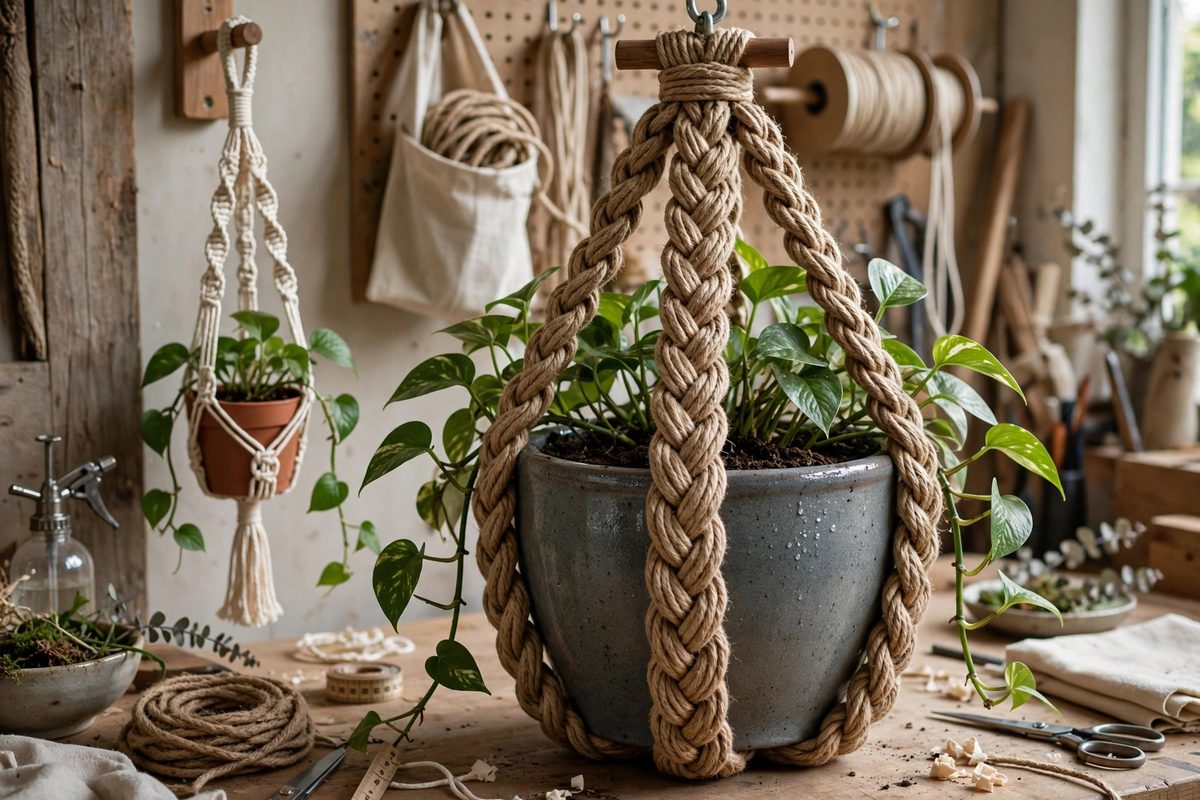
The loads a heavy sling carries
Start by honestly estimating the weight: a large ceramic pot alone can weigh many pounds, saturated soil adds substantially more, and water after a thorough watering adds more still. The total hanging weight of a large planted pot routinely surprises makers who estimated by lifting the dry, empty pot. That weight hangs from the sling's cords, dividing among them, but not evenly: the geometry of the sling means some cords carry more than others, particularly where the sling transitions from the hanging loop to the basket that cradles the pot. Dynamic loads add to the static weight: the sway when the plant is watered, the bump when it is hung, the gradual shifting as the plant grows asymmetrically. Design for the wet weight plus a generous safety margin, because the failure mode is a shattered pot and a ruined floor.
How the braided sinnet distributes load
A braided sinnet interlaces multiple cords so that each cord alternately passes over and under the others along the braid's length. Under tension, the interlacing does two things: it shares the load across all the cords, since each cord's tension transfers to its neighbors at every crossing, and it grips, because the crossings tighten under load like a Chinese finger trap. This self-tightening is the sinnet's great virtue in a sling: the harder the pot pulls, the more firmly the braid locks. Contrast this with parallel cords, which share load only as evenly as their lengths match; the slightly shorter cord hogs the load and fails first, cascading to the others. The sinnet's interlacing enforces load sharing mechanically rather than relying on perfectly matched cord lengths, which is why it is the right structure for real weights.
Sizing cord and strand count
Size the sinnet to the load with real margin. More strands share the load more widely and provide redundancy: a six-strand sinnet that loses one strand to abrasion still has five carrying the weight, while a three-strand braid is in trouble. Choose cord with a rated breaking strength, not just a craft-store thickness; natural fibers vary, and the rating is the only honest number. Apply a safety factor of several times the estimated wet weight, because knots reduce cord strength significantly, often by half, and because UV, moisture cycling, and abrasion degrade cord over time. The sinnet should look almost overbuilt for the pot; a sling that looks barely adequate is barely adequate, and time only weakens it.
Knots, transitions, and weak points
The sinnet itself is strong; the failures happen at the transitions. Where the hanging loop meets the sinnet, where the sinnet splits into the basket cords, and where the basket gathers under the pot, the load path changes direction and concentrates. Reinforce these points: wrap the transitions with additional binding, use metal rings at the major junctions to distribute the turn evenly, and avoid sharp bends in the cord, which stress the fibers. Every knot in the system is a strength reduction, so minimize knot count in the load path and place necessary knots where they are backed up by the braid's grip. Inspect the sling's history honestly: a sling that has held a heavy pot for years has proven itself, but its cords have also aged, and retirement before failure is the right call.
Hanging hardware and anchors
The sling is only as strong as what it hangs from. Size the hook, ring, and ceiling anchor for the same wet weight plus safety factor, and anchor into structure, a joist or a rated anchor, never into drywall alone. A heavy pot on a drywall anchor is a collapse waiting for the right moment, usually the middle of the night. Use hardware rated for the load with the rating visible; improvised hooks and bent wire are not structural hardware. Check the anchor periodically, since buildings move and anchors loosen. The complete system, anchor to pot, should be designed as one load path with no weak link, because the chain metaphor is literal here.
Inspection and retirement
Inspect heavy slings on a schedule, not when something looks wrong. Check the cords for abrasion, UV brittleness, and mildew; flex the sinnet and look for broken fibers at the crossings. Check the transitions and hardware for wear and corrosion. Watering splashes the sling regularly, so moisture degradation is the expected aging mode; natural fibers in damp service have finite lives. When in doubt, rebuild: cord is cheap, pots and floors are not. A retired sling can be repurposed for a light plant, but a heavy pot deserves fresh cord on a known schedule.
Heavy pot slings are structures: estimate the wet weight honestly, braid sinnets that share load by interlacing, size cord with real safety factors, reinforce the transitions, anchor into structure, and inspect on schedule. The braided sinnet earns its place by gripping tighter as the load grows. Build it like the weight matters, because it does.
Related Guides
- Braided Sinnet Load Sharing in Heavy Hanging Planters: A macrame plant hanger holding a small succulent is decoration. The same hanger holding a large potted plant, soil, water, and a ceramic pot, is a
- Square Knot Load Distribution in Heavy Plant Slings: A macrame plant sling holding a heavy potted plant is a suspension structure, and the square knots forming its net are the load-bearing elements
- Load Bearing Berry Knots in Multi-Strand Plant Slings: A plant sling holds real weight: a potted plant, wet soil, and a ceramic pot can easily reach twenty pounds or more, hanging from knots. The berry
- Sinnet Twist Structural Balance in Multi-Tier Cords: A plant holder hangs a living weight, soil, water, and a growing plant, from knotted cord, sometimes for years. The sinnet, a braided chain of knots