
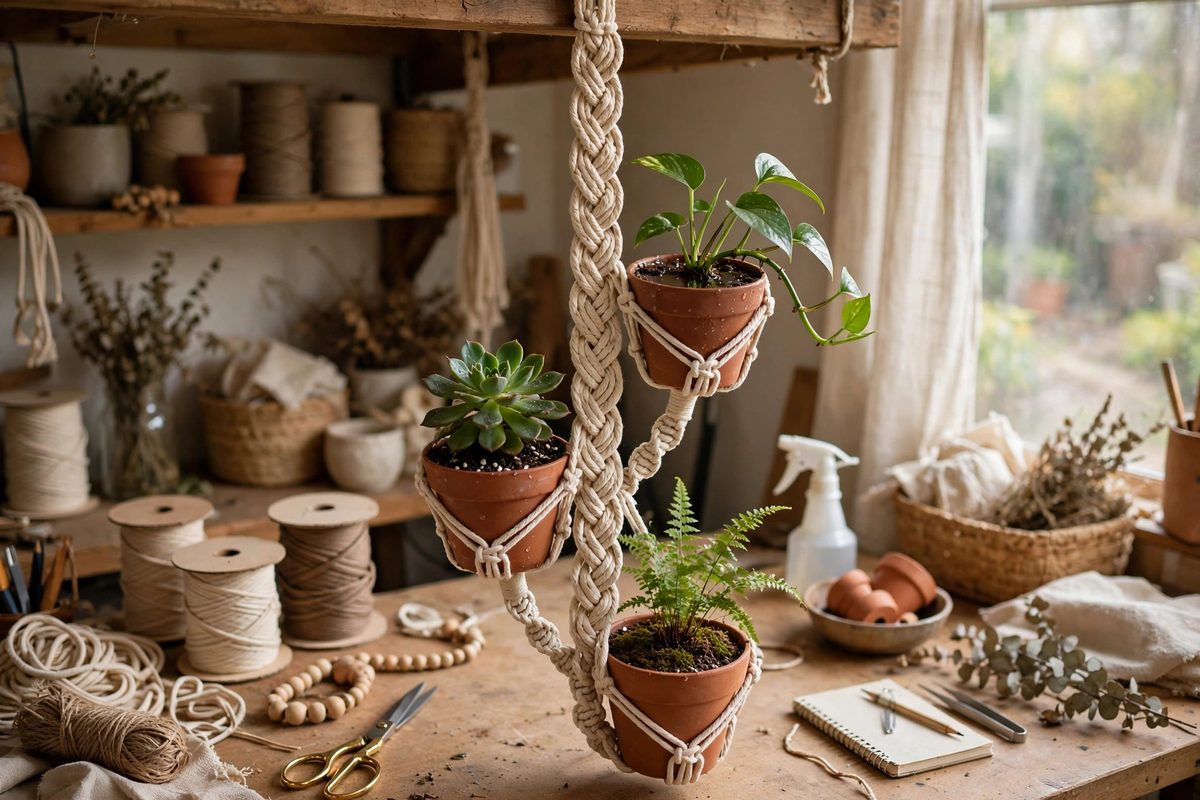
A plant holder hangs a living weight, soil, water, and a growing plant, from knotted cord, sometimes for years. The sinnet, a braided chain of knots, is the structural spine of most holders, and when a design calls for multiple tiers, two or three pots stacked vertically, the sinnet's twist balance becomes a structural question, not just a decorative one. An unbalanced sinnet slowly rotates under load, twisting the tiers, tangling the plant, and eventually stressing the knots. Here is how twist balance works and how to keep it.
What twist does to a hanging cord
Every knot you tie puts a small amount of twist into the cord. Tie a long series of identical knots in the same direction and the twist accumulates; the finished sinnet wants to rotate to release it. Unloaded, that rotation is just an aesthetic quirk. Loaded with a heavy pot, the rotation becomes a slow, persistent torque that works the tiers against each other. A single-tier holder tolerates this; a multi-tier holder multiplies the lever arm, and the bottom tier can end up visibly corkscrewed within months. Balance means arranging the knots so their twists cancel instead of adding up.
Balancing with mirrored knot sequences
The fix is symmetry in the knotting sequence. If you work a section of square knots that twist clockwise, follow it with a section that twists counterclockwise, or alternate the lead cord of each knot so the twist direction reverses every knot. The classic balanced sinnet is the alternating square knot chain: by swapping which cord leads each knot, the twist introduced by one knot is undone by the next, and the finished chain hangs straight under load. For spiral designs, where the twist is the point, balance the spiral section between two counter-spiraled sections of equal length so the net torque is zero.
Designing multi-tier load paths
In a multi-tier holder, each tier's weight hangs from the sinnet sections above it, so the topmost sections carry the full load. Size the cord for the total: a holder with three medium pots can easily carry ten pounds or more when freshly watered. Use cord rated well above that, and remember that knots reduce a cord's breaking strength substantially, often by a third or more, so the safety margin should be generous. Keep the tiers' attachment points symmetric around the central axis; an off-center pot creates a bending load that no amount of twist balancing will fix.
Testing balance before the plant goes in
Test with dead weight, not your prize fern. Load each tier with an equivalent weight, hang the holder, and watch it for a day. Mark the starting orientation of the bottom tier with a piece of tape; any rotation shows up clearly. If it twists, the fix is to add counter-twist sections or to rework the sinnet with alternating leads. Also watch for stretch: natural fiber cords elongate under sustained load, and a holder that stretches unevenly will tilt. Pre-stretch the finished holder under load for a few days before trusting it with a plant.
Cord materials and longevity
Cotton cord is the traditional choice and behaves predictably, but it weakens with prolonged moisture exposure, exactly the environment under a watered plant. Jute and hemp are stronger but stiffer and harder to balance finely. Synthetic cords hold strength when damp and resist rot, at the cost of a less traditional look. Whatever you choose, inspect hanging holders periodically: check the top attachment and the knots just below each tier, where stress concentrates. Retire any holder whose cord shows fraying at a knot; that is where failure starts.
A balanced sinnet hangs straight, carries its load quietly, and lets the plant be the star. Build the symmetry into the knots from the first tie, and the holder will behave for years.
Related Guides
- Braided Sinnet Load Distribution in Heavy Pot Slings: A plant hanger holding a small trailing pothos can get away with decorative knotting. A sling holding a heavy ceramic pot, soil, water, and a mature
- Braided Sinnet Load Sharing in Heavy Hanging Planters: A macrame plant hanger holding a small succulent is decoration. The same hanger holding a large potted plant, soil, water, and a ceramic pot, is a
- Load Bearing Berry Knots in Multi-Strand Plant Slings: A plant sling holds real weight: a potted plant, wet soil, and a ceramic pot can easily reach twenty pounds or more, hanging from knots. The berry
- Square Knot Load Distribution in Heavy Plant Slings: A macrame plant sling holding a heavy potted plant is a suspension structure, and the square knots forming its net are the load-bearing elements