
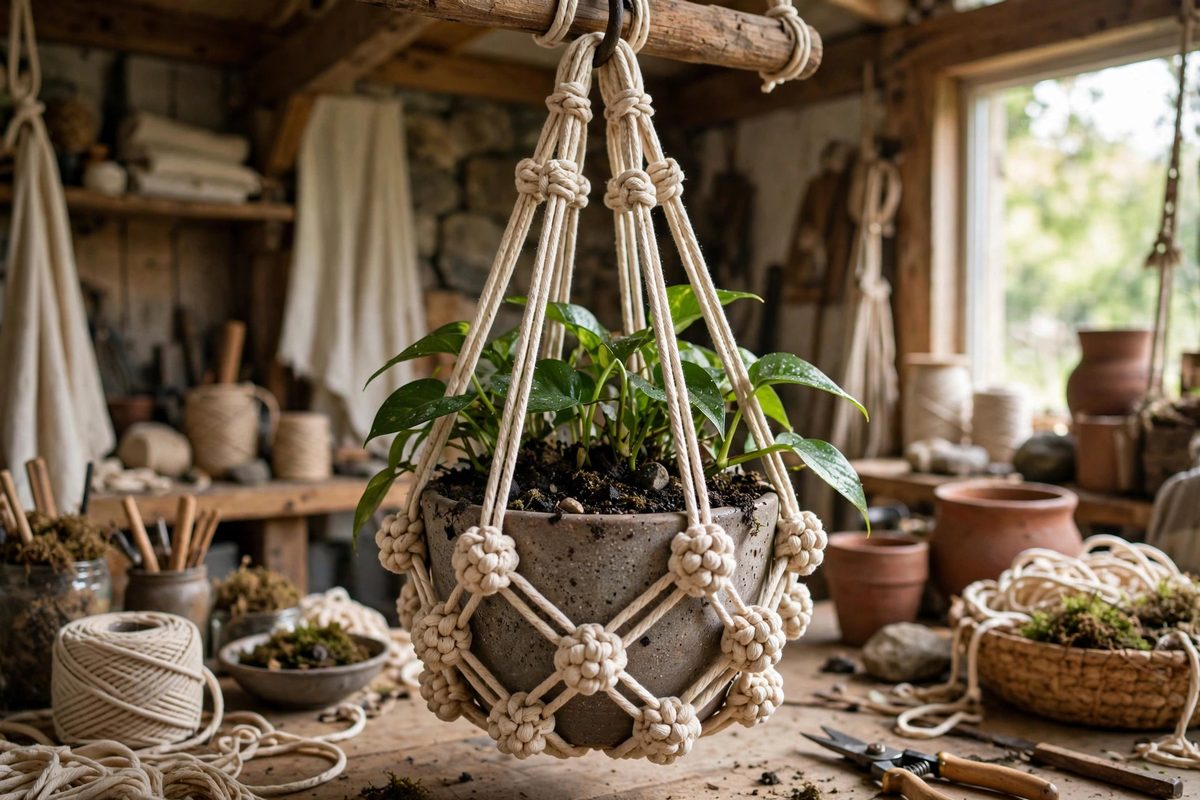
A plant sling holds real weight: a potted plant, wet soil, and a ceramic pot can easily reach twenty pounds or more, hanging from knots. The berry knot, the decorative netted knot that cradles the pot, is also a structural element, and in a multi-strand sling it carries its share of the load. Tying it to bear weight is a different skill from tying it to look pretty.
How the load travels through the sling
Weight in a plant hanger flows from the pot, through the cradling knots, up the working cords, to the gathering knot and the hanging point. Every knot in that chain carries tension, and the berry knots, sitting right under the pot's belly, carry it in a distributed net. The load is not evenly shared: the strands that take the shortest path carry more. Understanding the load path tells you which knots matter most and where a weak knot becomes a failure point.
Tying the berry knot for strength
A berry knot is essentially a netted pouch formed by looping cords around each other in sequence. For load bearing, every loop must be tightened fully and evenly; a loose loop in the net is a loop that does not carry its share, overloading its neighbors. Work the knot with consistent tension all the way around, and check that the net sits symmetrically before moving on. An asymmetric berry knot loads one side more than the other, and the overloaded side is where failure starts.
Strand count and load sharing
More strands mean more sharing. A four-strand berry knot divides the load four ways; an eight-strand version divides it eight ways, with each strand carrying half as much. For heavy plants, increase the strand count rather than hoping fewer strands will hold. The strands should also be balanced in length and tension before the knot is tied; a strand that starts slack stays slack and contributes nothing. Count and tension the strands deliberately at the start of the sling.
Cord selection for the weight
The cord must be rated, by your judgment and testing, for the load with a comfortable margin. Cotton cord is traditional and pleasant to work, but it stretches when wet and weakens over time; synthetic cords hold strength better in the damp environment of a watered plant. Whatever the fiber, use a diameter that feels substantial for the expected weight, and test a sample knot to destruction so you know the real breaking strength, not the hoped-for one. The test destroys a little cord and buys real confidence.
The gathering knot and hanging hardware
The berry knots are only as strong as what is above them. The gathering knot that collects all the strands must be tied with the same care, and the hanging ring or hook must be rated for the total weight. Metal hardware should be checked for sharp edges that can cut cord under load; wood beads and rings should be checked for cracks. The sling fails at its weakest point, and the weakest point is often the hardware, not the knots.
Maintenance over the seasons
A plant sling lives in sun, water, and fertilizer, all of which degrade cord. Inspect the sling periodically: look for fraying at the knots, stretching in the strands, and discoloration that signals weakening. Outdoor slings need more frequent checks than indoor ones. Retire a sling that shows real wear; retying a tired sling is a pleasant afternoon project, while a dropped plant is a mess and a loss.
Tie every loop tight, share the load across enough strands, choose cord for the wet weight, and inspect the whole system regularly. The berry knot can be both beautiful and structural, as long as it is tied like it means it.
Related Guides
- Square Knot Load Distribution in Heavy Plant Slings: A macrame plant sling holding a heavy potted plant is a suspension structure, and the square knots forming its net are the load-bearing elements
- Braided Sinnet Load Distribution in Heavy Pot Slings: A plant hanger holding a small trailing pothos can get away with decorative knotting. A sling holding a heavy ceramic pot, soil, water, and a mature
- Braided Sinnet Load Sharing in Heavy Hanging Planters: A macrame plant hanger holding a small succulent is decoration. The same hanger holding a large potted plant, soil, water, and a ceramic pot, is a
- Sinnet Twist Structural Balance in Multi-Tier Cords: A plant holder hangs a living weight, soil, water, and a growing plant, from knotted cord, sometimes for years. The sinnet, a braided chain of knots