
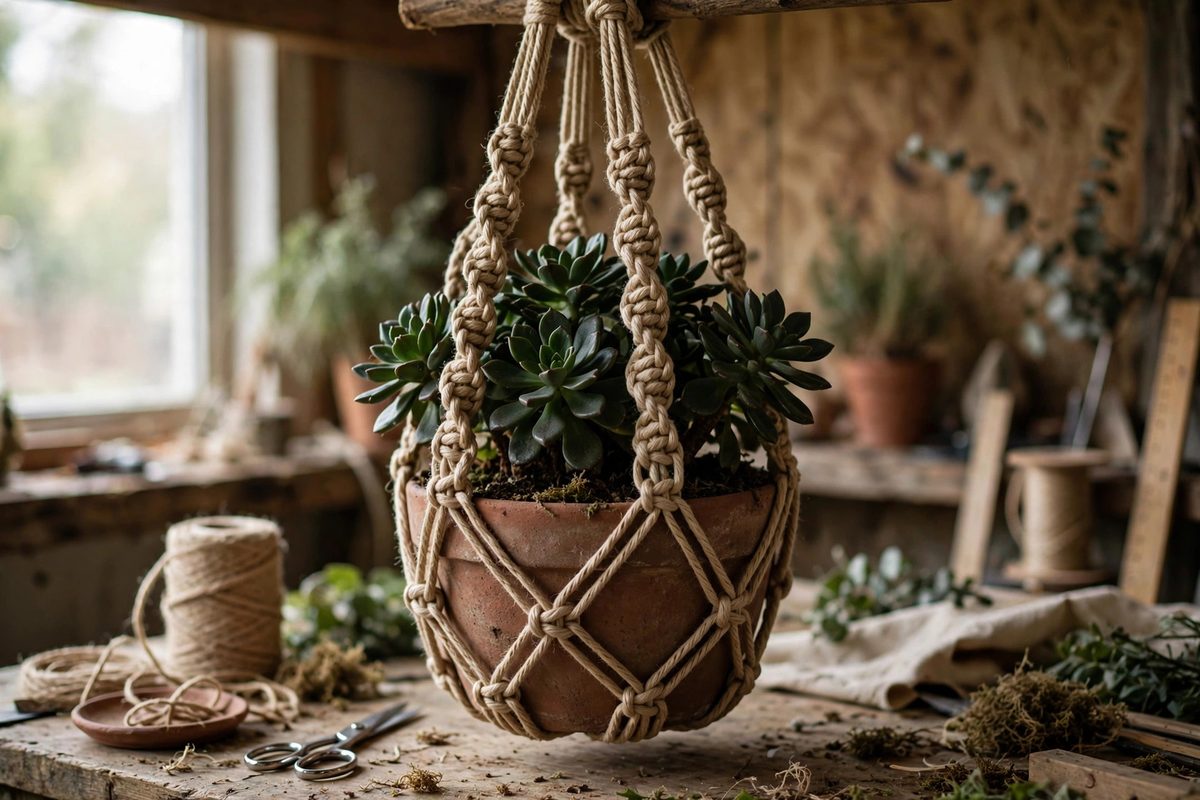
A macrame plant sling holding a heavy potted plant is a suspension structure, and the square knots forming its net are the load-bearing elements. Understanding how load distributes through square knot sennits, the braided columns of knots, tells you how many cords to use, how to space the knots, and where the failure points hide. A sling designed with load in mind holds a forty-pound planter confidently; one knotted by feel alone may not.
How a sling carries weight
The plant's weight hangs from the gathering knot or ring at top, travels down the working cords, distributes through the knotted net around the pot, and the pot's weight bears on the net's lower cradle. Every square knot in the load path carries a share, and the shares are not equal: knots near the top of each sennit carry the accumulated load of everything below them, so the uppermost knots are the most heavily loaded.
This means the sling's strength is set by its topmost load-bearing knots and by the gathering point, not by the average knot. Design the top of the sling and the hanger for the full load with margin; the decorative lower netting carries progressively less.
Square knot strength and cord count
A square knot's holding power comes from friction between the working cords and the filler cords, multiplied across the knot's wraps. In a sennit, each knot adds friction, but with diminishing returns: the first several knots do most of the gripping, and very long sennits gain little additional security. What long sennits do provide is load sharing across more cord length and redundancy.
Size the cord count to the load: more cords mean more filler cords sharing the weight and more working cords providing friction. A heavy planter wants at least six to eight working strands in the load-bearing sections, in cord rated well above the expected load. The cord's rated strength divided by a generous safety factor, then divided among the load-bearing strands, should comfortably exceed the planted weight including water, since a freshly watered plant is the heaviest case.
Knot spacing and the cradle
Knot spacing shapes the net that cradles the pot. Tighter spacing near the bottom forms a denser cradle that supports the pot's base securely; wider spacing in the middle saves cord and shows off the pot. The transition between spacings should be gradual to avoid stress concentrations where the pattern changes abruptly.
The cradle must match the pot: a net designed for a tapered terracotta pot fits a straight-sided ceramic pot poorly, and a poor fit concentrates load on a few contact points instead of distributing it. Measure the actual pot, design the net's widest and narrowest points to its dimensions, and test-fit before finalizing the gathering knot.
The gathering point: the critical detail
All load converges at the top gathering knot or ring, making it the single most stressed element. Wrap it thoroughly, with many tight wraps over a generous length, and consider a metal ring for heavy loads rather than an all-cord gathering; the ring distributes the converging cords evenly and eliminates the stress concentration of a wrapped bundle. Whatever the design, this junction deserves the most careful knotting in the piece.
Inspect the gathering point periodically in use. Cord creep, UV degradation, and the slow working of knots under sustained load all show here first. A sling that has held for a year without inspection is running on trust; check the top before trusting it with the good planter.
Materials for load-bearing slings
Choose cord for strength, UV resistance, and low stretch: braided cotton is traditional and beautiful but stretches and weakens with moisture and sun; synthetic cords hold strength better outdoors. Whatever the fiber, size it for the watered weight with a real safety factor, and replace slings that show fading, fraying, or stiffness changes, all signs of degradation.
Hang from structure, not from trim: the sling is only as strong as its anchor. A heavy planter needs a ceiling joist, a beam, or a rated hook, never just drywall. The load path runs from the plant through the sling to the building; engineer the whole path, not just the pretty middle.
Heavy plant slings are suspension engineering in cord: load concentrates at the top, cord count and knot friction share it, the cradle fits the pot, the gathering point gets the best work, and the anchor holds the building's end. Knot with the weight in mind and the plants hang safely for years.
Related Guides
- Braided Sinnet Load Distribution in Heavy Pot Slings: A plant hanger holding a small trailing pothos can get away with decorative knotting. A sling holding a heavy ceramic pot, soil, water, and a mature
- Load Bearing Berry Knots in Multi-Strand Plant Slings: A plant sling holds real weight: a potted plant, wet soil, and a ceramic pot can easily reach twenty pounds or more, hanging from knots. The berry
- Braided Sinnet Load Sharing in Heavy Hanging Planters: A macrame plant hanger holding a small succulent is decoration. The same hanger holding a large potted plant, soil, water, and a ceramic pot, is a
- Sinnet Twist Structural Balance in Multi-Tier Cords: A plant holder hangs a living weight, soil, water, and a growing plant, from knotted cord, sometimes for years. The sinnet, a braided chain of knots