
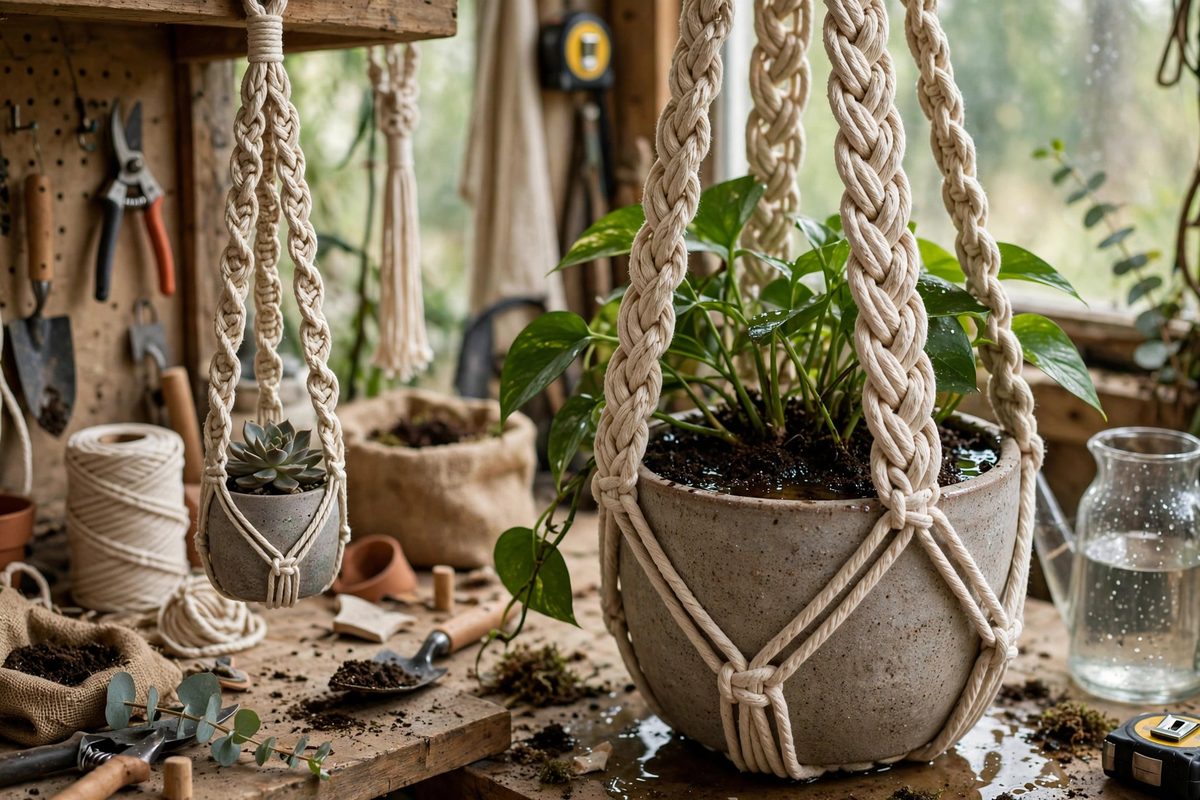
A macrame plant hanger holding a small succulent is decoration. The same hanger holding a large potted plant, soil, water, and a ceramic pot, is a load-bearing structure, and it needs to be engineered like one. Braided sinnets, the multi-strand braids that form the hanger's suspension cords, are where the load travels, and how they share that load determines whether the planter hangs safely for years or fails without warning.
How Load Travels Through a Hanger
Trace the forces: the plant's weight pulls down on the pot, the pot's weight transfers to the cradle or net holding it, the cradle gathers into suspension cords, and the cords carry the load up to the single hanging point. Every ounce travels through the sinnets. In a typical hanger, three or four sinnet groups share the total weight, which means each group carries a quarter or a third of a load that can easily reach tens of pounds for a large planted pot. The sinnets are not decorative here; they are the structure, and they need to be built with that understanding.
Why Braided Sinnets Share Load Well
A sinnet is a braid, and braiding is inherently load-sharing: multiple strands interlaced so that tension distributes across all of them. In a well-made sinnet, no single strand carries the full load; each strand carries its fraction, and the interlacing transfers load between strands if one is slightly longer or weaker than the others. This redundancy is the sinnet's safety feature: it tolerates the small imperfections inevitable in handwork. Compare this to a single cord, where one weak spot or one cut means total failure. For heavy planters, always use multi-strand sinnets, never single cords, for the suspension: the redundancy is not optional at these weights.
Equal Length: The Critical Detail
Load sharing only works if the sinnets are actually sharing, which requires them to be the same working length. If one sinnet group is even slightly shorter than the others, it carries disproportionate load: the shorter cord goes taut first and takes the weight while the longer ones hang slack. This is the most common failure mode in heavy hangers, and it is insidious because the hanger looks fine: the overloaded sinnet is simply working harder than designed, aging faster, until it fails and dumps its load onto the remaining sinnets, which then fail in cascade. When making the hanger, measure and tension the sinnet groups identically: hang the empty hanger and check that all groups are equally taut before it ever holds a plant. Adjust by re-knotting, not by hoping.
Sizing Cord for the Weight
Estimate the total weight honestly: pot, soil (wet soil is dramatically heavier than dry), plant, water, and any decorative elements. Then size the cord so that each sinnet group's share is a small fraction of the cord's breaking strength: a generous safety margin is cheap insurance against the unknowns of hand-knotted work, aging, and moisture. Thicker cord also knots into more substantial sinnets that resist the gradual creep that thinner cords exhibit under sustained load. And consider the hardware: the ring or hook at the top must be rated for the total weight, because the finest sinnets in the world do not help if the ceiling hook pulls out.
Knots, Moisture, and Aging
Several factors degrade a hanger over time. Knots reduce cord strength at the knot point, which is why the sinnet's load-sharing matters: the knots are the weak points, and sharing keeps any single knot's load low. Moisture from watering weakens natural fiber cords and encourages rot, as discussed for cordage generally; for heavy permanent planters, synthetic cord or treated natural cord is the prudent choice. UV from a sunny window degrades many fibers over time. Inspect heavy hangers periodically: look for fraying, stiffness, discoloration, and any sinnet group that has stretched longer than its mates (a sign it has been overloaded). Retire and remake a hanger that shows these signs: the cost of re-knotting is trivial compared to a large pot hitting the floor.
Hanging Hardware and Installation
The hanger is only as strong as its anchor. Use a ceiling hook or bracket rated well above the total weight, anchored into structure, a joist or solid blocking, not just drywall. For very heavy planters, consider a wall-mounted bracket that puts the load in shear on multiple fasteners rather than a single ceiling point in tension. Check the anchor periodically too: houses move, wood shrinks, and anchors loosen. A heavy planter deserves the same respect you would give any suspended load.
Braided sinnets share load beautifully, but only when they are equal in length, sized with margin, protected from moisture and UV, and hung from solid anchors. Build the hanger as structure, inspect it as structure, and your heavy planter will hang safely for years.
Related Guides
- Braided Sinnet Load Distribution in Heavy Pot Slings: A plant hanger holding a small trailing pothos can get away with decorative knotting. A sling holding a heavy ceramic pot, soil, water, and a mature
- Sinnet Twist Structural Balance in Multi-Tier Cords: A plant holder hangs a living weight, soil, water, and a growing plant, from knotted cord, sometimes for years. The sinnet, a braided chain of knots
- Square Knot Load Distribution in Heavy Plant Slings: A macrame plant sling holding a heavy potted plant is a suspension structure, and the square knots forming its net are the load-bearing elements
- Load Bearing Berry Knots in Multi-Strand Plant Slings: A plant sling holds real weight: a potted plant, wet soil, and a ceramic pot can easily reach twenty pounds or more, hanging from knots. The berry