
Theatre flats and rigid walls are usually built fast, struck faster, and expected to stand perfectly still in between. The plates, the horizontal members at the top and bottom of a framed wall, carry the nailing that holds the whole assembly together. Butt joints, where a plate meets a stud end to end, are the weak link if they are nailed casually. A few code-informed habits make the difference between a wall that racks and one that stays true through a full run.
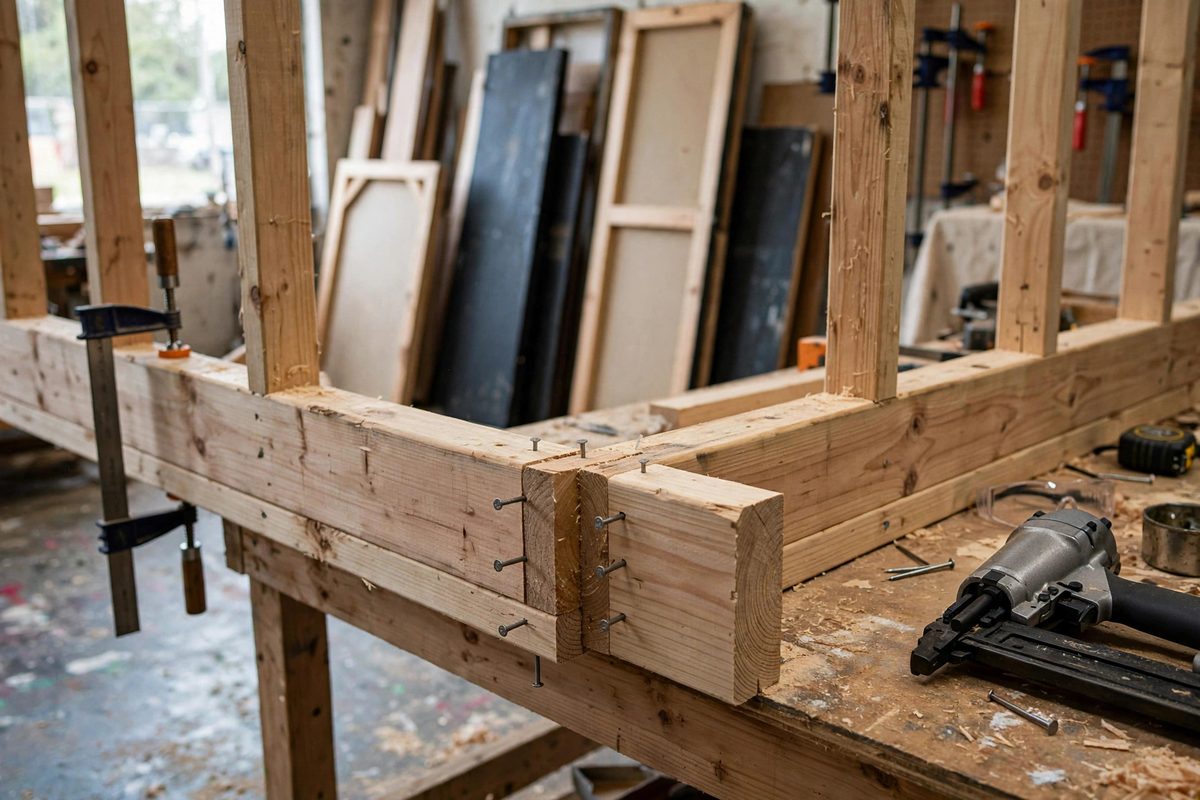
Why Butt Joints Need Attention
A butt joint has no interlocking geometry; the end grain of one member simply abuts the face of another, and the nails are the entire connection. End grain holds nails poorly compared to face grain, because the nail drives between the wood fibers instead of across them, so a butt joint nailed into end grain alone is the weakest connection in the frame. In a theatre wall, the plates are typically the members receiving nails into their ends at corners, or the studs are nailed through the plate into their end grain at top and bottom. Either way, the joint relies on the shear strength of the nails and the friction of the abutting faces. Proper nailing patterns and adequate nail size are what keep these joints from working loose under the repeated handling that scenery endures.
Nailing Patterns That Hold
Drive nails at a slight angle, toenailing, rather than straight in wherever the geometry allows; angled nails resist withdrawal far better because they engage more cross grain. For a stud meeting a plate, two nails driven at opposing angles through the stud into the plate, or through the plate into the stud end, form the basic connection. Stagger the nails so they do not split the wood along a single grain line, and keep them back from the ends of the member by a reasonable margin to avoid splitting. In softwood framing lumber of the sizes common in scenery, nails in the 8d to 16d range suit most plate connections; undersized nails bend and lose holding power, while oversized nails split the stock. Predrill or blunt the nail point when working near ends in dry lumber.
Plates, Splices, and Continuity
Long walls need plate splices, and a splice is just a butt joint in the middle of a run. Never leave a plate splice floating between studs; always land the splice on a stud so the stud backs the joint and the nails have solid material. Better still, offset the splices in the top and bottom plates so they do not occur at the same stud bay, which staggers the weak points. Where a wall must resist racking, the facing material, plywood or lauan, does most of the work once it is attached, but the frame has to survive handling before the skin goes on and after it comes off. A wall whose plates are properly spliced and nailed can be carried, stood, and struck repeatedly without loosening; a wall with floating splices starts to wobble after the second move.
What Building Codes Contribute
Theatre scenery is generally not subject to residential building codes, but the nailing schedules in those codes are based on tested connection strengths and they translate well to scenery. Code nailing schedules specify nail size, number, and placement for plate-to-stud and splice connections, and following them gives you connections with known capacity instead of guesswork. The deeper lesson from the codes is redundancy: structural connections use multiple fasteners so that no single nail carries the joint. Apply that thinking to every butt joint in the wall. If a joint matters, it gets at least two nails, and if it carries load or gets handled roughly, it gets more. Glue the joints as well when the wall is permanent for the run; construction adhesive plus nails is dramatically stronger than nails alone.
Inspection and Strike Considerations
Build inspection into the process. After nailing a wall, rack it gently by pushing the top corner; a well-nailed wall feels solid, while a poor one visibly flexes at the plate joints. Listen for creaking, which signals nails working in oversized holes. During strike, walls get dragged, dropped, and stacked, which is when marginal joints fail; walls built with proper plate nailing survive this abuse and can be reused, which is the economic argument for doing it right the first time. Keep a hammer and nails at the strike call for field repairs, and re-nail any joint that has worked loose rather than trusting it for the next venue. Rigid walls are only rigid if the joints stay tight.
Butt joints in plates hold because of nail size, angled driving, staggered placement, splices landed on studs, and redundancy at every connection. Borrow the discipline of code nailing schedules even where the code does not apply, and the walls will stand straight from load-in to strike.
Related Guides
- Standard Muslin Sizing for Seamless Theatre Flats: A theatre flat, the framed wall unit that builds stage scenery, gets its face from muslin stretched over the frame. Raw muslin is soft, wrinkled, and
- Triangular Plywood Gussets for Tall Theatrical Walls: Theatrical walls (flats) are built light so a small crew can move them, but tall walls are top-heavy and catch air like sails when shifted
- Stiffening Plywood Flats With Triangular Braces: A theatrical flat, a framed plywood or muslin panel, must stand rigid through a whole run: actors lean on it, doors slam in it, and stagehands
- Diagonal Corner Bracing Rigidity on Timber Flats: A theatrical flat, the classic timber-framed wall panel of stage scenery, is a rectangle that desperately wants to become a parallelogram. Without