
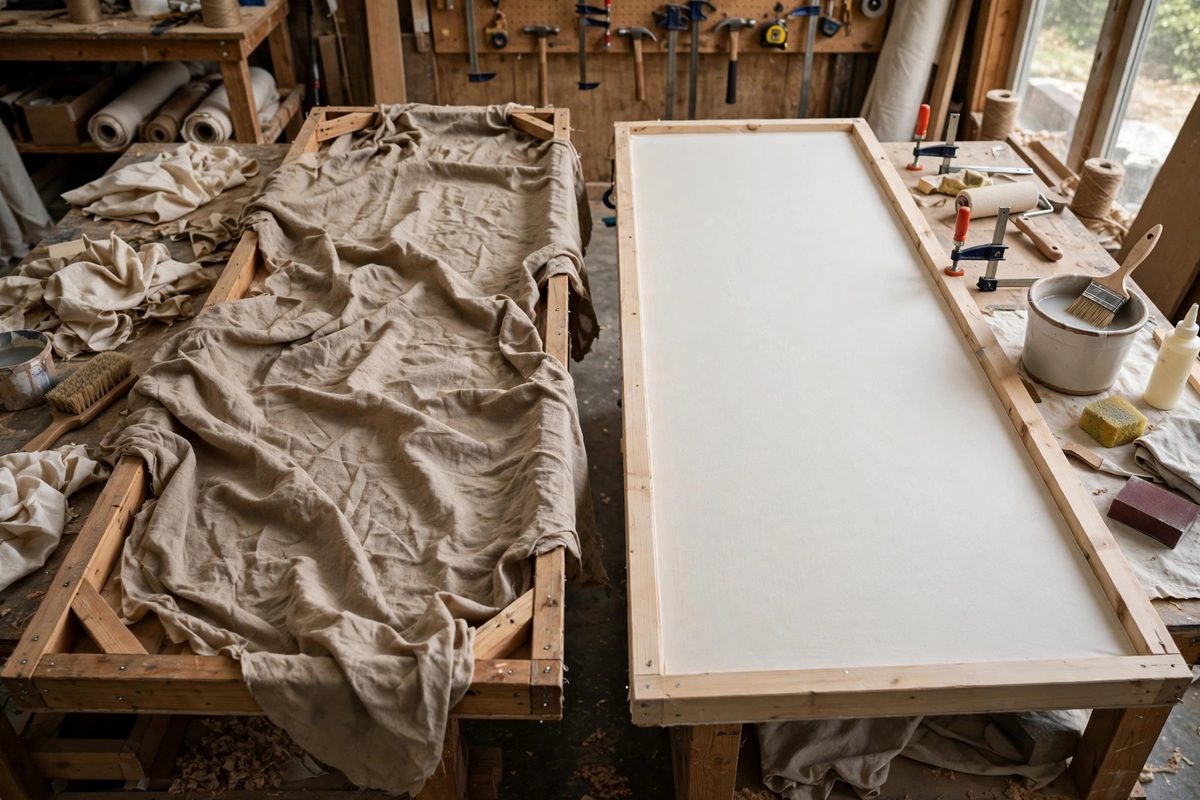
A theatre flat, the framed wall unit that builds stage scenery, gets its face from muslin stretched over the frame. Raw muslin is soft, wrinkled, and absorbent; sized muslin is taut, smooth, and ready for paint. Sizing, coating the fabric with a starch or glue solution that shrinks and stiffens it as it dries, is the transformation step between fabric and scenery. Done correctly, it produces a seamless, drum-tight surface that takes paint beautifully and survives a full run. Done poorly, it sags, cracks, or mildews.
Why muslin needs sizing
Untreated muslin stretched over a flat frame looks acceptable for about a day. Then humidity, handling, and the weight of paint cause it to sag between the frame members, wrinkle at the edges, and absorb paint unevenly, leaving a blotchy finish that reads as amateur from the house. Sizing addresses all three problems at once. The size solution penetrates the fibers and, as it dries, contracts, pulling the fabric taut across the frame like a drumhead. It fills the weave partially, giving paint a consistent surface instead of thirsty raw cloth. And it adds body, so the finished flat resists the dents and sags of backstage life. The sized flat is a fundamentally different object than the raw one: stable, paintable, and professional.
Choosing and mixing the size
Traditional sizing uses wheat paste, starch, or animal glue thinned to a brushable consistency; modern shops often use PVA-based scenic sizes or diluted white glue. Whichever you choose, the working principle is the same: a solution thin enough to penetrate the fabric, strong enough to tension it as it dries. Mix the size smooth, with no lumps, since lumps telegraph through to the painted surface. The consistency should be roughly like thin cream: it should brush on easily and soak in, not sit on the surface like paint. Test on a scrap frame first, because different muslin weights absorb differently and the size strength needs to match the fabric; heavyweight muslin wants a stronger size than lightweight. Keep the size warm if you are using a glue-based recipe, since cooling thickens it and changes how it penetrates.
Application technique
Stretch the muslin over the flat frame first, stapling or tacking it evenly with moderate tension; the sizing will add the final tautness, so the initial stretch should be firm but not strained. Apply the size with a wide brush or a sprayer, working it into the fabric in even passes and covering the entire surface without puddling. Work from the center outward, which encourages the fabric to tension evenly rather than pulling to one side. As the size dries, the muslin will tighten audibly, sometimes with little ticking sounds as fibers shift; this is normal and desirable. Let the flat dry flat or supported evenly, never leaning where gravity can pull the wet fabric into a sag. One thorough coat is usually sufficient; a second coat adds stiffness but also adds weight and cracking risk, so reserve it for flats that need extra body.
Priming, painting, and the finished surface
Once the size is fully dry, prime the flat with a scenic base coat, typically a flat latex or a traditional scenic primer, which seals the sized surface and gives the paint layers a uniform ground. The sized and primed flat should feel smooth and sound taut when tapped. Paint as designed, knowing the surface will take color evenly. One caution: sized muslin is less forgiving of heavy impasto or very wet techniques than raw canvas, since the size layer can soften and the fabric can spot-sag under extreme wetness; build heavy textures in thin passes with drying time between. The reward for the prep work is a flat that looks seamless under stage lighting, with no frame members ghosting through and no wrinkles catching highlights.
Fire safety and longevity
Stage scenery lives under hot lights in public buildings, so fire treatment is not optional. Many jurisdictions require scenic fabrics to be flame-retardant treated, and untreated muslin is alarmingly flammable. Apply an approved flame-retardant treatment compatible with your sizing, or use inherently flame-retardant muslin, and keep documentation of the treatment for the fire marshal. Check local codes before building; requirements vary, but the principle is universal. For longevity, store flats vertically in a dry space, face to face with protective covering, and touch up the size on any flat that develops sag between productions. A well-sized flat lasts for years and many shows; a neglected one sags after one.
Stretch it even, size it thoroughly, let it dry supported, prime it, and treat it for fire. The audience never notices the sizing, which is exactly the point: they see only a perfect wall where a wrinkled cloth used to be.
Related Guides
- Butt-Joint Plate Nailing Codes for Rigid Theatre Walls: Theatre flats and rigid walls are usually built fast, struck faster, and expected to stand perfectly still in between. The plates, the horizontal
- Diagonal Corner Bracing Rigidity on Timber Flats: A theatrical flat, the classic timber-framed wall panel of stage scenery, is a rectangle that desperately wants to become a parallelogram. Without
- Stiffening Plywood Flats With Triangular Braces: A theatrical flat, a framed plywood or muslin panel, must stand rigid through a whole run: actors lean on it, doors slam in it, and stagehands
- Triangular Plywood Gussets for Tall Theatrical Walls: Theatrical walls (flats) are built light so a small crew can move them, but tall walls are top-heavy and catch air like sails when shifted