
A theatrical flat, a framed plywood or muslin panel, must stand rigid through a whole run: actors lean on it, doors slam in it, and stagehands wrestle it between scenes. Plywood flats are stiffer than muslin ones, but a big flat still flexes, and flexing flats look cheap and eventually break. Triangular braces, the diagonal members that turn a wobbly rectangle into a rigid truss, are the traditional fix. Here is how to brace flats so they stand like walls.
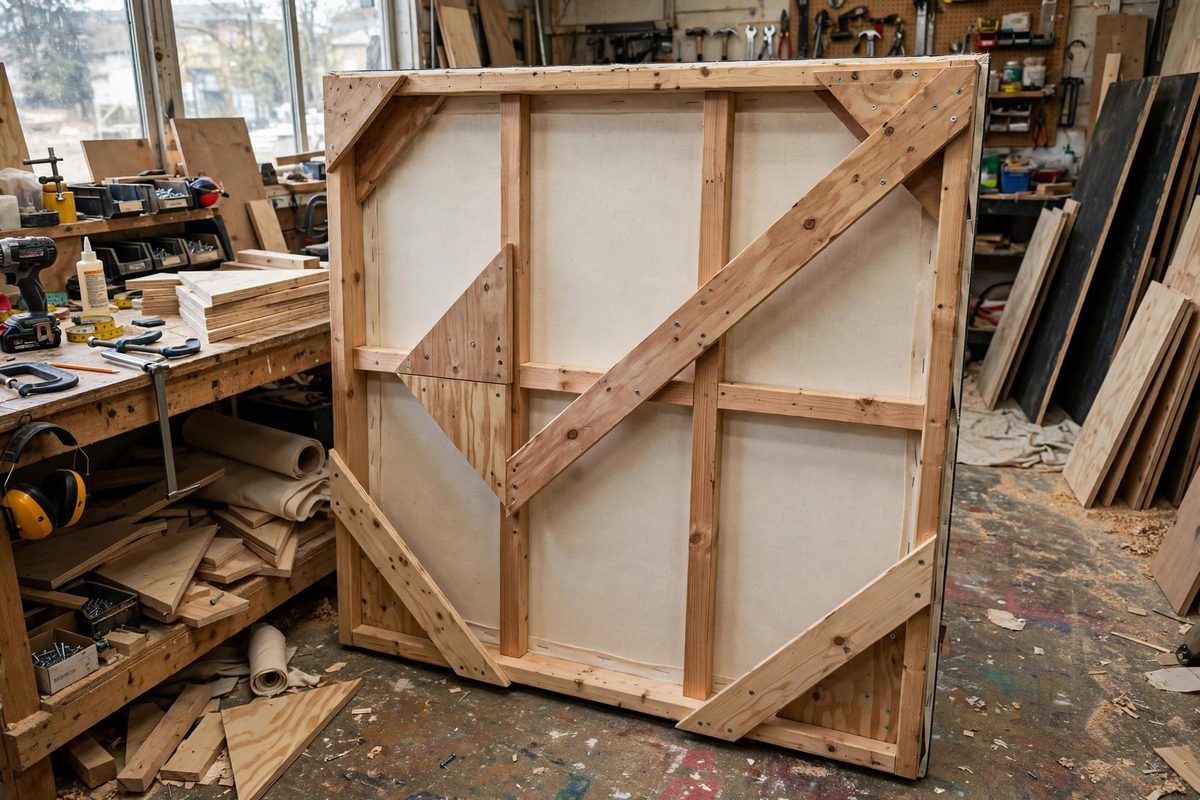
Why rectangles wobble and triangles do not
A rectangular frame with pinned or screwed corners can shear: push the top sideways and the rectangle becomes a parallelogram, because nothing resists the angular change. Add a diagonal member and the frame becomes two triangles; a triangle's shape is fixed by its side lengths, so it cannot shear without stretching a member. This is the whole structural principle: triangulation converts shear loads into tension and compression along the members, which wood handles well. Every brace you add should complete a triangle, or it is decoration.
Brace layout on a flat
The standard braced flat has its perimeter frame plus diagonal braces forming triangles across the back. For a typical 4x8 flat, one diagonal from corner to corner suffices for moderate duty; for tall flats or ones carrying doors or windows, use multiple diagonals forming a zigzag or a series of triangles. Keep braces on the back face so the front stays clean for painting. Attach braces with screws, not just glue: the joint must resist tension, and screws (or bolts for stock scenery) provide it. The brace ends should land on solid framing members, never on unsupported plywood skin.
Sizing the bracing lumber
Use the same dimension lumber as the flat's frame, typically 1x3 or 1x4, for the braces; matching dimensions keeps the back face flush and the joints simple. The brace does not need to be heavy: in triangulation, even light members provide enormous stiffness because they work in direct tension and compression rather than bending. What matters is the connection: each brace end needs at least two screws into the frame member, driven at slight angles (toenailing) or straight through with the joint glued as well. A brace with a weak connection is a brace that does nothing.
Stiles, rails, and the brace's partners
Bracing works with the flat's frame, not instead of it. Ensure the frame's corner joints are sound before adding diagonals; a brace cannot fix a frame whose corners are falling apart. On wide flats, add a vertical mid-stile to halve the unsupported span, then triangulate each half. Where a flat must come apart for transport, design the bracing as bolted sections that reassemble into the same triangles; a flat that is rigid in the shop but wobbly on stage was probably reassembled wrong, so mark the brace positions clearly.
Jack braces for freestanding flats
A flat that stands alone, not lashed to its neighbors, needs a jack: a triangular brace extending from the flat's back down to the stage floor, forming a right triangle with the flat and the floor. The jack's foot should extend at least a third of the flat's height out from the base, and it must be secured to the stage (screwed, weighted, or braced against something immovable). An unsecured jack is a rumor of stability. For tall or top-heavy flats, use two jacks spread across the width.
Triangulate every rectangle, connect every brace solidly, and jack what stands alone. The flat will take the whole run without a wobble.
Related Guides
- Triangular Plywood Gussets for Tall Theatrical Walls: Theatrical walls (flats) are built light so a small crew can move them, but tall walls are top-heavy and catch air like sails when shifted
- Diagonal Corner Bracing Rigidity on Timber Flats: A theatrical flat, the classic timber-framed wall panel of stage scenery, is a rectangle that desperately wants to become a parallelogram. Without
- Standard Muslin Sizing for Seamless Theatre Flats: A theatre flat, the framed wall unit that builds stage scenery, gets its face from muslin stretched over the frame. Raw muslin is soft, wrinkled, and
- Butt-Joint Plate Nailing Codes for Rigid Theatre Walls: Theatre flats and rigid walls are usually built fast, struck faster, and expected to stand perfectly still in between. The plates, the horizontal