
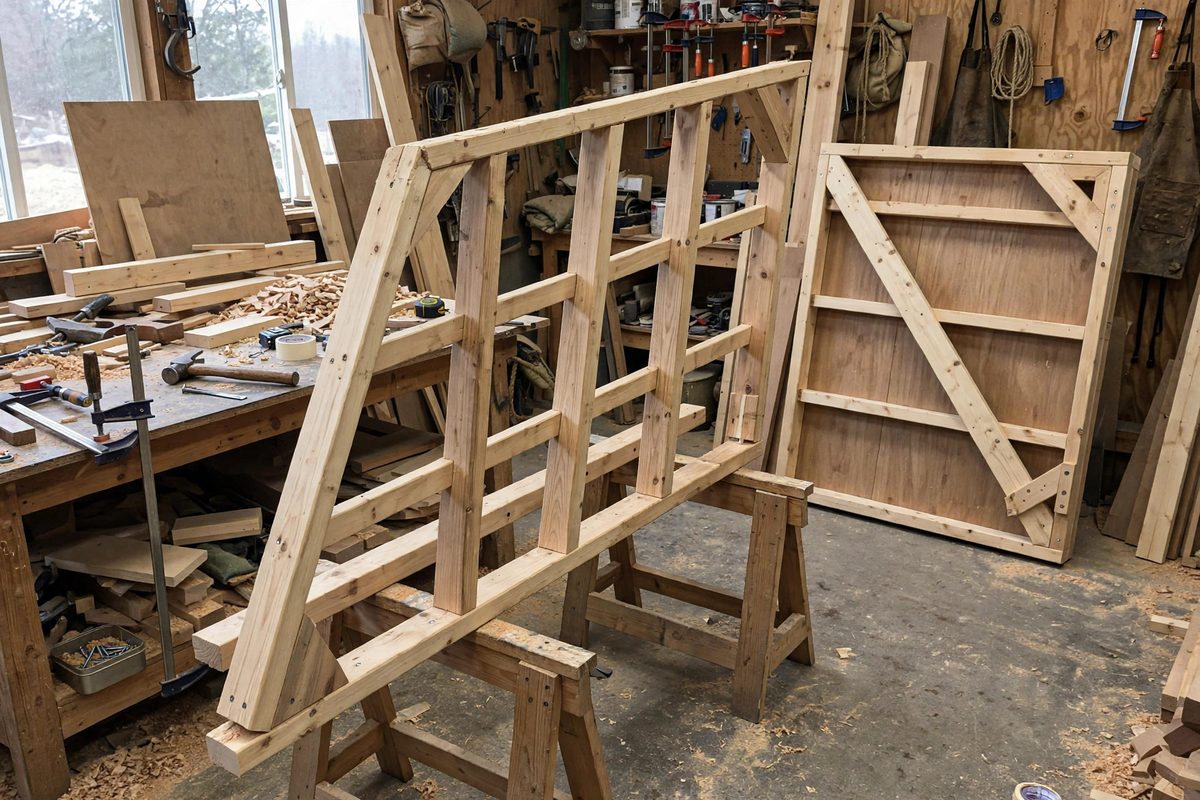
A theatrical flat, the classic timber-framed wall panel of stage scenery, is a rectangle that desperately wants to become a parallelogram. Without diagonal bracing, every flat racks under handling, and a racked flat will not join its neighbors cleanly or stand true. Corner bracing converts the rectangle into triangles, and triangles do not rack.
Why Rectangles Rack and Triangles Do Not
A rectangle pinned at its corners can shear sideways with almost no resistance; the joints just rotate. A triangle cannot change shape without changing the length of one of its sides, which means racking a braced flat requires stretching or compressing wood, and wood resists that strongly. One diagonal across a rectangular frame divides it into two triangles and locks the whole frame. This is the entire structural logic of flat bracing, and it works regardless of the flat's size or covering.
Placing the Diagonal
The diagonal should run corner to corner of the frame, or as close to the full diagonal as the frame's internal layout allows. A short diagonal that only spans part of the frame leaves unbraced rectangles at the ends, which will rack exactly where the brace does not reach. Where internal framing interrupts the full diagonal, use two shorter diagonals forming a V or an X across the obstructed area. The brace works in both tension and compression along its length, so orientation, rising left to right or right to left, does not matter structurally; pick the direction that avoids clashing with other hardware.
Joinery at the Brace Ends
The brace only works if its ends are solidly connected to the frame. A brace nailed loosely at each end pivots instead of bracing. Traditional flat construction uses screwed and glued joints, with the brace ends cut to fit snugly against the rails and stiles. Corner blocks or plywood gussets at the brace ends spread the load and keep the joint from working loose under repeated handling. Flats get carried, stacked, and dropped; the brace joints must survive that life, so build them like the flat will tour, even if it will not.
Bracing Both Directions
A single diagonal locks the frame against racking in the plane, which handles most of what a flat experiences. But flats also get pushed out of plane, leaned on, and wind-loaded when used outdoors. A second diagonal forming an X, or a horizontal mid-rail tied into the diagonal, stiffens the flat against out-of-plane flex. For tall flats, horizontal rails at third points break the long stiles into shorter spans that resist bowing. The flat should feel rigid when you grab two corners and twist; if it flexes, it needs more bracing before it gets its covering.
Bracing and the Covering
The traditional muslin covering, glued and sized, adds real stiffness to a braced flat once it dries taut, acting as a stressed skin. But the covering cannot substitute for the diagonal; sized muslin tears and sags over time, while the timber brace keeps working. Luan or plywood-faced flats gain stiffness from the skin itself and can sometimes use lighter bracing, but the diagonal is still cheap insurance. Brace first, cover second, and the flat will stay square through the run.
Diagonal corner bracing is the cheapest structural upgrade in scenery: one timber, two solid joints, and the rectangle becomes triangles. Build every flat braced, test it with a twist, and the walls will stand square from load-in to strike.
Related Guides
- Standard Muslin Sizing for Seamless Theatre Flats: A theatre flat, the framed wall unit that builds stage scenery, gets its face from muslin stretched over the frame. Raw muslin is soft, wrinkled, and
- Stiffening Plywood Flats With Triangular Braces: A theatrical flat, a framed plywood or muslin panel, must stand rigid through a whole run: actors lean on it, doors slam in it, and stagehands
- Butt-Joint Plate Nailing Codes for Rigid Theatre Walls: Theatre flats and rigid walls are usually built fast, struck faster, and expected to stand perfectly still in between. The plates, the horizontal
- Triangular Plywood Gussets for Tall Theatrical Walls: Theatrical walls (flats) are built light so a small crew can move them, but tall walls are top-heavy and catch air like sails when shifted