
Knitting on a long circular needle should be smooth: the stitches glide around the cable, the join stays put, the rhythm never breaks. But on very long cables the stitches can drag, bunch, and resist, a phenomenon knitters feel as tension drop. Understanding what causes it makes long-circumference knitting pleasant instead of a wrestling match.
What tension drop feels like
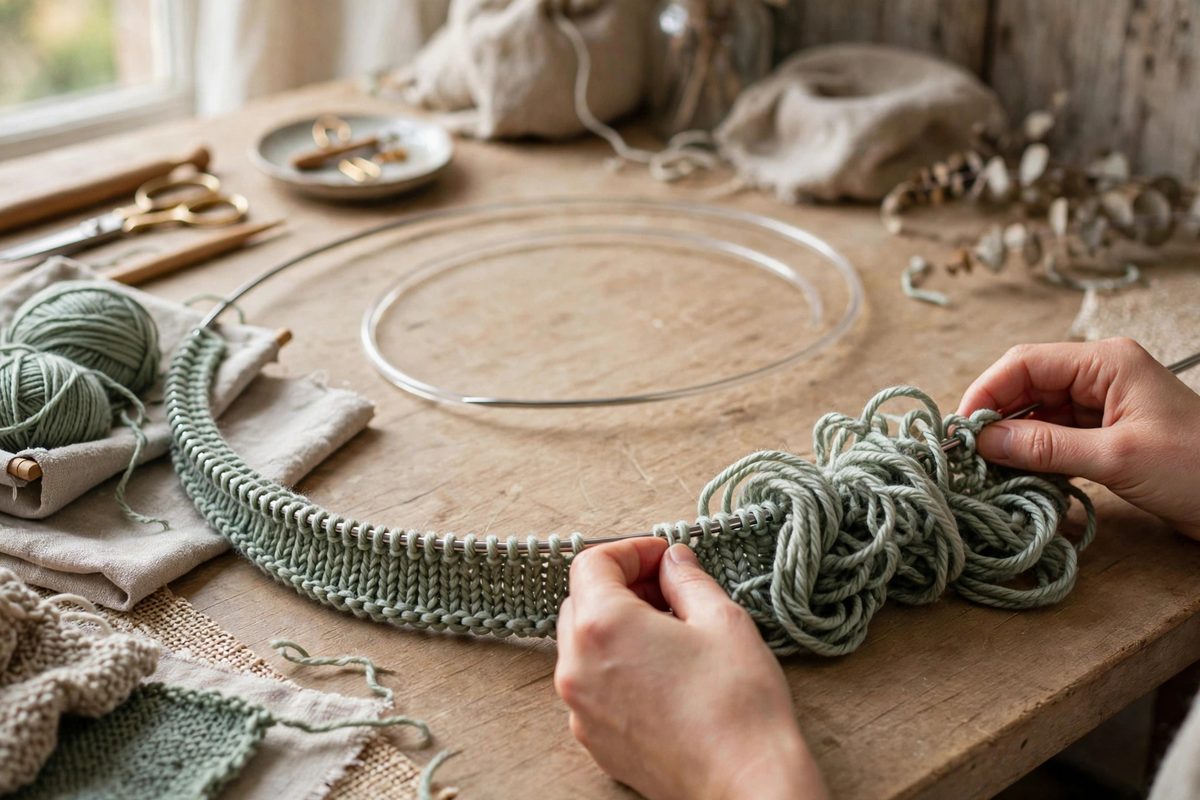
Tension drop shows up as stitches that will not slide freely around the cable, bunching up in the middle while the working area near the needle tips stays sparse. The knitter pushes the bunch along, the stitches resist, and the knitting rhythm breaks. It is most noticeable on long cables, forty inches and up, with a modest number of stitches: the classic magic-loop or large-circumference setup. The stitches are not stuck; they are fighting friction distributed over a long cable.
Friction along the cable
Every stitch in contact with the cable contributes a little friction, and on a long cable there are many stitches in contact. The friction is cumulative: pushing a hundred stitches around a long loop means overcoming the drag of all of them at once. Cable material matters enormously here. Smooth, slick cables, coated wire or polished nylon, let stitches glide; grabby or textured cables multiply the drag. If the stitches fight the cable, the cable is the first suspect, not the knitting.
Cable memory and kinking
Cables fresh from the package often retain coil memory, springing back into loops that fight the knitter. A kinked or coily cable forces stitches over bends, adding resistance at every kink. The fix is simple: soak the cable in warm water, or hang it with a weight, to relax the memory before casting on. Some knitters run the cable through their hands to warm and straighten it. A cable that lies flat and straight before the first stitch is cast on will behave through the whole project.
Matching cable length to the project
The most common cause of tension drop is simply too much cable for the stitch count. A sixty-inch cable holding a hat's worth of stitches means most of the cable is empty loop that the working stitches must travel around. Use the shortest cable that comfortably holds the stitches: for magic loop, just long enough for the loop; for large-circumference knitting, close to the actual circumference. The right cable length eliminates most of the problem before it starts. This is the highest-leverage fix and the most often ignored.
Stitch distribution technique
How the stitches sit on the cable affects the drag. Pushing all the stitches into one tight bunch maximizes the friction they exert as a group; spreading them loosely along the cable reduces it. When working magic loop, keep the non-working stitches relaxed on the loop rather than jammed tight. Periodically redistribute the stitches instead of letting them compact. Small handling habits compound over thousands of stitches.
Needle tips and the transition
The join between the needle tip and the cable is a friction point. A smooth, tapered transition lets stitches flow from cable to needle; a sharp step or a rough join catches every stitch. Check the joins on a new needle before committing to a project, running a few stitches back and forth to feel for snags. Quality varies between manufacturers and even between individual needles; the join is worth inspecting because it is the bottleneck every stitch passes through.
Size the cable to the project, straighten out the memory, choose a slick cable with smooth joins, and keep the stitches distributed. Long-circumference knitting should feel like the stitches are helping, not resisting.
Related Guides
- Magic Loop Cable Flex for Small Circumference Knits: Magic loop lets one long circular needle knit any small circumference, sleeves, socks, hats, by looping the excess cable out at two points and
- German Twisted Cast-On Tension for High Elasticity: The cast-on edge is the foundation of every knitted piece, and for anything that needs to stretch, cuffs, sock tops, necklines, hat brims, the
- Twisted Loop Cast-On Elasticity for Ribbed Cuffs: A ribbed cuff lives or dies by its edge. The cast-on must stretch when a hand pushes through and snap back to hug the wrist afterward, thousands of
- German Twisted Cast On Elasticity for Sock Ribbing: A sock cuff lives a hard life: stretched over the heel dozens of times a week, washed, worn, expected to snap back every time. The cast-on edge is