
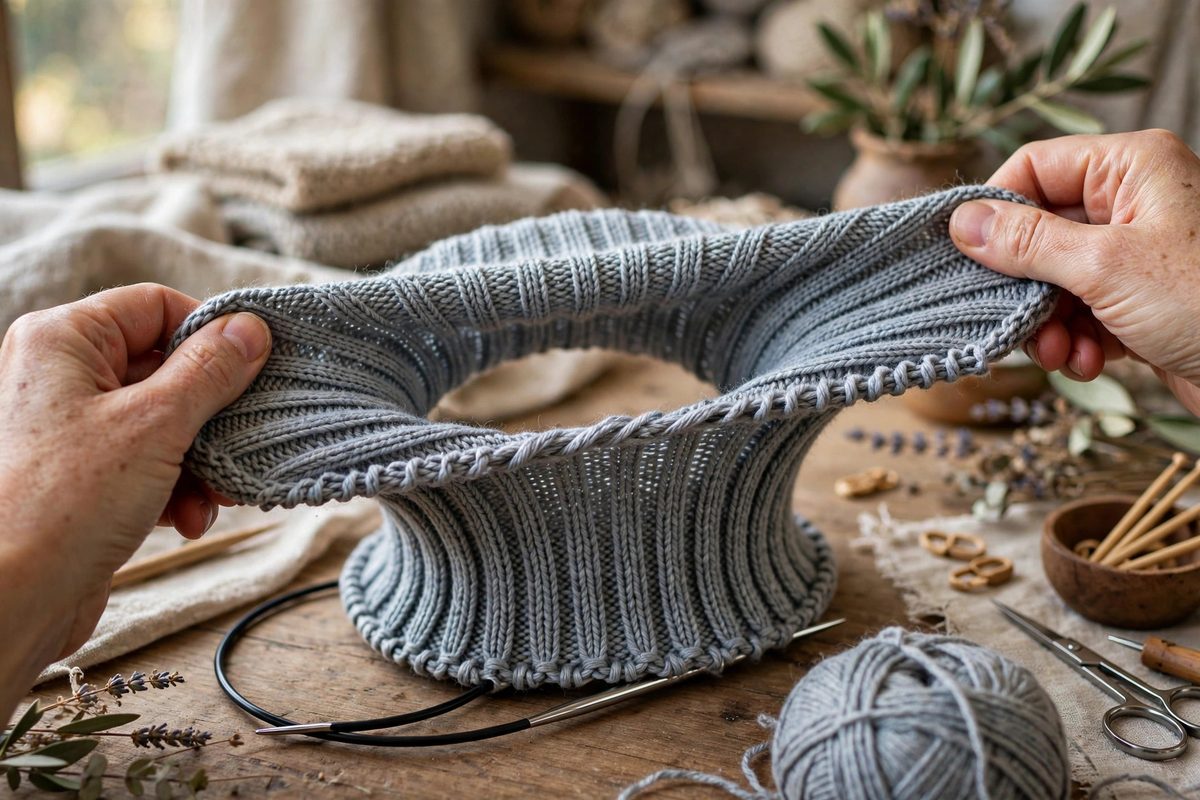
A ribbed cuff lives or dies by its edge. The cast-on must stretch when a hand pushes through and snap back to hug the wrist afterward, thousands of times over the garment's life. The twisted loop cast-on, also called the twisted German or Old Norwegian variation depending on whose grandmother taught it, is one of the stretchiest edges a knitter can produce. Here is how it works, why it out-stretches a plain long-tail edge, and how to use it on cuffs.
What makes it twisted
In a standard long-tail cast-on, each new stitch is a simple loop seated on the needle. In the twisted loop version, the working yarn takes an extra half turn around the thumb before the needle picks it up, so every stitch mounts with a built-in twist at its base. That twist does two things. First, it adds extra yarn into each stitch's foundation, yarn that pays out when the edge is stretched. Second, it orients the stitch base so the edge behaves like a tiny coil spring: stretch it and the twists open; release it and they close again. The result is an edge with noticeably more give than its plain cousin.
Working the cast-on
Set up exactly like a long-tail cast-on, with a long tail estimated generously. The difference comes in the thumb loop: instead of simply scooping under the thumb strand, bring the needle up through the loop, give it a half turn so the strand crosses, then complete the stitch as usual. Keep the tail tension relaxed; yanking each stitch tight defeats the purpose by locking the twist before it ever gets to work. Cast onto a needle one or two sizes larger than your ribbing needle if your cast-on tends toward the snug side, then switch to the working needle for the first row.
Matching elasticity to the ribbing
A cast-on can be stretchier than the ribbing above it, but it should never be tighter. The classic failure is a cuff whose ribbing stretches fine while the edge acts as a tourniquet; the fix is at the cast-on row, not in the ribbing. Test by stretching the first inch of ribbing firmly after a few rounds: the cast-on edge should open at least as far as the ribbing does. If it binds, the usual cause is tension creep during casting on, where each stitch gets a little tighter as you go. Consciously easing off, or casting on over two needles held together, restores the margin.
Yarn and fiber considerations
The twist mechanism works in any yarn, but the recovery depends on the fiber. Wool and wool blends snap back beautifully because the fiber itself is springy. Cotton and linen have little natural recovery, so a twisted cast-on in pure cotton will stretch and stay stretched; pair it with a ribbing pattern that has mechanical recovery, like a deep 2x2 rib, rather than relying on the edge alone. Superwash wools sit in between: stretchier than untreated wool when wet, with good recovery when dry. For cuffs that must survive daily wear, a wool or wool-blend yarn makes the twisted edge's elasticity a durable feature rather than a temporary one.
Where else it earns its place
Any edge that must pass over something wider than itself benefits: sock cuffs, mitten cuffs, hat brims, and the necklines of top-down sweaters. It is less suited to edges that must stay crisp and structured, like a button band or a tailored hem, where its springiness reads as wobble. Match the edge to the job: stretchy where the body needs it, firm where the design needs it.
Cast on with a twist, keep the tension honest, and the cuff will do its job for the life of the garment: stretch on demand, recover every time.
Related Guides
- German Twisted Cast-On Tension for High Elasticity: The cast-on edge is the foundation of every knitted piece, and for anything that needs to stretch, cuffs, sock tops, necklines, hat brims, the
- German Twisted Cast On Elasticity for Sock Ribbing: A sock cuff lives a hard life: stretched over the heel dozens of times a week, washed, worn, expected to snap back every time. The cast-on edge is
- Magic Loop Cable Flex for Small Circumference Knits: Magic loop lets one long circular needle knit any small circumference, sleeves, socks, hats, by looping the excess cable out at two points and
- Cable Tension Drop in Long Circumference Circular Needles: Knitting on a long circular needle should be smooth: the stitches glide around the cable, the join stays put, the rhythm never breaks. But on very