
Magic loop lets one long circular needle knit any small circumference, sleeves, socks, hats, by looping the excess cable out at two points and working half the stitches at a time. The technique's success hinges on cable flexibility: a stiff cable fights every stitch, while a supple cable disappears into the work. Understanding cable behavior turns magic loop from a fiddly struggle into the versatile method it should be, and it saves buying a drawer full of short circulars and double-pointed sets.
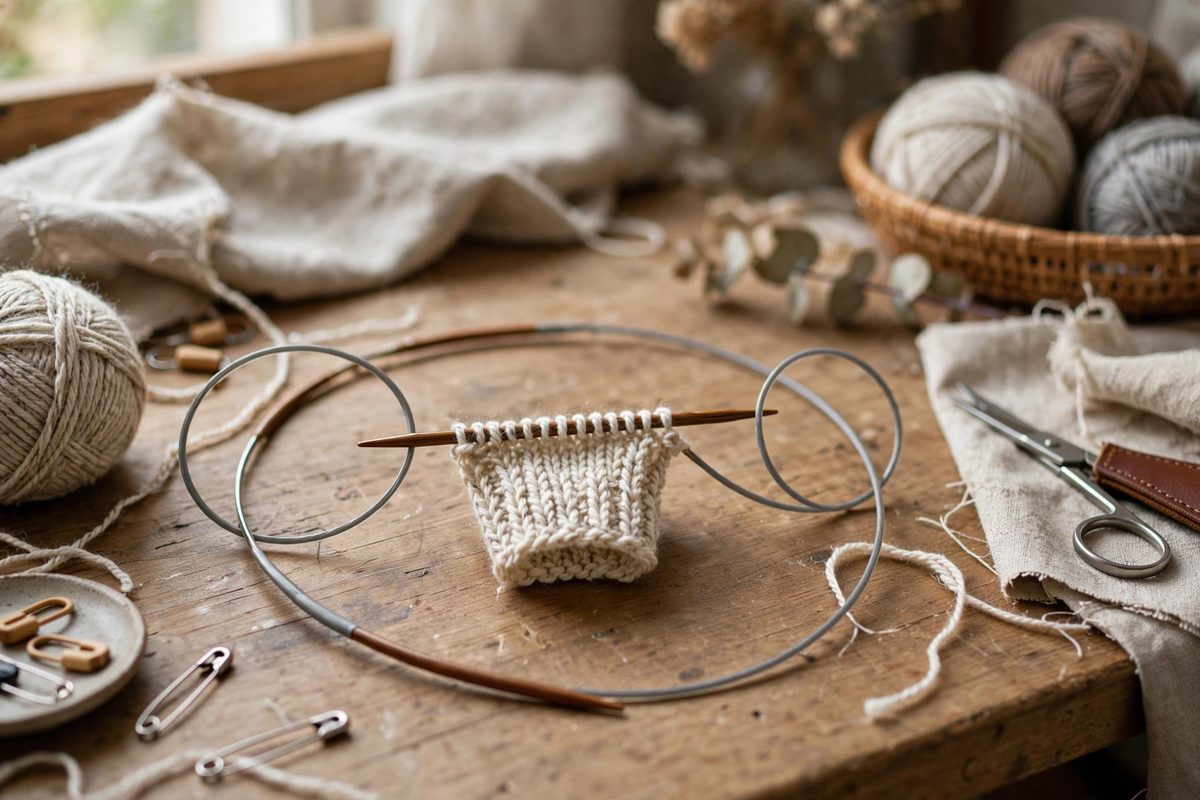
How magic loop works
The stitches divide into two halves, front and back, with the cable looped out at each side. You knit the front-half stitches onto the right needle tip, then pull the back needle tip through and rotate the work to knit the back half. The cable's excess length lives in the two loops, and the needle tips behave like short straights for each half. The method eliminates the need for double-pointed needles or multiple fixed circulars.
The cable does the crucial flexing work at every turn: it must bend sharply at the loop points without kinking, spring back without memory, and slide smoothly through the stitches as halves change. A cable that resists bending makes each transition a wrestling match; one that kinks permanently develops weak spots that snag.
Choosing a cable for magic loop
Cable length matters: too short and the loops strain, too long and the excess cable becomes unmanageable. For most small-circumference work, a cable in the 32 to 40 inch range gives comfortable loops without excess. Longer cables suit two-at-a-time projects; shorter ones fight the technique.
Cable material and construction matter more. Smooth, flexible coated cables with a good memory-free formulation outperform stiff nylon monofilament types. The join between cable and needle tip must be smooth and snag-free, since stitches cross it constantly during magic loop; a rough or stepped join catches yarn at every pass and destroys the rhythm. This is the feature worth paying for in a needle set.
Breaking in and maintaining cables
New cables often arrive coiled with strong memory. Break them in by soaking in warm water and hanging straight, or by running them through warm hands repeatedly; the goal is a cable that hangs without curling. A cable that retains coil memory will constantly try to twist the work, adding a background annoyance to every round.
Store circulars hanging or loosely coiled, never tightly wound. Heat is the enemy of cable memory discipline: do not leave needles in a hot car, and do not steam a cabled needle aggressively. A well-maintained cable lasts for years of magic loop; an abused one kinks and needs replacement.
Technique refinements
Manage the loop transitions deliberately: after finishing a half, pull the new working tip out with enough cable to work comfortably, and snug the first two stitches of the new half to prevent laddering, the loose column of stitches that forms at the loop points. Consistent snugging, not strangling, keeps the sides even.
Rotate which side the loops fall on occasionally, or work with the loops positioned to minimize cable twist. If the cable starts twisting the work, let the project dangle and untwist periodically; fighting twist while knitting degrades both speed and stitch quality. Smooth, unhurried transitions beat rushed ones that tangle. With practice the loop change becomes a single fluid motion rather than a multi-step procedure.
When magic loop is the right choice
Magic loop excels for small circumferences worked in the round where double-pointeds feel fiddly: sleeves, sock legs, hat crowns, mittens. It also shines for two-at-a-time knitting, where both socks or sleeves grow together on one long cable, guaranteeing matching. It is less ideal for very tiny circumferences like glove fingers, where the loop mechanics get cramped, or for knitters who simply prefer the rhythm of double-pointeds.
Choose the method that lets you knit happily; the best technique is the one you will actually use. But give magic loop a fair trial with a good cable before judging it, because most magic loop hatred is really stiff-cable hatred in disguise.
Magic loop is cable technique as much as knitting technique: a long, supple, memory-free cable with smooth joins, broken in and well stored, worked with deliberate transitions and snugged loop points. Get the cable right and the method feels like freedom; get it wrong and no amount of knitting skill compensates.
Related Guides
- Cable Tension Drop in Long Circumference Circular Needles: Knitting on a long circular needle should be smooth: the stitches glide around the cable, the join stays put, the rhythm never breaks. But on very
- Twisted Loop Cast-On Elasticity for Ribbed Cuffs: A ribbed cuff lives or dies by its edge. The cast-on must stretch when a hand pushes through and snap back to hug the wrist afterward, thousands of
- German Twisted Cast On Elasticity for Sock Ribbing: A sock cuff lives a hard life: stretched over the heel dozens of times a week, washed, worn, expected to snap back every time. The cast-on edge is
- German Twisted Cast-On Tension for High Elasticity: The cast-on edge is the foundation of every knitted piece, and for anything that needs to stretch, cuffs, sock tops, necklines, hat brims, the