
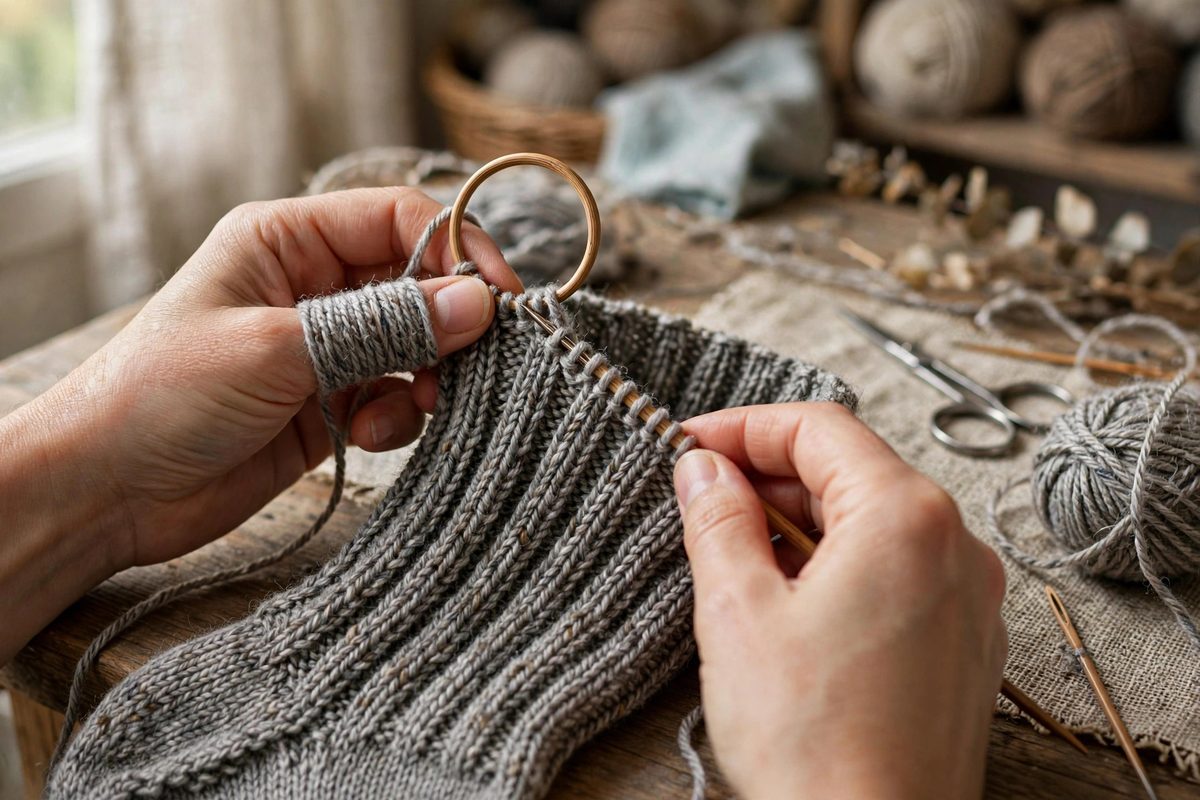
A sock cuff lives a hard life: stretched over the heel dozens of times a week, washed, worn, expected to snap back every time. The cast-on edge is the most stressed part of the whole sock, and a rigid cast-on turns the cuff into a tourniquet that fights the foot going in and never quite recovers. The German twisted cast-on, also called the Old Norwegian cast-on, solves this with a simple structural trick: each cast-on stitch includes an extra twist that acts like a tiny spring, giving the edge remarkable elasticity without looseness. For sock ribbing, it is arguably the best cast-on in the knitter's repertoire.
Why sock cuffs need elastic edges
Consider what the cuff edge endures. It must stretch wide enough to pass over the heel, which is substantially larger in circumference than the ankle the cuff then grips. It must then contract to hold the sock up without constricting circulation. And it must do this thousands of times without the edge stitches distorting, breaking, or losing their recovery. A standard long-tail cast-on provides moderate stretch, but its edge stitches, once extended past their comfortable range, deform permanently; the cuff gradually goes slack and starts slouching. An edge that is merely loose is not the answer either, since a loose edge flares and looks sloppy. The requirement is true elasticity: stretch under load, full recovery after, which is a property of the stitch structure, not just of loose tension.
How the twist creates elasticity
In the German twisted cast-on, each new stitch is formed with the thumb yarn twisted an extra turn before the needle picks it up. That extra twist wraps additional yarn into the base of each stitch in a configuration that functions as a spring: when the edge stretches, the twists open slightly and feed yarn to the extension; when the tension releases, the twists close and pull the edge back. The mechanism is built into every stitch, so the elasticity is uniform around the entire cuff, unlike methods that achieve stretch through uneven tension. The twisted structure also makes the edge slightly thicker and rounder, which wears better against shoes and resists the abrasion that frays ordinary cast-on edges. It is a small change in technique that reengineers the edge's mechanics.
Working the cast-on
Set up as for a long-tail cast-on, with a generous tail, then work each stitch with the characteristic twist: the thumb yarn is looped with an extra turn around the thumb before the needle dives through. The motion feels awkward for the first dozen stitches and then becomes rhythmic; most knitters find it only slightly slower than the standard long-tail once learned. Keep the tension even and moderate: the twist provides the elasticity, so there is no need to cast on loosely, and an overly loose German twisted edge loses its crispness. Count carefully, since the twisted stitches are slightly harder to count on the needle than plain ones. Place a marker or count in groups to avoid the special frustration of discovering a miscount three pattern repeats into the leg.
Pairing with ribbing
The German twisted cast-on truly shines under ribbing. Work the cuff in a knit-purl rib, commonly two-by-two or one-by-one for socks, and the twisted edge's elasticity compounds with the rib's natural stretch and recovery. The combination produces a cuff that expands enormously for the heel and grips the leg firmly without pressure points. Match the cast-on's character to the rib: a firm, springy edge under a firm rib gives a cuff with real staying power, ideal for everyday socks. For a delicate or decorative cuff, the same cast-on still works, since its elasticity does not come at the cost of bulk; the edge remains neat and defined. Avoid pairing it with a rigid stitch pattern that cannot use the stretch, which wastes the technique's advantage.
Troubleshooting the edge
Common issues have straightforward fixes. If the edge flares despite the technique, the cast-on tension is too loose; the twist needs moderate tension to function as a spring. If the edge feels tight and unyielding, check that the extra twist is actually being made on every stitch; it is easy to unconsciously revert to a standard long-tail mid-row, producing a hybrid edge with dead spots. If the first row after the cast-on is difficult to work, the stitches may be twisted inconsistently, making some tight and some loose; aim for uniformity of motion. And if the tail runs short, which happens because the twist consumes more yarn than a standard cast-on, allow extra tail length in the setup, roughly a third more than usual for the stitch count.
Care and longevity
A well-made German twisted edge outlasts the sock's other features, but care extends it further. Wash socks in a mesh bag to reduce abrasion, avoid high heat that degrades wool's elasticity, and dry flat or on forms rather than hanging by the cuffs. When a beloved sock's cuff eventually tires, the cast-on edge can be carefully unpicked and rebound, though the twisted structure makes this fussier than with a plain edge. Better to build the sock well from the start: the German twisted cast-on is a few extra minutes at the beginning that pays dividends through the entire life of the sock.
The German twisted cast-on builds a spring into every edge stitch, giving sock cuffs the stretch to clear the heel and the recovery to stay up. Learn the twist motion, keep tension moderate and even, pair it with ribbing, and allow extra tail. The cuff will outwork every other cast-on you know.
Related Guides
- German Twisted Cast-On Tension for High Elasticity: The cast-on edge is the foundation of every knitted piece, and for anything that needs to stretch, cuffs, sock tops, necklines, hat brims, the
- Twisted Loop Cast-On Elasticity for Ribbed Cuffs: A ribbed cuff lives or dies by its edge. The cast-on must stretch when a hand pushes through and snap back to hug the wrist afterward, thousands of
- Magic Loop Cable Flex for Small Circumference Knits: Magic loop lets one long circular needle knit any small circumference, sleeves, socks, hats, by looping the excess cable out at two points and
- Cable Tension Drop in Long Circumference Circular Needles: Knitting on a long circular needle should be smooth: the stitches glide around the cable, the join stays put, the rhythm never breaks. But on very