
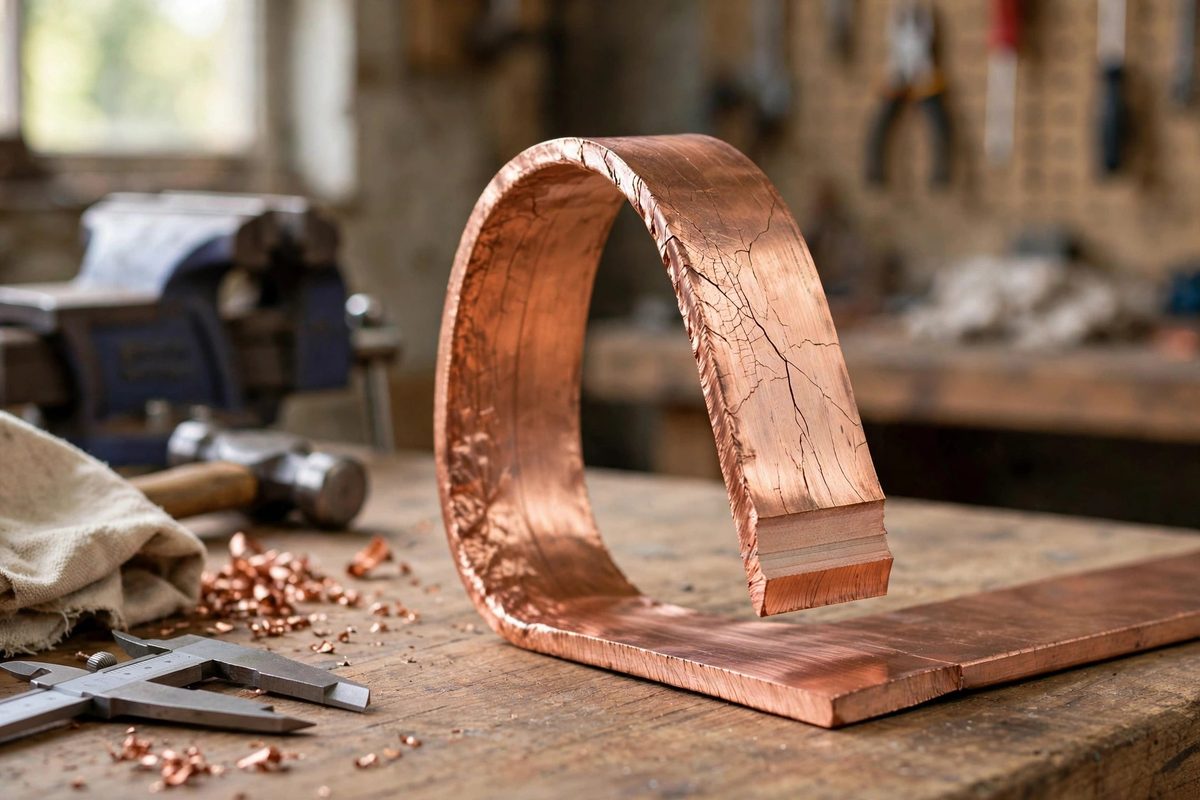
Bend a strip of copper and the outside stretches while the inside compresses; somewhere between them lies the neutral axis, the layer that neither stretches nor compresses. The K-factor locates that axis as a fraction of the thickness, and it is the number that makes flat-pattern layout accurate. Copper's softness shifts the K-factor from steel's familiar values, so copper work needs copper numbers.
What the K-Factor Does
When laying out a flat pattern for a bent part, you need the developed length: the flat size that folds into the finished dimensions. The bend allowance, the amount of material consumed in the bend, depends on where the neutral axis sits. The K-factor expresses that position as a ratio of the thickness, typically between 0.3 and 0.5. Multiply through the bend allowance formula and the flat pattern comes out right. Get the K-factor wrong and every bend in the part is off by a little, which accumulates across multiple bends into a part that does not fit.
Copper's Behavior in Bending
Annealed copper is soft and ductile, which pushes the neutral axis toward the inside of the bend compared to harder materials; typical K-factors for soft copper run lower than steel's common 0.4-ish values. Work-hardened copper behaves more like steel. The bend radius matters enormously: tight inside radii shift the neutral axis inward, while generous radii let it sit nearer the center. Thickness matters too, since the ratio of bend radius to thickness is what actually drives the K-factor, not either dimension alone. These dependencies are why published K-factor tables are starting points, not gospel.
Determining Your K-Factor
The reliable method is empirical: bend a test strip of the actual copper, at the actual thickness, over the actual radius you will use, then measure the resulting legs and back-calculate the bend allowance and the K-factor that produced it. Cut the test strip to a known length, bend it to ninety degrees, measure the outside dimensions of the legs, and do the arithmetic. One careful test beats any table, because it captures your material, your tooling, and your technique in one number. Repeat for each distinct bend radius in the project; the K-factor for a tight radius does not apply to a sweeping one.
Applying It to the Flat Pattern
With the K-factor established, calculate each bend's allowance and lay out the flat pattern by adding the flat leg lengths and the bend allowances. Work from the finished dimensions inward, because the finished part is what must fit. For parts with multiple bends, lay out sequentially from one end so errors do not compound from both directions. Mark bend lines clearly on the flat, noting the bend direction for each; a bend folded the wrong way wastes the whole pattern. Cut the first article, bend it, measure it, and adjust the K-factor if needed before cutting the batch.
Copper-Specific Tips
Anneal the copper before bending if it has work-hardened from handling or previous operations; hard copper springs back more and needs a different K-factor than soft. Support the sheet well during bending to avoid unintended deformation away from the bend line. Deburr the flat pattern edges before bending, since burrs affect how the sheet seats in the brake and shift the effective bend line. Copper's softness is forgiving of small errors but punishes sloppy layout, so the accurate K-factor earns its keep in parts that fit the first time.
The K-factor for copper is measured, not assumed: bend a test strip, calculate the real number for your radius and temper, lay out the flat pattern from finished dimensions, and prove it on a first article. The bends will land where the drawing says they should.
Related Guides
- Calculating Bend Deduction in Sheet Aluminum: When sheet aluminum bends, the material on the inside of the bend compresses and the outside stretches, and the neutral axis, the layer that neither
- Fire Welding Temperature Windows in Coal Benches: Fire welding, forge welding steel in a coal forge, is the blacksmith's high-wire act: the steel must reach a temperature where its surfaces will fuse
- Shielding Gas Flow Rates for Short Circuit MIG: Short circuit MIG, the mode where the wire repeatedly touches the puddle and the arc extinguishes and restrikes dozens of times per second, is the
- Tramming Mill Heads to Eliminate Radial Scallops: A milling machine with its head out of tram cuts a subtle lie into every surface: instead of a flat plane, the cutter leaves a series of shallow
- High Frequency AC Balance Tuning for Thin TIG Aluminum: Thin aluminum punishes sloppy TIG settings: too much heat and it falls through, too little cleaning and the weld is contaminated, wrong balance and