
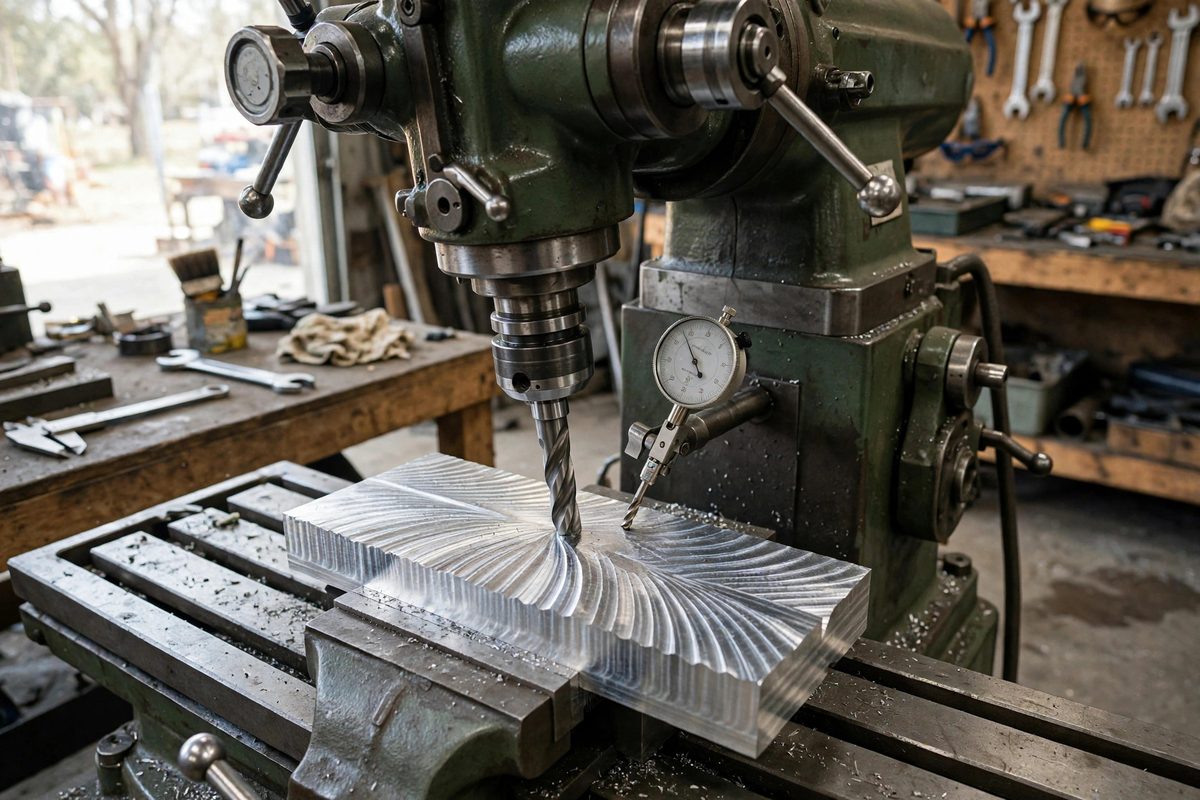
A milling machine with its head out of tram cuts a subtle lie into every surface: instead of a flat plane, the cutter leaves a series of shallow scallops or a tilted face, and no amount of careful feed technique fixes it. Tramming, squaring the spindle axis to the table in both directions, is the foundational alignment of the mill. When the head is truly trammed, a fly cutter or face mill leaves a surface that reads flat under a straightedge and needs no apology. When it is not, every part carries the error.
What Tram Error Looks Like on the Work
Tram error shows up in two axes: nod (front-to-back tilt) and tilt (side-to-side). A nodding head cuts a surface that is slightly dished or crowned along the Y axis; the cutter digs deeper on one side of its rotation than the other, leaving radial scallops that catch a fingernail. Side tilt does the same along X. Either one also cuts shoulders and steps that are not square to the face, so the error compounds through every subsequent operation.
The telltale sign is a face-milled surface with a visible directional pattern that changes when you rotate the part. If the pattern rotates with the part, it is the cut; if it stays aligned to the machine axes, it is the tram. Check with a dial indicator before assuming anything else.
The Indicator Sweep Method
Tramming is measured with a dial test indicator mounted in the spindle, sweeping a large circle on the table or on a precision reference. Mount the indicator on an arm so the tip describes the widest circle the table allows; a wider sweep amplifies the error and makes small misalignments readable. Zero the indicator at one point, rotate the spindle by hand through 180 degrees, and read the difference: that difference, halved, is the tram error in that axis.
Sweep both axes. The X axis (side to side) is adjusted by tilting the head on its pivot; the Y axis (front to back) by nodding it. Adjust, re-sweep, and repeat. The process is iterative because the two axes interact slightly; getting X perfect and then adjusting Y will move X a touch. Work both toward zero together rather than perfecting one and then the other.
How Tight Is Tight Enough
For general shop work, tram within about a thousandth of an inch over the sweep diameter is a solid target. For fine facing work with large cutters, tighter is better, since the error scales with cutter diameter: a thou over a six-inch sweep becomes very visible under a wide face mill. There is a point of diminishing returns where chasing the last tenth takes longer than the job, so match the tram to the work.
- Sweep the indicator on a clean, deburred table or a known-flat reference; dirt under the sweep lies.
- Lock every axis not being adjusted; an unlocked knee or quill drifts during the sweep.
- Rotate the spindle by hand, not under power; power rotation adds vibration that masks the reading.
- Recheck tram after any crash, heavy cut, or head repositioning; it moves more easily than you think.
Nod Versus Tilt: Adjusting Each Axis
On a typical Bridgeport-style mill, the head nods on one pivot and tilts on another, each with its own locking bolts. Loosen only the bolts for the axis you are adjusting, make the correction in small increments, and snug the bolts before re-sweeping. The classic mistake is leaving both axes loose, which lets the head flop and turns tramming into a random walk.
Tap the head into position with a soft mallet or by hand pressure rather than cranking on the adjustment; fine movements respond better to taps than to force. And always approach the final position from the same direction to take up any backlash in the pivot. Consistency in technique produces consistency in the reading.
Verifying With a Test Cut
The indicator says the head is trammed; the test cut proves it. Face a piece of scrap with a fly cutter or face mill, then check the surface with a straightedge and feeler gauges in both axes. A properly trammed head leaves a surface flat within the indicator's promise. If the test cut disagrees with the sweep, suspect the sweep setup: a bent indicator arm, a dirty table, or an unlocked axis will all lie to you.
Make tramming a habit, not an event. A quick sweep at the start of precision work takes minutes and saves hours of scrapped parts. The mill only cuts as true as its head, and the head only stays true if someone checks it.
Sweep wide, adjust small, lock everything, and prove it with a cut. Tram is the mill's handshake with flatness, and it is worth renewing often.
Related Guides
- Tramming Quill Runout on Precision Knee Mills: A knee mill that is not trammed cuts tapered faces, drills angled holes, and generally lies to you about every dimension. Tramming, aligning the
- Calculating Bend Deduction in Sheet Aluminum: When sheet aluminum bends, the material on the inside of the bend compresses and the outside stretches, and the neutral axis, the layer that neither
- Fire Welding Temperature Windows in Coal Benches: Fire welding, forge welding steel in a coal forge, is the blacksmith's high-wire act: the steel must reach a temperature where its surfaces will fuse
- Shielding Gas Flow Rates for Short Circuit MIG: Short circuit MIG, the mode where the wire repeatedly touches the puddle and the arc extinguishes and restrikes dozens of times per second, is the
- Calculating K-Factor Values for Formed Sheet Copper: Bend a strip of copper and the outside stretches while the inside compresses; somewhere between them lies the neutral axis, the layer that neither