
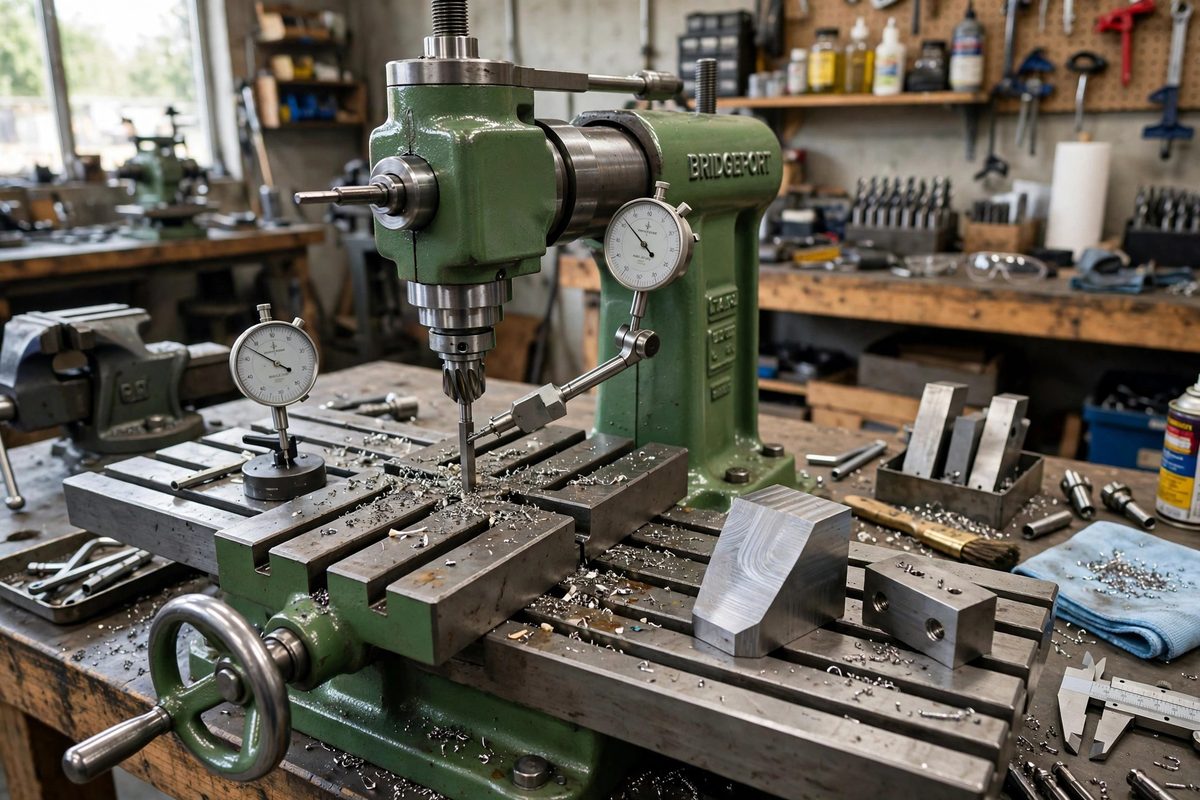
A knee mill that is not trammed cuts tapered faces, drills angled holes, and generally lies to you about every dimension. Tramming, aligning the spindle axis square to the table, and checking quill runout are the two setup procedures that determine whether the machine tells the truth. They take minutes and they underpin everything the mill does.
What Tramming Corrects
The mill's head can tilt on two axes, nod (front to back) and tilt (side to side), and any misalignment means the spindle is not perpendicular to the table. Even a small error shows up fast: a face mill cutting with a tilted spindle leaves a stepped or dished surface, and a drilled hole wanders off perpendicular. Tramming sets both axes true using a dial indicator swept across the table. The goal is not perfection beyond measurement but alignment within the tolerance the work requires; a machine trammed to a tenth over the sweep diameter is true enough for most work.
The Tramming Procedure
Mount a dial indicator on an arm in the spindle, with the indicator tip touching the table surface, and sweep it through a full rotation by turning the spindle by hand. Note the readings at front, back, left, and right. Adjust the head's nod until front and back read the same, and the tilt until left and right read the same, iterating because the adjustments interact slightly. Lock the head after each adjustment and recheck, since locking can shift the setting. Sweep a large diameter for sensitivity; a small sweep hides errors that a large sweep reveals. Clean the table first, because a chip under the indicator tip corrupts every reading.
Checking Quill Runout
With the head trammed, check the quill itself: mount the indicator to read on the quill's outside diameter and extend and retract the quill, watching for movement that indicates a bent quill or worn bore. Then check spindle runout with a test bar or a known-true toolholder in the spindle, indicating near the spindle nose and again several inches out; the difference reveals angular error. Runout at the nose comes from the spindle bearings or a damaged taper; runout that grows with distance points to a bent test bar or a misaligned quill. Know which you are measuring before drawing conclusions.
Spindle Bearing Condition
Quill runout that was not there last month suggests bearing wear or damage. Check for play by pushing and pulling on the spindle nose while indicating; movement under hand pressure means the bearings are loose or worn. Listen to the spindle at speed: rumbling or whining that was not there before corroborates the measurement. Bearing replacement is a bigger job, but running a precision mill on failing bearings produces scrap and risks damaging the spindle itself. The indicator gives you early warning; act on it.
Maintaining the Tram
Tram drifts with use: heavy cuts, head repositioning, and even temperature changes move things. Check the tram whenever the head has been moved, after any crash or heavy interrupted cut, and periodically as routine maintenance. Keep a record of the tram readings; a head that needs frequent re-tramming has a mechanical problem, loose gibs, worn ways, or a damaged tilt mechanism, that adjustment alone will not fix. The disciplined habit is to verify before critical work, not to discover the error in the finished part.
Tram the head with a swept indicator, verify the quill and spindle runout, listen to the bearings, and recheck on a schedule. The knee mill then cuts square, drills true, and earns the name precision in its description.
Related Guides
- Tramming Mill Heads to Eliminate Radial Scallops: A milling machine with its head out of tram cuts a subtle lie into every surface: instead of a flat plane, the cutter leaves a series of shallow
- Calculating Bend Deduction in Sheet Aluminum: When sheet aluminum bends, the material on the inside of the bend compresses and the outside stretches, and the neutral axis, the layer that neither
- Fire Welding Temperature Windows in Coal Benches: Fire welding, forge welding steel in a coal forge, is the blacksmith's high-wire act: the steel must reach a temperature where its surfaces will fuse
- Shielding Gas Flow Rates for Short Circuit MIG: Short circuit MIG, the mode where the wire repeatedly touches the puddle and the arc extinguishes and restrikes dozens of times per second, is the
- Calculating K-Factor Values for Formed Sheet Copper: Bend a strip of copper and the outside stretches while the inside compresses; somewhere between them lies the neutral axis, the layer that neither