
Fire welding, forge welding steel in a coal forge, is the blacksmith's high-wire act: the steel must reach a temperature where its surfaces will fuse under the hammer, but not so hot that it burns. The window between welding heat and burning heat is narrow, measured in color and seconds, and the coal fire is both the tool and the complication. Understanding the temperature window, how to see it, how to hold it, and how the coal fire affects it, is the difference between a weld that holds and a bar that crumbles.
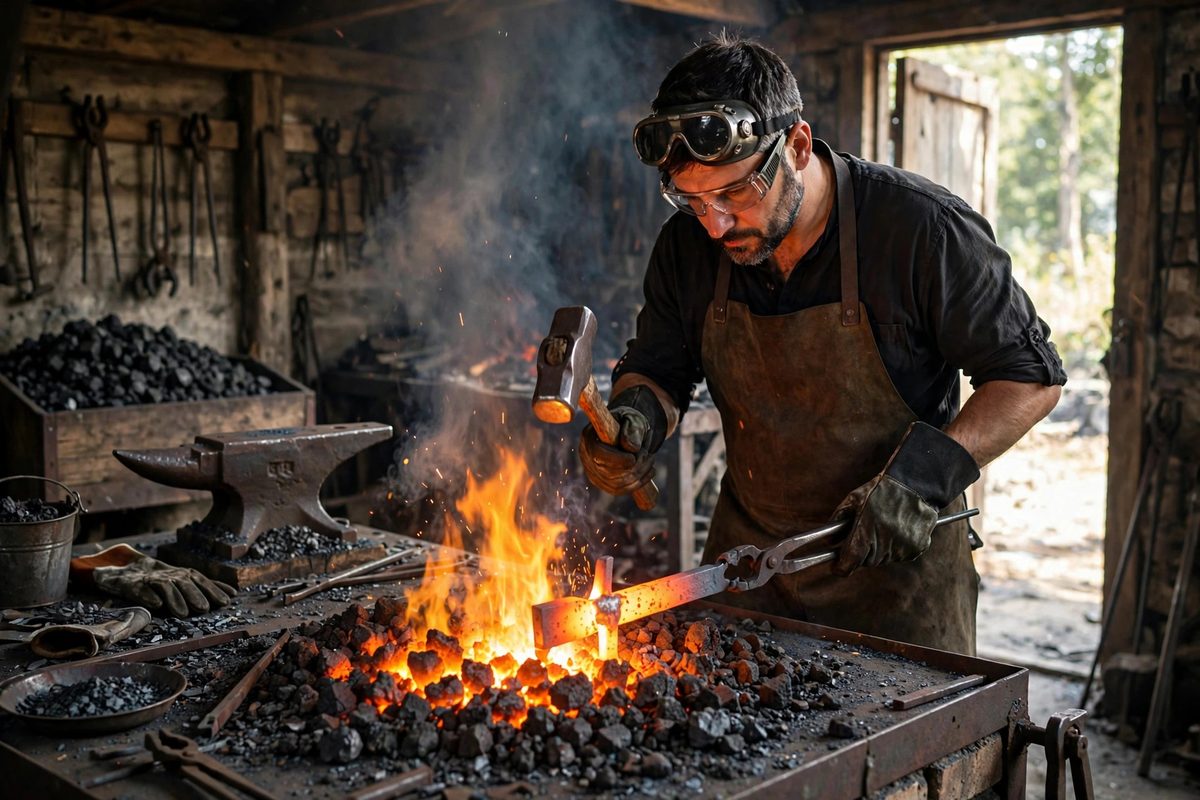
The Welding Window in Steel
Steel welds when its surface reaches a near-molten, sparkling state, roughly in the bright yellow to white range, where the surface is fluid enough to bond under hammer pressure. Below that, the surfaces merely stick or bounce apart; the weld looks made but fails under load. Above it, the steel burns: carbon boils out of the surface, the metal sparks excessively and throws off molten droplets, and the burned layer will never weld to anything.
The window is only a few hundred degrees wide, and it moves with the steel. Low-carbon steels weld at the lower end and tolerate a wider window; higher-carbon steels need more heat and punish overshoot faster, because the carbon that makes them hardenable also makes them burnable. Know your steel before you light the fire.
Reading the Fire and the Color
In a coal forge, you read temperature by color in dim light. The progression runs from dull red through cherry, orange, yellow, to the near-white of welding heat. Welding heat shows as a bright, almost dazzling yellow-white with a wet, almost sweaty look on the surface, and the first tiny sparks beginning to pop off. Profuse showering sparks mean you have passed welding and entered burning; pull the steel or lose it.
Judge the color in consistent light. A forge in bright daylight lies to you: everything looks cooler than it is, and you will overheat before the color looks right. Shade the work area or work toward dusk, and trust the color you see in the dimmer light. Generations of smiths learned this the hard way.
Flux and the Coal Fire
Flux, traditionally borax, protects the weld surfaces from the fire's atmosphere. At welding heat, the steel surface oxidizes instantly in air; the oxide layer prevents welding, so the flux melts into a glassy coating that seals the surfaces until the hammer drives them together. Apply flux as the steel approaches welding heat, not before: flux applied too early melts, runs off, and leaves the steel unprotected at the critical moment.
The coal fire complicates this because coal brings sulfur and impurities that a gas forge does not. A clean, well-coked fire matters enormously for welding: coke the coal first by pushing fresh coal to the edges and working from the established coke heart, so the steel heats in relatively clean coke rather than in raw, gassy coal. Welding in a dirty fire invites inclusions that no hammer work will fix.
- Build a deep fire; shallow fires oxidize the steel from the blast before it reaches heat.
- Keep the steel buried in the coals, not sitting on top where the air blast hits it directly.
- Manage the blast: a gentle air supply brings the steel up evenly, while a fierce blast overshoots the window before you can react.
- Have the anvil, hammer, and flux within arm's reach before the steel reaches heat; seconds matter.
The Weld Itself: Speed and Pressure
When the steel hits the window, move. Carry it to the anvil quickly but without panic, and start with light, rapid blows to tack the surfaces together, squeezing out the molten flux and scale. Then follow with heavier blows to consolidate the weld, working from the center outward or from one end to the other so trapped flux has an exit path.
Watch the weld line as you work. A good weld shows the surfaces merging with flux squeezing out ahead of the hammer; a failing weld shows the pieces springing apart or a dark line that will not close. If it will not take, do not keep hammering cold steel: reflux and bring it back to heat. Hammering below welding heat work-hardens the joint and makes the next attempt harder.
Safety at Welding Heat
Welding heat throws sparks, spalls scale, and radiates enough heat to burn skin at a distance. Wear eye protection rated for the brightness, keep your body out of the spark stream, and be aware that the scale popping off at these temperatures can travel several feet. Leather apron, closed boots, and no synthetic clothing that melts: the standard forge safety rules apply with extra emphasis at welding heat.
Learn the window on mild steel before attempting high-carbon welds. Mild steel forgives; tool steel does not. The color reading, the flux timing, and the hammer speed are the same skills either way, and they are cheaper to learn on steel that tolerates mistakes.
Coke the fire clean, read the color in dim light, flux at the right moment, and hammer fast while the window is open. Fire welding is a conversation between your eyes and the steel, and fluency comes from watching a thousand heats. Start watching.
Related Guides
- Tuning Tuyere Blast Velocity for High Temp Coal Forges: The tuyere delivers the air blast that makes a coal forge hot, and the velocity of that blast controls everything: how hot the fire gets, where the
- Calculating Bend Deduction in Sheet Aluminum: When sheet aluminum bends, the material on the inside of the bend compresses and the outside stretches, and the neutral axis, the layer that neither
- Shielding Gas Flow Rates for Short Circuit MIG: Short circuit MIG, the mode where the wire repeatedly touches the puddle and the arc extinguishes and restrikes dozens of times per second, is the
- Tramming Mill Heads to Eliminate Radial Scallops: A milling machine with its head out of tram cuts a subtle lie into every surface: instead of a flat plane, the cutter leaves a series of shallow
- Calculating K-Factor Values for Formed Sheet Copper: Bend a strip of copper and the outside stretches while the inside compresses; somewhere between them lies the neutral axis, the layer that neither