
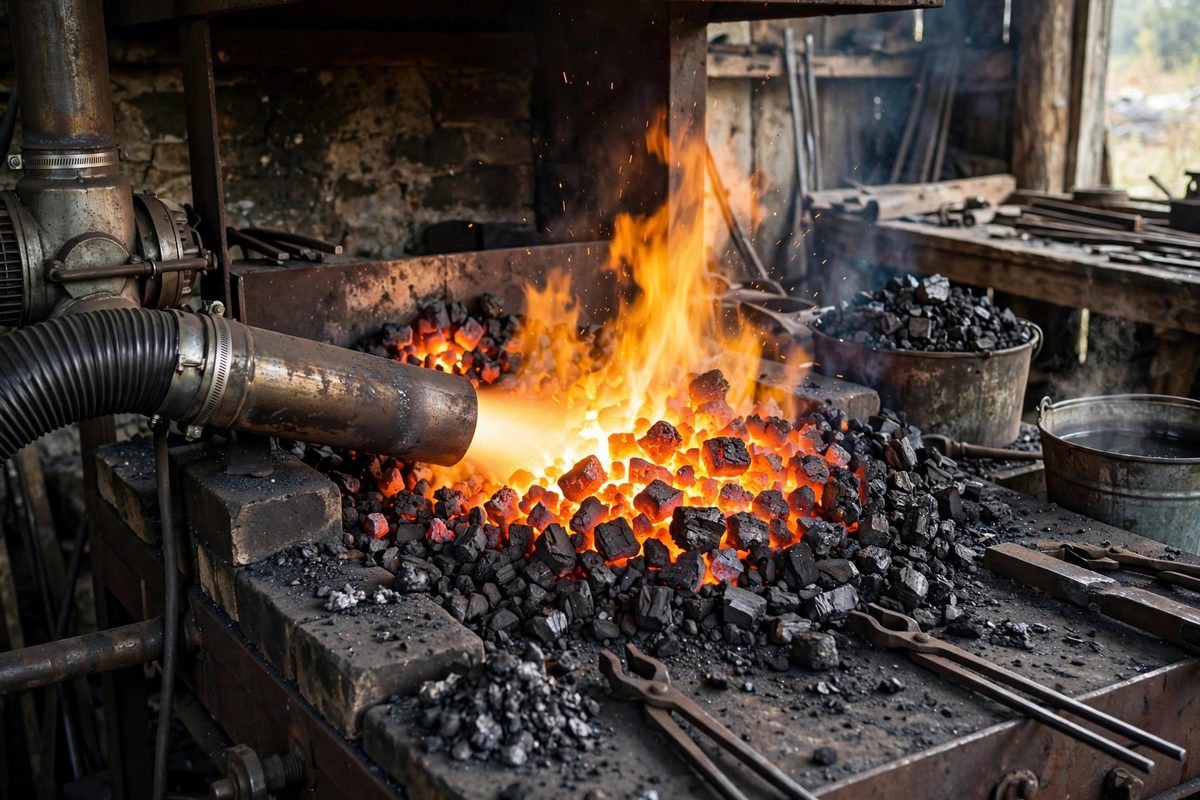
The tuyere delivers the air blast that makes a coal forge hot, and the velocity of that blast controls everything: how hot the fire gets, where the hot spot sits, and how fast the coal burns. Too little air and the forge never reaches welding heat; too much and it burns through coal, oxidizes the steel, and blows the fire apart. Tuning the blast is the core skill of coal forge work.
What Blast Velocity Does
Air velocity through the tuyere determines the oxygen delivery rate to the fire, and oxygen delivery sets the combustion intensity. Higher velocity drives a hotter, more concentrated hot spot directly above the tuyere; lower velocity spreads a gentler heat over a wider area. The velocity also affects the fire's depth behavior: a strong blast pushes the hottest zone deeper into the coal bed, while a weak blast keeps the heat shallow. The smith tunes the blast to the work: high heat for welding, moderate for general forging, low for delicate work or for holding a fire between heats.
Reading the Fire
The fire tells you what the blast is doing. A fire that will not come up to heat despite plenty of coal wants more air. A fire burning through coal at an alarming rate, throwing sparks and showering the shop, has too much blast. Steel coming out with heavy scale is being oxidized by excess air; steel that will not reach welding heat is starved. The classic sign of correct blast is a clean-burning fire with a well-defined hot spot, coke forming properly around it, and the steel heating evenly without drama. Learn to read these signs and the tuyere adjustments become intuitive.
Adjusting the Blast
Control comes from the air gate or blower speed, and the adjustment should be smooth and incremental. Open the blast gradually when bringing the fire up, watching the fire respond; coal forges lag behind the adjustment by a bit, so give each change time to show its effect before adjusting again. For welding heat, open up to a strong blast once the steel is near temperature, then back off the moment the weld is done; holding full blast wastes coal and overheats the fire. Between heats, cut the blast back to a whisper that keeps the fire alive without consuming the coal bed. The rhythm of blast adjustment becomes second nature: up for heat, down for holding.
Tuyere Design and Placement
The tuyere's size and position shape the blast before any adjustment. A tuyere too large for the firepot delivers a lazy blast that will not concentrate heat; too small and it jets, blowing a hole in the fire. The tuyere should sit at the proper depth in the firepot, with the coal bed deep enough above it for the blast to diffuse into a hot zone rather than blowing straight through. Clinker management matters enormously: a tuyere choked with clinker delivers uneven blast no matter the gate setting, so clean it regularly. The best-tuned blast in the world cannot fix a blocked tuyere.
Fuel and Blast Interaction
Different coals want different blasts. High-volatile bituminous coal ignites easily and wants a gentler blast to avoid burning too fast; coke, already devolatilized, tolerates and needs a stronger blast. Wet coal steams and cools the fire, demanding more air to compensate, though drying the coal is the better fix. Size the coal appropriately for the work; large lumps for a big hot fire, smaller for delicate work. The blast, the fuel, and the firepot form a system, and tuning one without considering the others leads in circles.
Tune the tuyere blast to the fire's needs: enough air for the heat required, no more; read the fire's behavior; keep the tuyere clean; match the blast to the fuel. The coal forge then delivers exactly the heat the work demands, from a gentle warming fire to a roaring weld.
Related Guides
- Fire Welding Temperature Windows in Coal Benches: Fire welding, forge welding steel in a coal forge, is the blacksmith's high-wire act: the steel must reach a temperature where its surfaces will fuse
- High Frequency AC Balance Tuning for Thin TIG Aluminum: Thin aluminum punishes sloppy TIG settings: too much heat and it falls through, too little cleaning and the weld is contaminated, wrong balance and
- Calculating Bend Deduction in Sheet Aluminum: When sheet aluminum bends, the material on the inside of the bend compresses and the outside stretches, and the neutral axis, the layer that neither
- Shielding Gas Flow Rates for Short Circuit MIG: Short circuit MIG, the mode where the wire repeatedly touches the puddle and the arc extinguishes and restrikes dozens of times per second, is the
- Tramming Mill Heads to Eliminate Radial Scallops: A milling machine with its head out of tram cuts a subtle lie into every surface: instead of a flat plane, the cutter leaves a series of shallow