
A living hinge, a thin flexible section printed as part of the whole, lets a 3D-printed part bend repeatedly without hardware. In TPU, the flexible filament, living hinges can survive thousands of cycles, but only if the hinge geometry respects the material's limits. Too thick and it will not bend; too thin and it tears. Calculating the deflection the hinge must survive, and sizing the hinge for it, is straightforward engineering that saves a lot of failed prints.
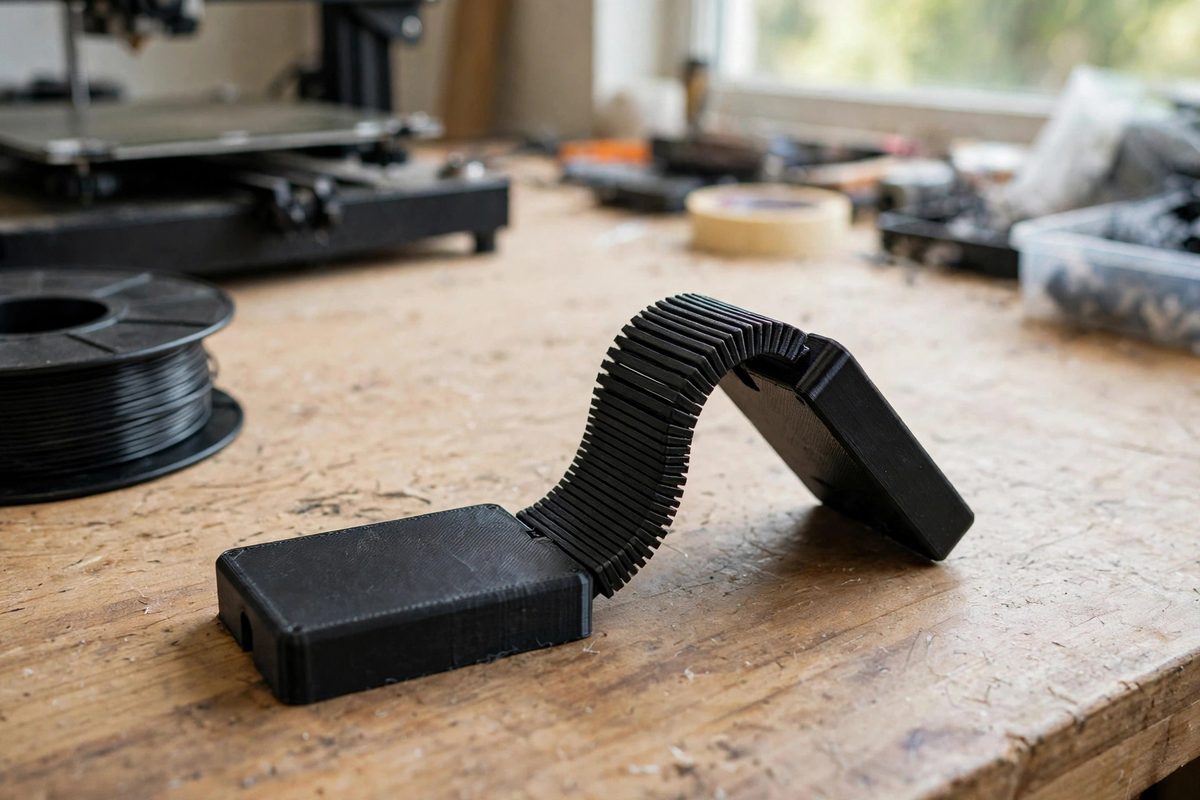
How a living hinge bends
When a hinge flexes, the material on the outside of the bend stretches and the material on the inside compresses. The strain is highest at the surfaces and zero at the neutral axis in the middle. For a hinge of thickness t bent to a radius r, the surface strain is approximately t divided by 2r. TPU can typically tolerate repeated strains in the range of 20 to 50 percent depending on the formulation, far more than rigid plastics. That generous strain budget is what makes TPU hinges practical, but it is still finite, and exceeding it on every cycle fatigues the material until it cracks.
Sizing the hinge thickness
Work backward from the bend the hinge must make. If the design needs a 180-degree fold (the lid closing flat against the body), the bend radius will be tight, often close to the hinge thickness itself. For a target surface strain of, say, 30 percent at the tightest bend, the hinge thickness should be roughly 0.6 times the bend radius. In practice, TPU living hinges in the range of 0.6 to 1.2mm thick handle most consumer-part folds, with thinner hinges for tight folds and thicker ones where the hinge also carries load. Print a test strip with several hinge thicknesses and cycle each by hand; the right thickness bends easily without whitening at the crease.
Hinge length and stress distribution
A longer hinge distributes the bend over more material, reducing the peak strain at any point. If a short hinge shows stress whitening (the pale crease that signals the material is near its limit), lengthening the hinge section often fixes it without changing the thickness. Aim the hinge length at roughly three to five times the thickness for a 180-degree fold. Also consider the hinge's width: the full width of the part is fine, but a hinge narrower than the part concentrates stress at the transitions, so blend the hinge into the surrounding walls with generous fillets rather than sharp corners.
Print orientation and layer lines
Print the hinge so the bend axis runs along the layer lines, not across them. Layer adhesion in TPU is good but still the weakest direction; a hinge bent across layer lines delaminates along the crease after repeated cycling. Orient the part so the hinge's bend flexes the extruded strands lengthwise. Use enough perimeters that the hinge is mostly perimeter walls rather than infill; two to three perimeters in a 1mm hinge gives solid, consistent material. Avoid infill patterns that create voids in the hinge zone.
Testing for cycle life
A hinge that survives ten hand cycles is not proven. Cycle test prototypes to at least several hundred bends, watching for whitening, cracking at the edges, or increasing stiffness. TPU formulations vary enormously in fatigue life, so test the actual filament you will use. If the design needs tens of thousands of cycles, consider whether a printed hinge is the right solution at all; sometimes a separate flexible component or a mechanical hinge serves better. Engineering honesty beats optimism.
Calculate the strain, size the thickness, lengthen to distribute stress, orient with the layers, and test honestly. TPU rewards the math with hinges that just keep bending.
Related Guides
- Living Hinge Fatigue Calculations for TPU Prints: A living hinge printed in TPU is one of those designs that either lasts years or snaps in a week, and the difference is geometry, not luck. Unlike
- Snap Fit Tab Beam Deflection Tolerances in PETG Files: Snap-fit tabs are the 3D printer's answer to screws: a cantilever beam that bends aside during assembly and springs back to lock parts together. They
- Chamfer Relief Clearance for Friction Fit Printable Pins: Printed pins that press into printed holes are the bread and butter of 3D-printed assemblies: hinges, joints, locators, fasteners. Getting the
- Printable Snap Joint Clearances for Hard Polycarbonate: Snap-fit joints, the cantilever hooks and annular rings that click assemblies together without fasteners, are among the most satisfying features to