
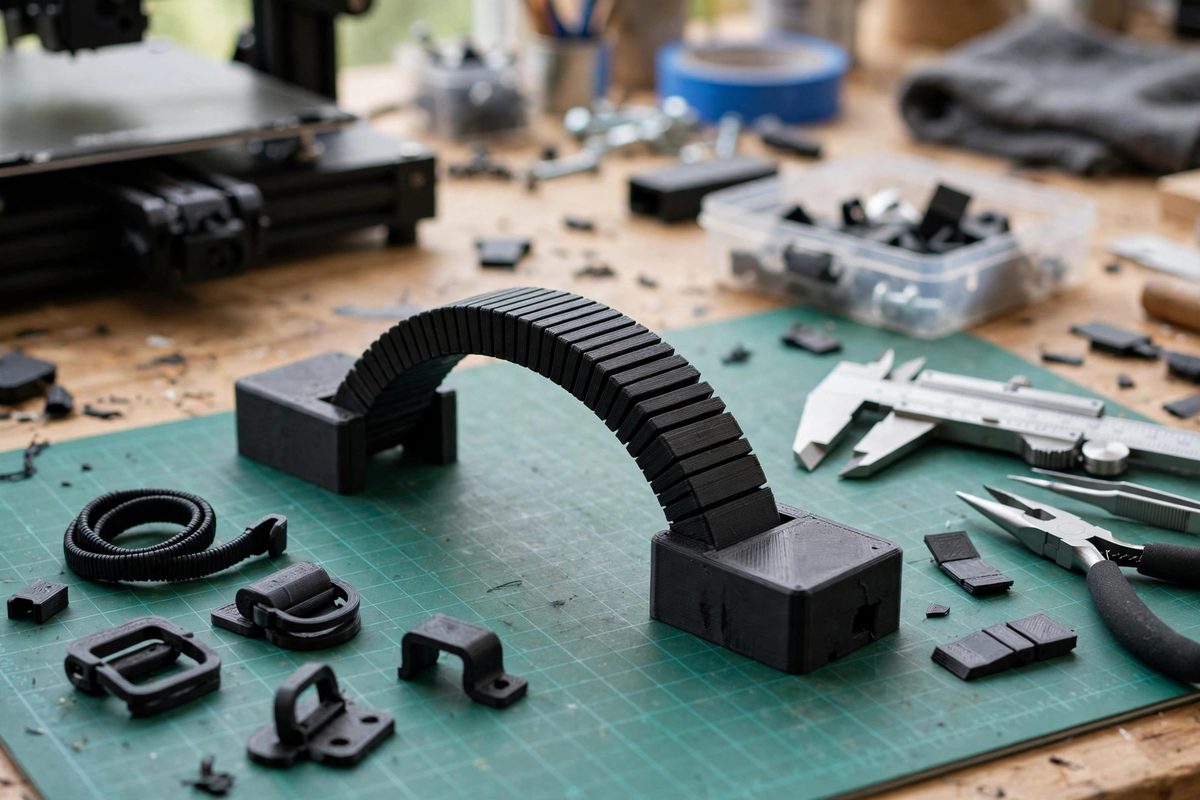
A living hinge printed in TPU is one of those designs that either lasts years or snaps in a week, and the difference is geometry, not luck. Unlike polypropylene hinges that rely on molecular orientation, a TPU hinge survives on elasticity: it bends because the material stretches and recovers, which means every design choice about thickness, bend radius, and cycle count feeds directly into how long the part lives.
How TPU Handles Repeated Bending
TPU (thermoplastic polyurethane) has far higher elongation at break than PLA or PETG, often several hundred percent, which is why thin TPU sections can fold back on themselves without whitening. But elasticity is not infinite. Each bend cycle strains the hinge's outer fibers, and over thousands of cycles the material accumulates micro-damage that eventually shows as surface crazing, then as a tear. Fatigue life depends on the peak strain per cycle, so the entire design goal is to keep that strain as low as practical while still getting the flex you need.
The Strain Geometry: Thickness and Radius
For a simple bend, the outer-fiber strain is approximately the hinge thickness divided by twice the bend radius (strain ≈ t / 2R). This one relationship drives everything. Halve the hinge thickness and you halve the strain; double the bend radius and you halve it again. In practical terms, a hinge section around 0.6 to 0.8 mm thick bending around a generous radius (8 mm or more) will outlast a 1.2 mm hinge folded sharp by an order of magnitude. Print the hinge section with enough clearance that it is never forced into a tighter radius than designed, because a sharp crease concentrates all the strain in one line.
Orienting the Print for Strength
Layer lines are the hinge's enemy. A living hinge must be printed so the bend axis runs parallel to the layer lines, meaning the hinge section is printed flat and bends across the layers, not along them. If the bend flexes along the layer boundary, the part delaminates after a handful of cycles; this is the single most common failure in printed living hinges. Design the part so the hinge is a thin section printed in the same flat orientation as the rest of the part, and let the bend happen across the XY plane, where layer adhesion is strongest.
Estimating Cycle Life
Exact fatigue prediction for printed TPU is genuinely hard, because print quality, hardness, and even ambient temperature shift the numbers. As shop wisdom: keep peak outer-fiber strain under roughly 10 percent of the material's elongation at break for high-cycle parts (hinges opened dozens of times a day), and under roughly 25 percent for occasional-use closures like a battery door opened monthly. Softer TPU (around 85A) survives more cycles than harder blends (95A and up) because it absorbs strain with less internal stress. When in doubt, print test coupons at several thicknesses, flex them a few hundred times by hand, and inspect for whitening; a coupon that stays clear after 500 hand flexes is a reasonable production candidate.
Design Details That Add Life
A few geometric tricks multiply fatigue life. Relieve the hinge with a gentle fillet or a wider thinned zone instead of a sharp notch, so strain spreads over a longer section. Add mechanical stops that limit the bend to the designed angle, because over-folding is what kills most hinges in the field. And keep the hinge section free of infill transitions: the solid hinge area should merge smoothly into the surrounding walls, since an infill boundary inside a flexing zone creates a stress riser exactly where you cannot afford one.
Living hinges in TPU reward designers who respect the strain equation. Thin the hinge, open the radius, orient the layers right, and limit the travel, and the part will cycle far longer than anyone expects from a 3D print. When a hinge fails, it is almost always one of those four rules being violated, so check them in order before redesigning from scratch.
Related Guides
- Calculating Living Hinge Deflection in TPU Parts: A living hinge, a thin flexible section printed as part of the whole, lets a 3D-printed part bend repeatedly without hardware. In TPU, the flexible
- Snap Fit Tab Beam Deflection Tolerances in PETG Files: Snap-fit tabs are the 3D printer's answer to screws: a cantilever beam that bends aside during assembly and springs back to lock parts together. They
- Chamfer Relief Clearance for Friction Fit Printable Pins: Printed pins that press into printed holes are the bread and butter of 3D-printed assemblies: hinges, joints, locators, fasteners. Getting the
- Printable Snap Joint Clearances for Hard Polycarbonate: Snap-fit joints, the cantilever hooks and annular rings that click assemblies together without fasteners, are among the most satisfying features to