
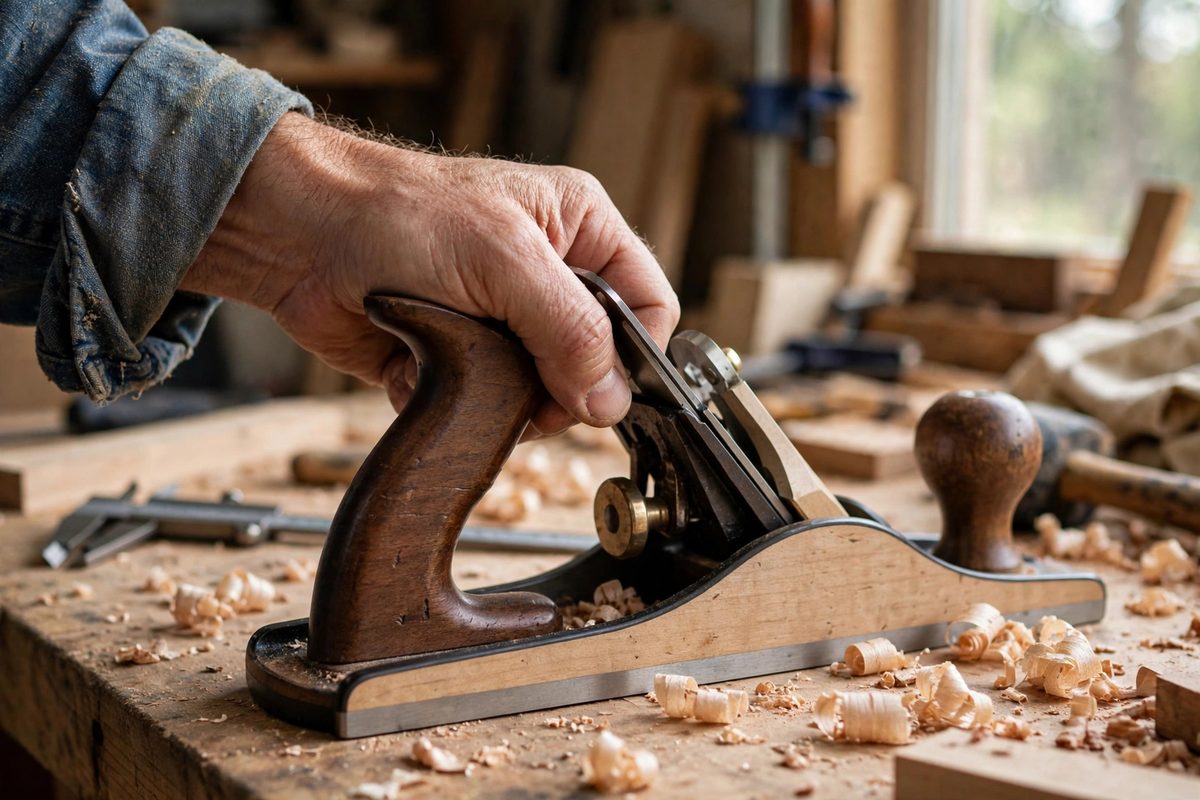
A hand plane's tote, the rear handle, is where the craftsman's hand meets the tool, and its profile determines comfort, control, and fatigue over a day of planing. The subtle master variable is the relationship between the grip profile and the plane's center of mass: a tote shaped and positioned so the hand naturally sits over the balance point lets the tool do the work, while a poorly placed grip forces the wrist to fight torque all day. Understanding this balance transforms tote design from aesthetics to engineering.
Where the mass sits
A bench plane's mass concentrates in the iron, the frog, and the sole: roughly the middle to front-middle of the body. The center of mass typically sits forward of the tote's mounting point, which means the hand on the tote is always managing some forward pitching moment. The tote's height, angle, and palm position determine how comfortably the wrist handles that moment.
Find the balance point empirically: balance the assembled plane across a finger or a dowel and mark the spot. That mark is the truth the grip design must respect. Every tote decision, height, rake angle, palm swell position, should be evaluated against where the mass actually is, not where it looks like it should be.
Tote geometry and wrist mechanics
The tote's rake angle, typically leaning back from vertical, positions the wrist in a neutral alignment where the forearm's pushing force drives through the hand into the tool without bending the wrist sideways. Too vertical and the wrist cocks back uncomfortably on the push; too raked and the hand slides up under load. The classic tote angle, refined over a century of metal planes, sits in a narrow comfortable band for good reason.
Handle height matters as much as angle. A tote that positions the palm's pushing surface roughly at or slightly above the center-of-mass height lets the push force act through the mass, minimizing the pitching torque the wrist must resist. Wooden tote replacements that change this height change the tool's feel more than any other single dimension.
The palm swell and pressure distribution
The tote's profile should distribute pressure across the palm and the base of the fingers, not concentrate it on one ridge or edge. A well-shaped palm swell fills the hand's hollow, spreading the load; sharp edges or flat slabs create pressure points that become painful within the hour. Carve or select totes with a full, rounded cross-section that the hand wraps rather than pinches.
Size the tote to the hand. Hands vary enormously, and a tote scaled for an average hand punishes everyone else. When making a replacement tote, trace the user's grip: have them hold a modeling-blank and mark where the fingers fall, then shape to those marks. A custom-fit tote is the ergonomic upgrade that costs only time.
Front knob and the two-handed system
The tote does not work alone; the front knob or handle completes the system. The front hand guides and adds downforce at the toe, while the rear hand provides the driving push. The balance between them should feel natural: if the rear hand is doing all the work and the front hand is just along for the ride, the tote geometry or the plane's setup needs attention, often the iron projection or the mouth opening rather than the handle.
Knob height and shape follow the same principles: a knob that fills the palm without forcing the wrist into extension, positioned so the guiding hand's downforce acts near the front of the sole. The two grips together should make the plane feel like an extension of the arms, not a wrestling opponent.
Testing and iteration
Test tote designs by planing, not by holding. A tote that feels fine in the hand for thirty seconds can reveal pressure points after twenty minutes of continuous work. Plane a real board, paying attention to hot spots in the palm, wrist angle fatigue, and whether the tool tracks straight without conscious correction. Adjust the profile with rasps and sandpaper, re-test, and repeat; wooden totes invite this iteration.
Compare against the balance mark after each change. Material removed from the tote shifts the center of mass slightly and changes the grip relationship; major reshaping deserves a re-check of the balance point. The goal is a plane that pushes straight and true with a relaxed grip, which is the signature of grip geometry done right.
Tote design is balance engineering: locate the center of mass, set the rake and height to drive through it, shape the palm swell to the hand, complete the system with the front knob, and iterate by planing. The plane will feel lighter than it is, because the wrist stopped fighting it.
Related Guides
- Handle Axis Offset Calculations for Hand Saws: The handle of a hand saw is not just a grip; it is a lever arm that determines how cutting force reaches the teeth. The offset between the handle's
- Wrist Supination Angles When Pushing Hand Planers: Push a hand plane for an hour and your wrist will file a complaint. The angle of the wrist during the push, specifically how much it supinates
- Neutral Wrist Alignment on Pull Stroke Japanese Saws: Japanese pull saws cut on the pull stroke, which reverses the body mechanics that Western push-saw users have internalized: instead of driving the
- Offset Tote Handles for Reduced Wrist Strain on Saws: The tote handle of a handsaw, that closed grip your hand wraps around, looks like a simple thing, but its position relative to the blade determines