
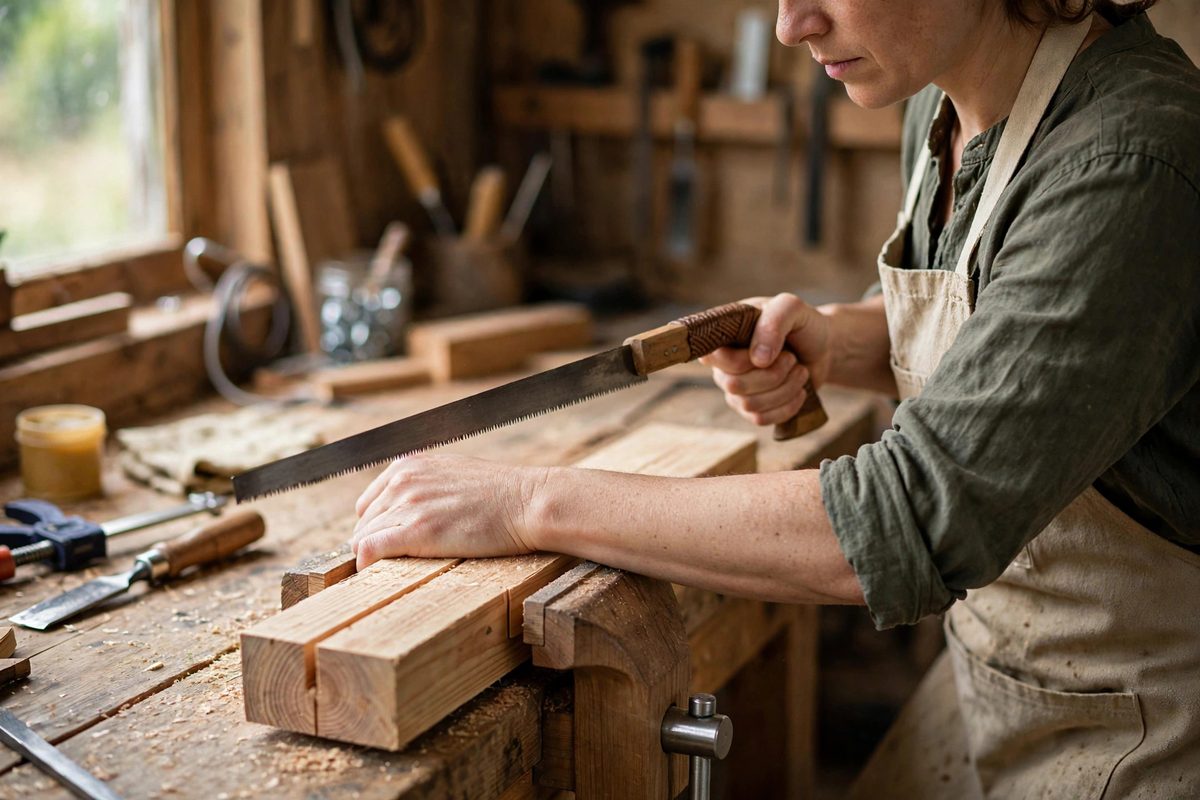
Japanese pull saws cut on the pull stroke, which reverses the body mechanics that Western push-saw users have internalized: instead of driving the saw forward with the shoulder, you draw it toward you, and the wrist's role changes completely. The critical ergonomic principle is neutral wrist alignment: keeping the wrist straight, neither bent up nor down nor cocked sideways, through the entire stroke. A bent wrist under the repetitive load of sawing concentrates stress on tendons and nerves; a neutral wrist distributes the load through the forearm's structure. The pull stroke makes neutral alignment both more achievable and more important.
Why the Pull Stroke Changes the Ergonomics
Push saws load the wrist in compression and demand a locked, braced wrist to transmit force without buckling: the natural tendency is to cock the wrist to stabilize it, which is precisely the harmful posture. Pull saws load the wrist in tension: the saw pulls the hand toward the work, and the forearm's flexor muscles engage in their strong, natural pulling configuration. In tension, the wrist wants to stay straight because the pulling force aligns the hand with the forearm automatically; fighting this by bending the wrist is both unnatural and unnecessary. The blade's thinness, possible because pull-cutting puts the blade in tension rather than compression, means less cutting force is needed overall, further reducing the load the wrist must manage. The ergonomic advantage is the mechanical advantage of tension over compression applied to human anatomy.
Finding Neutral Wrist
Neutral wrist means the back of the hand continues the line of the forearm: no upward bend (extension), no downward bend (flexion), no sideways deviation. To find it, hold the saw handle with a relaxed grip and let the arm hang: the wrist settles near neutral naturally. Then bring the saw to the work while preserving that alignment, adjusting the body's position rather than the wrist's angle. The common error is reaching too far or standing too close, which forces the wrist to bend to keep the blade on the line; the correction is footwork, moving the body so the arm operates in its comfortable mid-range where the wrist stays neutral effortlessly. Check periodically during long cuts: fatigue creeps the wrist out of neutral unconsciously, and a moment's attention restores it.
Grip and Handle Interaction
The traditional Japanese saw handle, a long rattan-wrapped grip, is designed for a relaxed, full-hand hold that promotes neutral wrist: the hand wraps the handle without clenching, and the handle's length allows the grip to shift along it as the stroke demands. Grip lightly: the pull stroke needs guidance, not force, and a death grip tenses the forearm, pulling the wrist out of neutral. Let the handle sit in the fingers rather than buried in the palm; this reduces the wrist torque needed to control the blade's angle. If the handle is uncomfortable or forces a bent wrist, the handle is wrong for your hand, not your technique: handles can be rewrapped, reshaped, or replaced, and a handle fitted to the hand is an ergonomic investment that pays off in every cut.
Stroke Mechanics That Protect the Wrist
The stroke itself should originate from the elbow and shoulder, not the wrist: the wrist's job is to transmit, holding neutral while the larger joints produce the motion. Start the cut with light, short strokes to establish the kerf, using minimal wrist involvement; once the kerf guides the blade, lengthen the stroke, letting the arm's natural reciprocation do the work. Keep the elbow close to the body and moving in the cutting plane: an elbow flaring outward twists the wrist to compensate. Let the saw's weight and the pull do the cutting: pressing down, the push-saw habit, loads the wrist unnecessarily and bends the thin blade. The rhythm should feel easy, almost lazy; if sawing feels like effort, something is wrong, usually excessive downward pressure or a dull blade forcing the issue. Sharpness is ergonomic: a sharp saw cuts with guidance alone, while a dull one demands force that the wrist pays for.
Long Sessions and Warning Signs
Even perfect form accumulates load over long sessions, so pace the work: alternate sawing with other tasks, shake out the hands periodically, and stop when form degrades, because tired muscles cannot hold neutral wrist and the joints take the load instead. Heed the warning signs: tingling in the fingers, aching in the wrist or forearm, or a need to shake the hand out frequently are signals to stop and rest, not to push through. These symptoms indicate the tissues are being overloaded, and repetitive strain injuries develop from exactly this pattern of ignored warnings. Stretch the wrists and forearms gently between sessions: flexor and extensor stretches maintain the tissue health that good form protects. The goal is a lifetime of sawing, and the wrist alignment habits that enable it are worth more than any single project's speed.
Neutral wrist on the pull stroke is the pull saw's ergonomic gift: tension aligns the wrist naturally, the thin blade needs little force, and the arm's large joints do the work. Find neutral, grip lightly, stroke from the elbow, keep the blade sharp, and listen to the warning signs. The saw cuts on the pull; the wrist should merely come along for the ride.
Related Guides
- Offset Tote Handles for Reduced Wrist Strain on Saws: The tote handle of a handsaw, that closed grip your hand wraps around, looks like a simple thing, but its position relative to the blade determines
- Wrist Supination Angles When Pushing Hand Planers: Push a hand plane for an hour and your wrist will file a complaint. The angle of the wrist during the push, specifically how much it supinates
- Handle Axis Offset Calculations for Hand Saws: The handle of a hand saw is not just a grip; it is a lever arm that determines how cutting force reaches the teeth. The offset between the handle's
- Center of Mass Balance in Hand Plane Grip Profiles: A hand plane's tote, the rear handle, is where the craftsman's hand meets the tool, and its profile determines comfort, control, and fatigue over a