
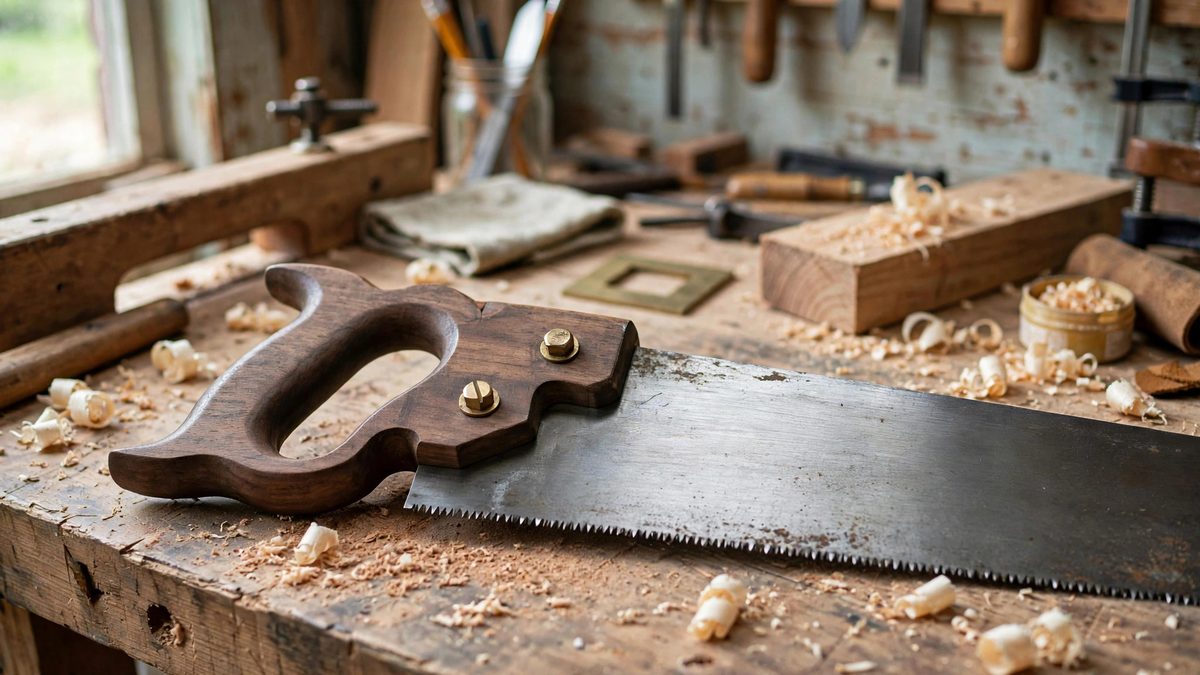
The tote handle of a handsaw, that closed grip your hand wraps around, looks like a simple thing, but its position relative to the blade determines how much your wrist suffers. A traditional centered tote forces the wrist into an awkward angle on every stroke; an offset tote aligns the handle with the natural line of push, letting the forearm drive the saw instead of the wrist fighting it. It is a small geometric change with a large ergonomic payoff.
What the Wrist Does During a Saw Stroke
On the push stroke, your arm delivers force along the line of the blade; on the pull stroke, it guides the return. With a centered tote, the grip sits directly above the blade, which sounds logical but puts the wrist in extension: the hand must bend backward to keep the forearm aligned with the push, and every stroke loads the wrist joint at an angle. Over a long rip cut, that repeated angled loading fatigues the wrist extensors and can aggravate existing wrist problems. The wrist is a poor power transmitter when bent; it is designed to transmit force best in a near-neutral position.
How an Offset Tote Changes the Geometry
An offset tote shifts the grip forward or angles it so the hand sits in line with the thrust. Instead of the wrist bending to connect the forearm to the blade, the handle meets the hand where the arm naturally wants to push. The forearm, wrist, and blade form a straighter line, and the force flows through the wrist neutrally rather than torquing it. The practical effect is immediate: the saw feels easier to push, tracking improves because the hand is not introducing sideways wobble through a bent wrist, and the wrist finishes the cut far less tired. This is why many premium saw designs and custom totes use some degree of offset: it is biomechanics, not fashion.
Closed vs Open Totes and Hand Fit
The tote's shape matters alongside its offset. A closed tote, with the hand fully enclosed, gives the most control and is the traditional choice for larger saws; an open tote (pistol-grip style) allows more hand positions and suits smaller saws and detail work. Whichever style, the tote must fit the hand: too small and the fingers cramp, too large and the grip is insecure. The grip's cross-section should fill the palm without sharp edges, and the horn at the top should support the hand without digging in. An offset tote that does not fit is no improvement over a centered one that does, so fit comes first and offset second.
Adapting or Replacing a Tote
If your saw's tote punishes your wrist, you have options. Some saws accept aftermarket or custom-made totes: the woodworking community has a long tradition of carving replacement totes, and patterns for offset designs are widely shared. When fitting a replacement, the critical dimensions are the mounting hole positions and the blade slot; the grip shape is yours to design. Carve the tote from a dense, stable hardwood, shape it to your hand with rasps and sandpaper, and finish it with oil for a grip that improves with use. Even modest reshaping of an existing tote, rounding sharp edges, relieving pressure points, opening the grip slightly, can reduce strain noticeably.
Technique Complements the Hardware
No handle fixes bad technique. Let the saw do the cutting: excessive downward or forward force loads the wrist regardless of tote geometry. Use the full length of the blade with long, relaxed strokes rather than short choppy ones, because short strokes concentrate the work in the wrist and forearm instead of distributing it. Stand so your shoulder, not just your arm, drives the stroke, and keep the wrist as neutral as the tote allows. Take breaks on long cuts: even perfect ergonomics cannot make repetitive strain disappear, only reduce it.
When Wrist Pain Needs More Than a Tote
An offset tote reduces strain; it does not treat injury. If sawing causes sharp pain, numbness, or pain that persists after you stop, that is a medical issue, not a tooling issue: see a professional rather than shopping for handles. Ergonomic improvements are preventive, and they work best as part of a broader approach that includes technique, pacing, and attention to what your body is telling you.
The offset tote is a quiet revolution in saw design: move the handle to meet the hand where it wants to be, and the wrist stops paying for every stroke. Fit it to your hand, pair it with relaxed technique, and long sawing sessions get noticeably kinder.
Related Guides
- Handle Axis Offset Calculations for Hand Saws: The handle of a hand saw is not just a grip; it is a lever arm that determines how cutting force reaches the teeth. The offset between the handle's
- Neutral Wrist Alignment on Pull Stroke Japanese Saws: Japanese pull saws cut on the pull stroke, which reverses the body mechanics that Western push-saw users have internalized: instead of driving the
- Wrist Supination Angles When Pushing Hand Planers: Push a hand plane for an hour and your wrist will file a complaint. The angle of the wrist during the push, specifically how much it supinates
- Center of Mass Balance in Hand Plane Grip Profiles: A hand plane's tote, the rear handle, is where the craftsman's hand meets the tool, and its profile determines comfort, control, and fatigue over a