
In lace knitting, yarn overs create the holes and decreases shape the fabric, and the two must balance: every yarn over needs a matching decrease or the stitch count drifts. Double decreases, which remove two stitches at once, are the workhorses of symmetrical lace motifs, but only when they are truly centered. A double decrease that leans left or right drags the whole motif off axis, and in openwork, where the eye follows the lines of decreases like roads on a map, even a slight lean is glaringly visible.
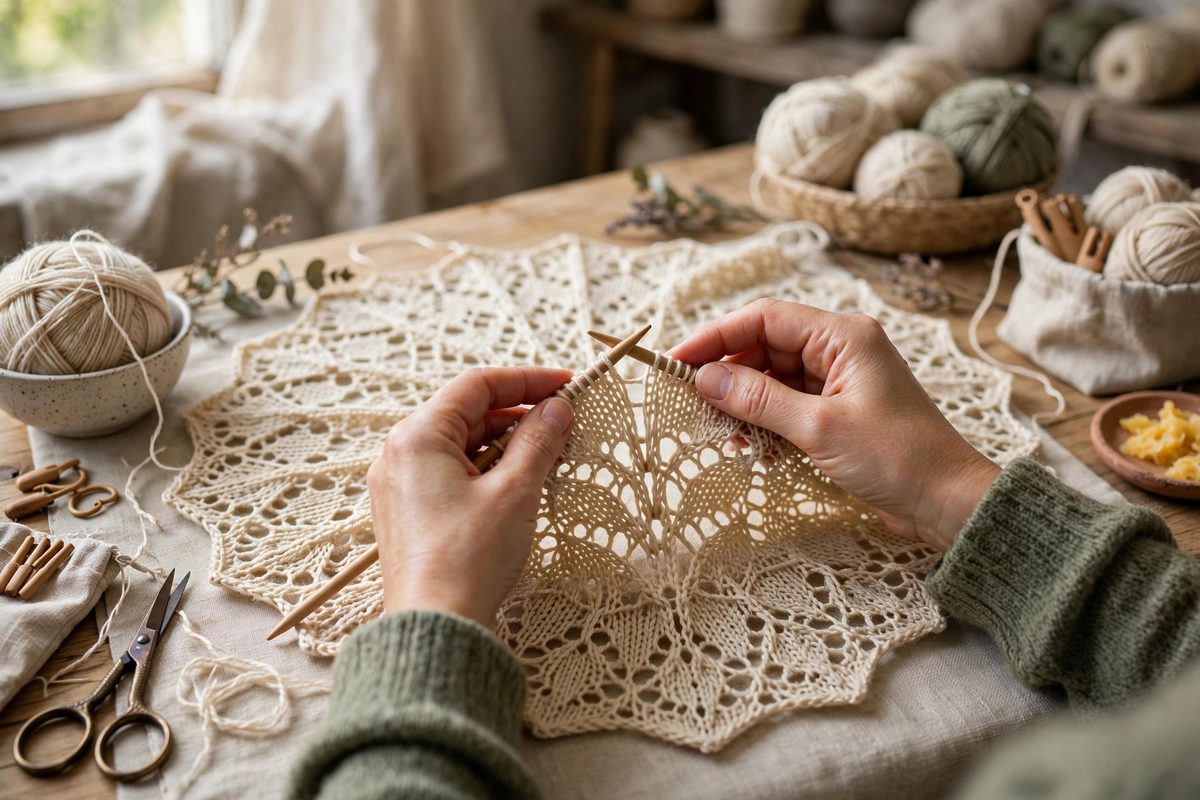
What a Centered Double Decrease Does
A centered double decrease takes three stitches and turns them into one, with the middle stitch ending up on top, centered over the two decreased-away stitches below. The classic method: slip two stitches together knitwise, knit the next stitch, then pass the two slipped stitches over. The result is a decrease with no lean: the center stitch sits proudly on top, and the two side stitches tuck symmetrically behind it. In a lace motif, this creates the crisp vertical spine that anchors diamonds, leaves, and medallions. The symmetry is the point: the motif reads as balanced because the decrease is balanced.
Why Centering Matters More in Openwork
In solid stockinette, a slightly leaning decrease is a subtle texture variation. In openwork, the decrease lines are the design: they form the visible framework around the yarn-over holes, and the eye tracks them continuously across the fabric. A leaning double decrease at the center of a diamond motif shifts the diamond's axis, and because lace is symmetric by design, the asymmetry screams. Worse, an off-center decrease changes which stitches sit where, which can throw off the yarn-over placement in subsequent rows: the error propagates. In lace, precision at the decrease is precision everywhere.
Executing the Centered Decrease Cleanly
The mechanics reward care. Slip the two stitches together knitwise, not individually: slipping them together keeps their orientation correct so they lie flat when passed over. Knit the center stitch at an even tension, not tighter than its neighbors: a strangled center stitch cups the fabric and distorts the motif. Pass the slipped stitches over smoothly and snug the resulting stitch gently. The most common mistake is working the decrease too tightly overall, which puckers the lace at its most visible point; the second is inconsistent execution, centered on one repeat and leaning on the next, which breaks the rhythm of the pattern. Develop one method and use it identically every time.
Reading Your Knitting for Drift
Check centering as you go, not at the end of the row. After working a centered double decrease, look at it: the top stitch should sit squarely over the gap below, with equal amounts of fabric on each side. If it leans, you likely slipped the stitches incorrectly or passed them over unevenly; tink back and redo it now, because a leaning decrease buried under six more rows of lace is miserable to fix. Place stitch markers around motif repeats so you can verify the stitch count frequently: in lace, the count is your early-warning system, and a count error near a double decrease usually means the decrease consumed the wrong stitches.
Charts and the Centered Decrease Symbol
Lace charts use specific symbols for centered double decreases, distinct from left- and right-leaning decreases, precisely because the direction matters to the design. Learn your chart's legend: the centered symbol typically shows the middle stitch on top. When reading a chart, note where centered decreases fall: they almost always mark the axis of symmetry of a motif. If your knitting's axis does not match the chart's, the decrease is the first suspect. And when designing your own lace, place centered double decreases on every symmetry axis deliberately: they are the structural guarantee that the motif mirrors correctly.
Blocking Reveals the Truth
Lace is not finished until it is blocked, and blocking is the final judge of your decreases. Proper blocking opens the yarn overs into crisp holes and lets the decrease lines relax into their intended geometry; a well-executed centered decrease blooms into a sharp, straight spine. Blocking also exposes problems: a leaning decrease that looked minor on the needles becomes obvious when the fabric is tensioned. Block a swatch of your motif before committing to the full project: it is the cheapest way to verify that your decreases are truly centered and your motif behaves as designed.
Centered double decreases are the quiet architecture of lace: invisible when right, glaring when wrong. Slip two together, knit one, pass over smoothly, keep the tension even, and check every one. The symmetry of your openwork depends on it.
Related Guides
- Centering Double Slip Decreases in Openwork Stitches: Lace knitting is architecture in yarn: every decrease shapes the fabric, and every yarn-over opens a window. The centered double decrease, which
- Central Double Decrease Geometry in Mirrored Lace Rows: In mirrored lace, the same motif reflects across a center line: decreases lean toward the spine on one side and away on the other, keeping the fabric
- Lifeline Thread Placement in Complex Lace Knitting: Complex lace knitting involves hundreds of stitches per row, yarnovers and decreases in precise relationships, where one missed operation several
- Managing Wrap and Turn Gaps in Complex Shetland Shawls: Shetland shawls are lace knitting at its most demanding: fine yarn, complex patterns, and shaping that relies on short rows. The wrap and turn is the