
Lace knitting is architecture in yarn: every decrease shapes the fabric, and every yarn-over opens a window. The centered double decrease, which turns three stitches into one with the middle stitch on top, is the structural keystone of symmetrical lace motifs, creating the crisp vertical spine that anchors diamonds, leaves, and medallions. Worked as a slipped decrease, it lies flatter and more defined than its knitted-through-the-back-loop cousins. But in openwork, where the surrounding fabric is full of holes and the stitch counts shift constantly, keeping this decrease truly centered demands attention to what sits on each side of it. This guide covers the mechanics and the placement discipline.
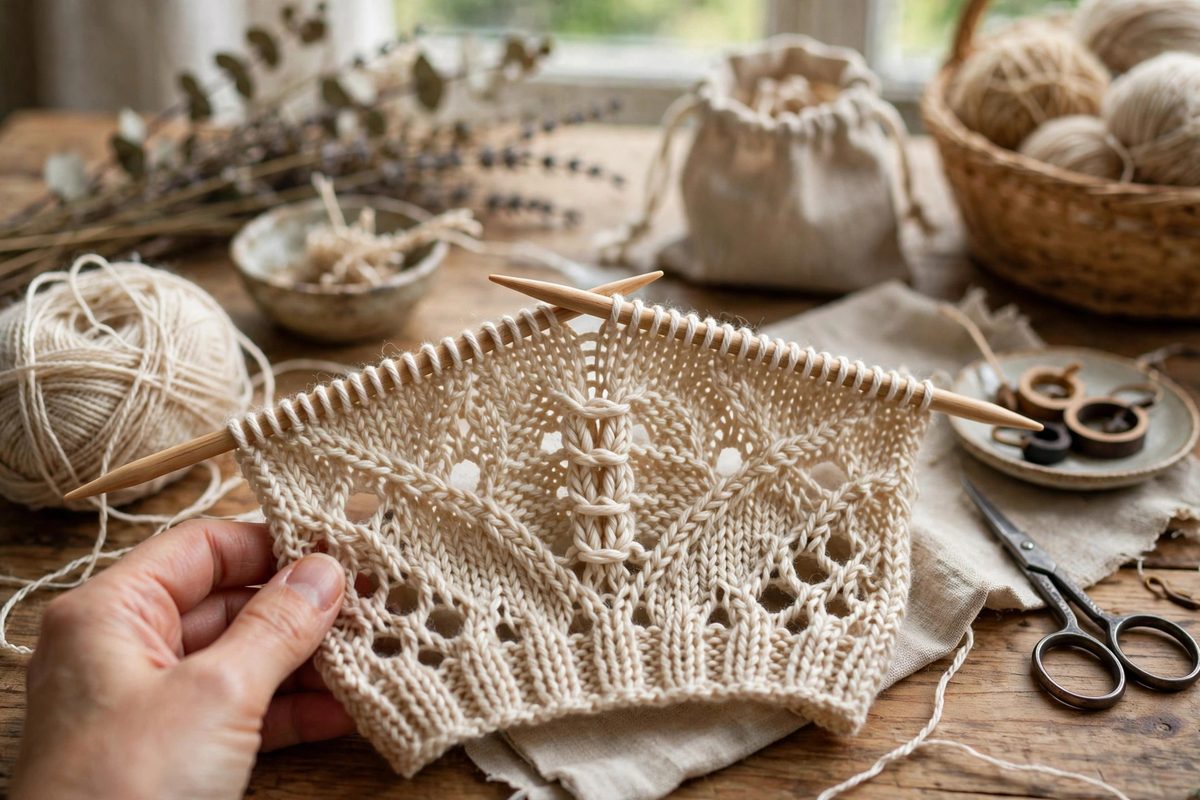
Anatomy of the centered double decrease
The decrease works three stitches at once: slip two together knitwise, knit the third, then pass the slipped stitches over. The result consumes two stitches of width and stacks the center stitch prominently on top, forming a raised vertical line. This centered character is what distinguishes it from left-leaning and right-leaning double decreases, which pull the motif's spine to one side. In lace, where the decrease typically sits at the center of a symmetrical motif flanked by mirrored yarn-overs, any lean in the decrease breaks the symmetry visibly; the motif skews, and the eye catches it immediately. The slip-two-knit-one-pass-over construction is also relatively flat, avoiding the bulk that would distort the delicate surrounding openwork. It is the right decrease for the job structurally as well as visually.
Why centering fails in openwork
In plain stockinette, centering a double decrease is trivial: count to the middle. In lace, the stitch count between markers changes every row as yarn-overs add stitches and decreases remove them, so the middle moves. The common failure is placing the decrease by counting from the edge of the motif rather than from the motif's structural center, which drifts as the lace grows. Another failure comes from the flanking stitches: if the stitches immediately beside the decrease are not mirror images, one a yarn-over and the other a plain knit, the decrease sits centered by count but off-center by structure, and the motif leans. True centering in lace means the decrease sits on the motif's axis of symmetry with mirrored fabric on both sides, not merely at the numerical midpoint of a row.
Reading the motif's symmetry
The reliable method is to read the knitting, not count it. Identify the motif's vertical axis: the line around which the left and right halves mirror. On the row below, find the centered stitch or the paired decreases that mark the axis, and place the new decrease directly above it, with the center stitch of the three stacked on that axis stitch. Check the flanking: the stitch sequences to the left and right of the decrease should mirror each other for at least the immediate neighbors. Charts make this visual; in charted lace, the centered double decrease symbol sits on the chart's symmetry line, and the symbols flanking it mirror. Train yourself to see the axis in the fabric as you work, checking each decrease against the column below before working it. This habit catches drift before it compounds.
Working the decrease cleanly
Execution matters as much as placement. Slip the two stitches together knitwise smoothly, without stretching them; distorted slipped stitches make a lumpy decrease. Knit the center stitch firmly but not tightly, then pass the slipped stitches over with an even motion that seats them flat. In fine lace yarn, consider working the decrease with a slightly looser tension than the surrounding fabric, since the triple-thick stack of the decrease otherwise pulls the neighboring yarn-overs tight and distorts the holes. Keep the center stitch's mount correct so it sits truly on top rather than twisting to one side; a twisted center stitch leans the whole decrease. The decrease should read as a crisp, flat, vertical element, the calm center of the motif's activity.
Balancing decreases and yarn-overs
Lace equilibrium requires every yarn-over to be balanced by a decrease somewhere in the pattern, and the centered double decrease, consuming two stitches, typically balances two yarn-overs. When placing it, verify the row's stitch count logic: the decrease should sit where the pattern's math puts it, and the total count should resolve correctly. A centered double decrease worked in the wrong row, or twice in the same motif repeat, throws the count off in ways that surface rows later as a mysteriously growing or shrinking panel. Use stitch markers at motif boundaries and count the stitches between markers on every row; in lace, counting is not beginner behavior but professional discipline. The few seconds per row prevent the hours of tinking a drifted motif.
Blocking reveals the truth
Lace is finished by blocking, and blocking reveals every centering decision. A truly centered decrease opens into a straight, crisp spine with symmetrical holes on each side; a drifted one shows as a wandering line with lopsided windows. Block aggressively enough to open the yarn-overs fully, pinning the motif's axis straight, and inspect before the piece dries. Minor drift can sometimes be coaxed straight in blocking, but significant drift is structural and must be fixed in the knitting. Photograph the blocked piece and compare it against the chart; the comparison teaches the eye to see centering in future work. Over time, placing centered decreases becomes automatic, and the motifs come off the needles already true.
Center the double decrease on the motif's axis of symmetry, verified by reading the fabric and mirroring the flanks, not by counting from the edge. Work it cleanly, balance it against its yarn-overs, count every row, and let blocking confirm the result. Symmetry in lace is not luck; it is placement discipline.
Related Guides
- Centering Double Decreases in Openwork Knit Stitches: In lace knitting, yarn overs create the holes and decreases shape the fabric, and the two must balance: every yarn over needs a matching decrease or
- Central Double Decrease Geometry in Mirrored Lace Rows: In mirrored lace, the same motif reflects across a center line: decreases lean toward the spine on one side and away on the other, keeping the fabric
- Lifeline Thread Placement in Complex Lace Knitting: Complex lace knitting involves hundreds of stitches per row, yarnovers and decreases in precise relationships, where one missed operation several
- Managing Wrap and Turn Gaps in Complex Shetland Shawls: Shetland shawls are lace knitting at its most demanding: fine yarn, complex patterns, and shaping that relies on short rows. The wrap and turn is the