
Shetland shawls are lace knitting at its most demanding: fine yarn, complex patterns, and shaping that relies on short rows. The wrap and turn is the standard short-row technique, and its gaps, the little holes where the work turns, can mar an otherwise exquisite shawl. Managing those gaps is a core skill of the form.
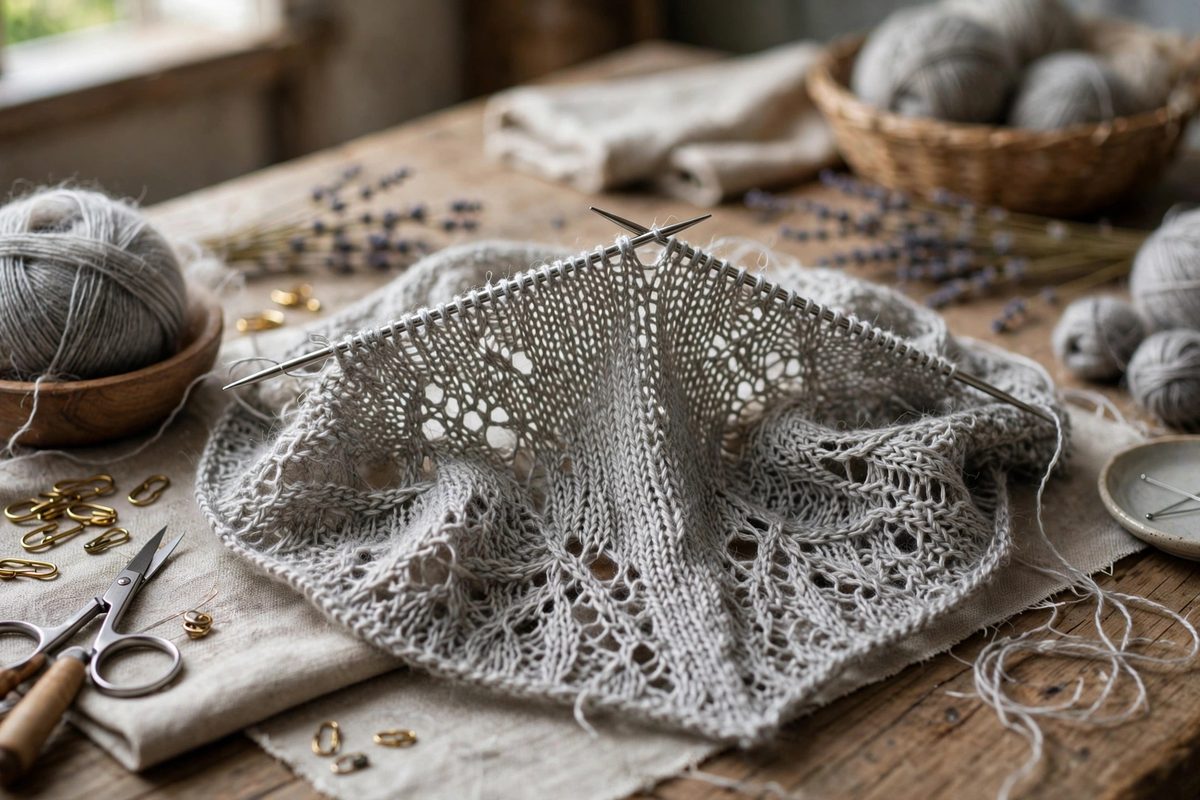
Why gaps appear
A wrap and turn works by wrapping the yarn around the next stitch before turning, creating a loop that is later picked up to close the turn. If the wrap is loose, or if the wrapped stitch is worked incorrectly on the return, a hole remains. In fine Shetland yarn at lace gauge, even a small gap is visible, and in a shawl where the lace pattern is the whole point, visible gaps read as mistakes. The gap is a technique failure, not a yarn failure, which means it is fixable.
Wrapping with intention
The wrap itself needs to be snug. Bring the yarn firmly around the stitch, not loosely draped, and keep the tension even as you turn. Some knitters wrap twice for extra security on slippery yarns, though this can show as a slightly heavier spot. The direction of the wrap matters for how it sits when picked up later; follow a consistent method so every wrap behaves the same. Consistency across dozens of short rows is what makes the technique disappear into the fabric.
Picking up the wraps cleanly
The return over the wrapped stitches is where gaps are actually closed. Pick up each wrap together with its stitch, working through both so the wrap is hidden inside the stitch. On knit rows this is straightforward; on purl rows it takes more care, and many knitters find purl-side wraps harder to close neatly. Work the pickup firmly but not tightly; yanking distorts the surrounding lace. If a gap persists after pickup, it usually means the wrap was too loose to begin with, and the fix is in the wrapping, not the picking up.
Placing turns within the lace pattern
In complex Shetland shawls, short-row turns often fall inside lace patterning, which complicates everything. Plan the turn positions to land in the least conspicuous parts of the pattern: in a plain section, at a pattern boundary, or inside a yarn-over column where a little extra openness hides. Chart the shawl with the turn positions marked before knitting; discovering mid-row that a turn lands in the middle of a nupp cluster is a preventable crisis. The pattern and the shaping have to be designed together.
Alternative short-row methods
If wrap and turn consistently leaves gaps in your knitting, other short-row methods may suit you better. The German short row, with its doubled stitch, closes very neatly and is easy to work in both knit and purl. The Japanese method, with its pinned marker, gives precise control. Each method has its own look and feel in fine yarn; swatch all of them in the actual shawl yarn before deciding. There is no moral superiority in wrap and turn; there is only the result.
Blocking and the final assessment
Shetland shawls are blocked aggressively, pinned out to open the lace, and blocking hides a multitude of small sins. But it does not hide gaps; it enlarges them along with everything else. Assess the short-row turns before blocking, while corrections are still possible. After blocking, the turns should be invisible, detectable only by counting rows. That invisibility is the standard, and it is achievable with deliberate technique.
Wrap snugly, pick up cleanly, place turns thoughtfully within the pattern, and consider alternatives if the method fights you. The shawl's shaping should be felt in its drape, never seen in its holes.
Related Guides
- Lifeline Thread Placement in Complex Lace Knitting: Complex lace knitting involves hundreds of stitches per row, yarnovers and decreases in precise relationships, where one missed operation several
- Central Double Decrease Geometry in Mirrored Lace Rows: In mirrored lace, the same motif reflects across a center line: decreases lean toward the spine on one side and away on the other, keeping the fabric
- Centering Double Slip Decreases in Openwork Stitches: Lace knitting is architecture in yarn: every decrease shapes the fabric, and every yarn-over opens a window. The centered double decrease, which
- Centering Double Decreases in Openwork Knit Stitches: In lace knitting, yarn overs create the holes and decreases shape the fabric, and the two must balance: every yarn over needs a matching decrease or